

Third Heatwave of the Year Begins in the UK
The United Kingdom has entered its third heatwave of 2023, with temperatures forecast to reach up to 34C in some areas by midweek. While this heatwave is not expected to be as severe as the one in late June, when temperatures peaked at 37.7C, it is anticipated to persist for a longer duration.
The UK's Health Security Agency (UKHSA) has issued yellow heat-health alerts across the Midlands and southern England, effective until 20:00 GMT on 11 July. The agency advises that minor impacts on health and social care services are expected, with an increased risk to vulnerable populations.
Northern regions of the UK will experience warmer conditions, although cloud cover and rain are likely to continue, particularly in western Scotland. Temperatures in the Midlands, East Anglia, and south-east England could rise to 31C on Monday afternoon. With temperatures exceeding 28C anticipated, the official heatwave criteria will be met widely in these areas over the coming days.
Understanding the UK’s Official Heatwave Criteria
The heatwave is expected to intensify from midweek, with temperatures across England and east Wales reaching the high 20s to low 30s Celsius. London and south-east England may see temperatures peak around 34C on Wednesday and Thursday.
Although it is unlikely that temperatures will reach the 37.7C recorded at the end of June, some weather forecasting models indicate a possibility of temperatures in the mid to high 30s this week. The UK’s all-time temperature record of 40.3C was set in July 2022 at Coningsby, Lincolnshire.

Longer Lasting Heat Forecast
The first two heatwaves of 2023 were record-breaking. New monthly temperature records were set by a significant margin, with temperatures reaching 35.1C in May and 37.7C in June. The June heatwave was accompanied by extremely high humidity, making it feel hotter, with some locations experiencing apparent temperatures above 40C.
Overnight temperature records were also broken, with several "tropical nights" where temperatures did not fall below 20C. Amber and red heat-health alerts were issued, and the Met Office issued a rare red warning for extreme heat at the end of June.
During the June heatwave, temperatures exceeded 30C somewhere in the UK for seven consecutive days. In comparison, the May heatwave saw six consecutive days above 30C.
Although the current heatwave is not expected to bring the extreme temperatures or high humidity seen in June, it is forecasted to last longer. Current forecasts suggest temperatures exceeding 30C somewhere in the UK could persist for up to 10 consecutive days.
Temperatures will rise above average over the coming days as another significant heatwave develops across Europe.
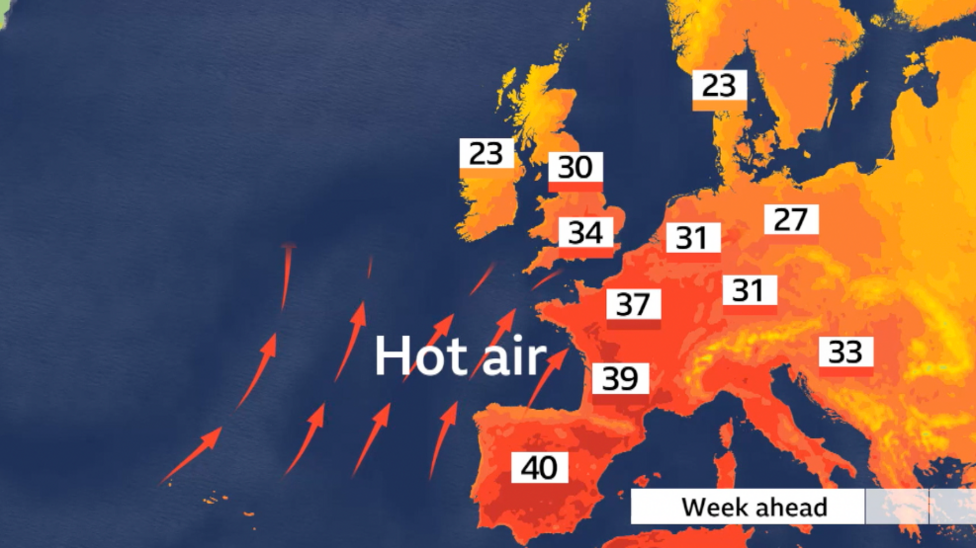
Dry European Heat Develops
Significant heat has recently developed in Portugal and south-west Spain. Porto recorded a temperature of 40.1C over the weekend, just below the city’s hottest day on record. Temperatures around 40C have been widespread, and this heat is expected to gradually spread northwards into France this week.
Meteo-France has issued warnings of another period of intense heat, with temperatures forecast to reach the mid-to-high 30s Celsius, and some locations in southern France may exceed 40C. Northern Italy is also expected to experience warmer than average temperatures.
The humidity levels during this European heatwave are expected to be lower than those experienced in June. Combined with very dry soils, this increases the risk of wildfires.


