Swinney Plans Vote on Independence Powers Post-Election
John Swinney will initiate a vote to seek powers for an independence referendum on the first day of the next Scottish Parliament, even if he does not secure an overall majority, according to his aides.
The senior adviser to the Scottish National Party leader indicated that, if necessary, Swinney would depend on support from the pro-independence Scottish Greens to pass the vote. This would be to request that the UK government grant Holyrood the legal authority to hold a second referendum on Scottish independence.
Swinney has previously stated that an overall SNP majority was the “clear and unambiguous” prerequisite for pursuing those powers—a position reinforced in the party’s 2026 manifesto.
However, a strategy document released by Swinney on Monday, outlining the actions an SNP government would take in its first 100 days, did not specify that a majority was required.
The document stated that the SNP would “bring forward” a vote in early May on the parliament’s first sitting day if the SNP formed the government, without any preconditions.
Uncertainty Over Majority Requirement for Vote
When repeatedly asked by reporters whether the vote would proceed if he failed to win a majority, Swinney declined to confirm. The First Minister emphasized his preference for a majority but added:
“I’m simply saying to people, vote SNP and let’s get on with it.”
Swinney’s most senior policy aide told reporters the vote would occur even with a minority government, stating:
“You continue to pursue your agenda to the maximum amount, as all governments do. If we’re elected as a government that manifesto stands. Otherwise what’s the purpose of a manifesto? The whole manifesto stands.”
The first 100 days document also indicated the SNP would publish a draft referendum bill at a later date, featuring the same yes or no question on independence that was used in the 2014 referendum.
If produced, that draft bill would have no legal standing and would be unlikely to be formally introduced at Holyrood. Attempts to do so by former First Minister Nicola Sturgeon were blocked by the Lord Advocate, Scotland’s chief law officer, because the powers to legislate for a referendum are reserved solely to Westminster.
Legal Challenges and UK Government Position
The Supreme Court ruled that only the UK government could legislate for an independence referendum—a decision that precipitated Sturgeon’s resignation as First Minister. The UK government has consistently stated it would refuse to authorize a referendum.
Speaking on Monday, Swinney declined to confirm whether he would pursue legal action to compel the UK government to delegate referendum powers if a majority vote at Holyrood was achieved.
He has previously asserted that a legal challenge would be based on the precedent set by the then Conservative-led UK government in 2012, which granted Holyrood powers largely because the SNP had won an overall majority in 2011.
Swinney’s approach appears to have softened. On Monday, he described a majority as “an incredibly strong foundational argument” but did not confirm plans for legal action to secure those powers.
Nevertheless, he emphasized his commitment to independence, stating:
“My message to people in Scotland who are independence supporters is that I’m offering a pathway for Scotland to have a choice to become independent [and] I would encourage any independence supporters to vote for the SNP to make sure that happens.”
Polling and Political Reactions
Repeated opinion polls suggest that while the SNP is poised for a comfortable victory on 7 May, only about 75% of Scotland’s pro-independence voters plan to support the SNP. Many intend to back the Scottish Greens or other parties.
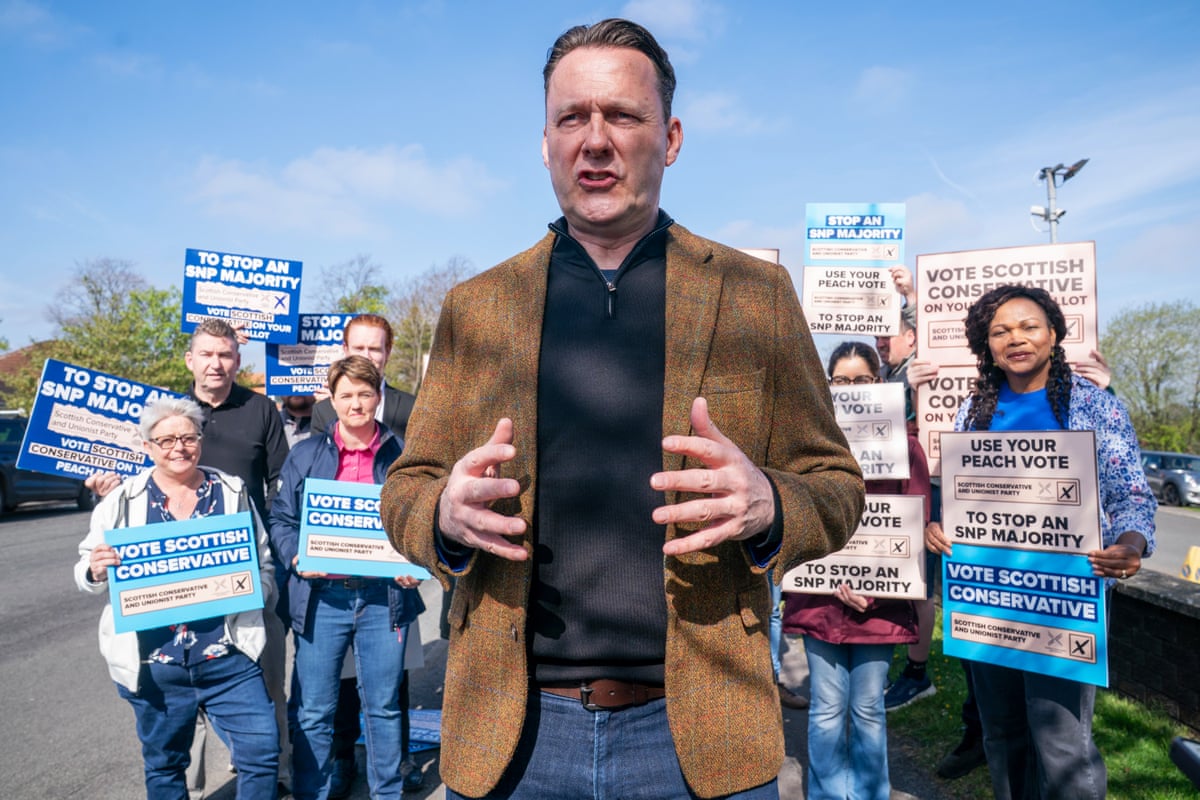
Russell Findlay, the Scottish Conservative leader, criticized Swinney’s plans, stating:
“John Swinney’s plot to make the first vote of the new parliament about an independence referendum confirms how breathtakingly out of touch he is with the people of Scotland.
Instead of focusing on the cost of living crisis, jobs, education or the NHS, he’s hellbent on plunging Holyrood into fresh constitutional chaos.”