
Starmer Details Capital Cuts to Fund Defence Investment Plan
Keir Starmer has announced that certain capital projects, including those related to roads and energy, will be deferred to finance the Defence Investment Plan (Dip). He explained that this approach involves departments optimizing the use of assets such as underutilized land and expects departments with the largest capital budgets to contribute more.
"It means departments making better use of assets like underused land, and it means those departments with the largest capital budgets contributing more. Therefore, some capital projects, for example on roads and energy, which are important but not immediately vital, will no longer go ahead as planned. But this is about taking the necessary choices, the right choices to protect our nation."
Starmer confirmed the new spending totals, stating:
"Now we are already delivering the biggest sustained increase in defence spending since the 1980s – £270 billion over the spending review period. And I can announce today that under the defence investment plan, we are increasing this by a further £15bn, setting a new record of spending almost £300bn over the next four years to back our armed forces and strengthen our national security."
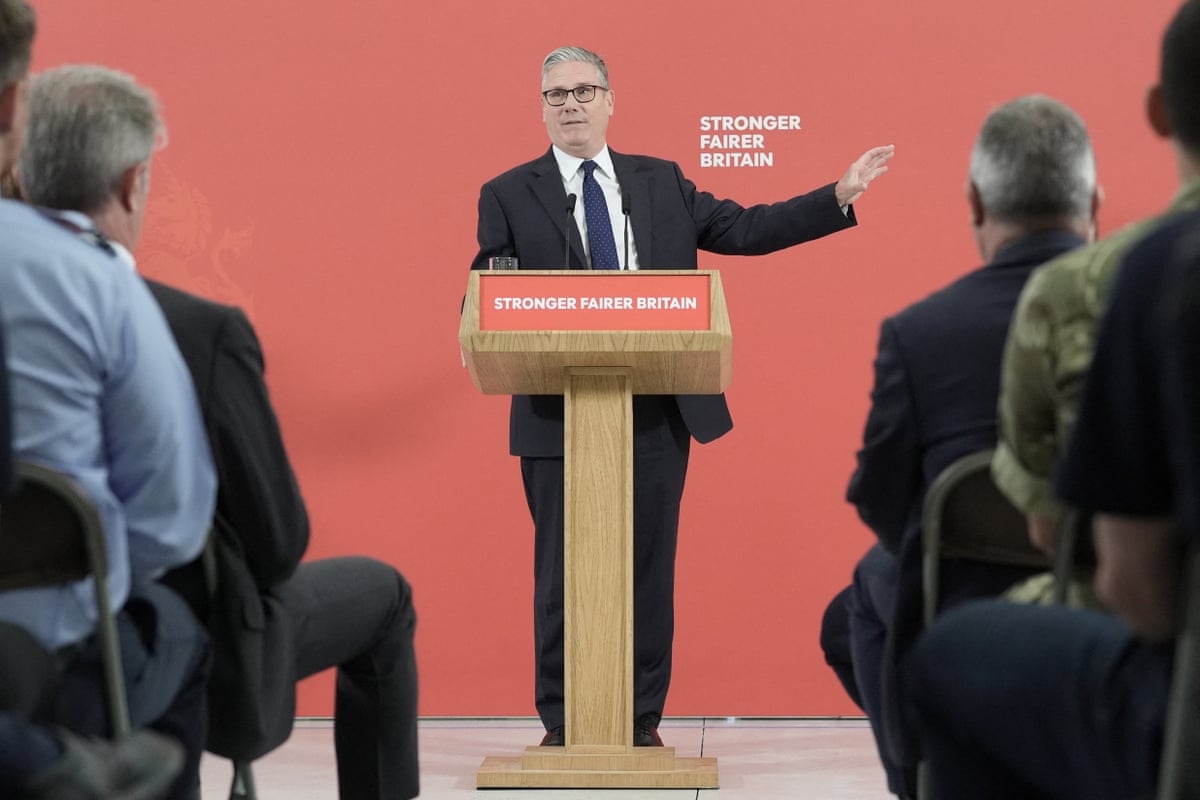
Starmer Emphasizes Need for Efficient Defence Spending
Starmer acknowledged that defence spending has previously been perceived as a "bottomless pit" but emphasized the need for more effective expenditure this time. He highlighted the importance of reforms within the Ministry of Defence (MoD) to maximize investment value, accelerate innovation and procurement, and reduce non-military expenditures such as civil service staff costs.
"We can’t just spend more. We’ve got to spend better. That includes driving real reforms within the Ministry of Defence to get greater value from our investment, accelerating innovation and procurement, and reducing non-military spending, for example, on civil service staff."
Starmer stated that defence spending is on track to reach 3% of GDP, currently at 2.7%, with the next parliament prioritizing achieving the 3% target. He also referenced commitments made at the previous year’s NATO summit to allocate 5% of GDP to wider security, encompassing energy security and critical infrastructure, with the Dip moving this figure to 4.2%.
"We are raising it to 2.7%, putting us on a trajectory to reach 3% in the next parliament, which must be the number one priority at the next spending review. At last year’s Nato summit, I committed to spend 5% of GDP on our wider security, covering things like energy security and critical infrastructure as well as defence. The defence investment plan published today takes us to 4.2%."
Funding the Defence Investment Plan Through Capital Budget Reallocation
Starmer confirmed that the Dip is fully costed and addressed differing views on defence funding. He rejected the notion that defence spending could be increased without sacrifices in other capital areas or solely through borrowing, noting that defence bonds are essentially borrowing and could raise interest rates at a time when debt interest already consumes a significant portion of public spending.
"You have some people in this debate who underplay the threat and deny the need to prioritise defence and security. You also have those who say you can fund defence without making sacrifices in other areas of capital spending, and you have those arguing that we can just raise borrowing. But let’s be clear defence bonds [an idea promoted by the Liberal Democrats] are just borrowing by another name. We’ve looked at this very carefully, but the fact is doing this through borrowing would push interest rates higher at a time when £1 in every ten already goes on paying debt interest, and this government has fought hard to bring the public finances under control, and it has paid off, helping to bring inflation and mortgage rates down."
He emphasized that the settlement adheres to fiscal rules and will not detract from frontline services such as health and education. Instead, funding will be sourced by reallocating capital budgets across government departments by one percent, while maintaining public investment at the highest sustained levels since the 1970s.
"The settlement I’m setting out today is the right choice for the country. It delivers the decisive action we need on defence in a way that is within our fiscal rules, and that will not take resources away from day to day spending on frontline services like health and education. Instead, this funded by reallocating spending from across government departments, reallocating capital budgets by one penny in every pound, while still maintaining public investment at the highest sustained levels since the 1970s."
Starmer stated that the Dip fulfills the strategic defence review and goes beyond it, expressing confidence that his successor will build upon it.
"Ahead of the Nato summit next week, this plan represents our best judgement of what the country needs to meet this moment, and it is a platform on which I know my successor will build."
Starmer on Preparing for War to Preserve Peace
Starmer articulated the paradox of peace in a world marked by rising aggression, asserting that preparation for war is essential to deter conflict and maintain stability.
"We want our people to be able to live in a world defined by peace, stability, and the rule of law. But the paradox of peace is that when the world is arming and aggression is rising, the best way to avoid war is to prepare for it. The best way to defend is to deter, to have the strength to make your adversaries think again before they act."
Starmer Praises NATO and Calls for Increased European Defence Spending
He reiterated his longstanding view that the UK must strengthen its own capabilities and meet emerging global challenges to ensure national safety and capitalize on opportunities from sovereign strength investment.
"My view has been the same since day one. We must stand more firmly on our own two feet. We must do what it takes to meet this new world head on, to keep our country safe and seize the opportunities that come from investing in our sovereign strength."
Ukraine Conflict Highlights Changing Nature of Warfare
Starmer highlighted how the war in Ukraine has transformed warfare, noting Ukraine’s success against a larger Russian force through courage and technological innovation, particularly the integration of drones.
"We also see on the battlefield in Ukraine that the very nature of conflict is changing before our eyes. Despite having a limited navy, limited traditional air power and limited armour, Ukrainian forces have destroyed the Black Sea Fleet. They struck deep into Russian territory and stopped the advance of one of the biggest armies in the world. How have they done that? Through sheer courage, yes, but also by embracing technology. They’ve integrated drones into their fighting like never before, understanding that the ability to innovate and produce at speed and at scale is more vital than ever to military power."
Security Threats Include Foreign State Actions
Starmer acknowledged public concerns about global security threats, emphasizing that some threats are immediate and domestic, including violence and disinformation orchestrated by foreign powers. He referenced arson attacks linked to a Russian-led plot targeting properties connected to himself and mentioned a visit to Malloy Aeronautics, a drone design firm.
Rachel Reeves Confirms £15bn Defence Spending Increase
Chancellor Rachel Reeves, speaking after Defence Secretary Dan Jarvis, confirmed the £15 billion increase in defence spending. She recalled last year’s decision to reprioritize aid spending towards defence, marking the largest uplift since the Cold War, and justified the further increase as necessary due to changing global circumstances.
"Last year, I made the decision in the national interest to reprioritise aid spending towards defence and achieve the biggest uplift in defence spending since the end of the cold war. That was the right choice because the world has changed. National security is economic security. Today, we uplift defence spending further – an additional £15bn worth of funding – by again re-prioritising spending across government."
Dan Jarvis on Ukraine’s Impact on Warfare and Defence Investment
Defence Secretary Dan Jarvis described how the Ukraine conflict has fundamentally altered warfare. He announced the UK’s largest ever investment in drone warfare, increased funding for a hybrid Royal Navy, enhanced British Army lethality, and investment in the next-generation Royal Air Force. He reaffirmed commitments to nuclear deterrence and NATO support.
"This plan recognises the hard truth that the conflict in Ukraine completely upended the way of war. In response, today we’re committing the UK’s biggest ever investment in drone warfare; more money for a hybrid Royal Navy, more money to increase the British Army’s lethality, and more money for the next generation Royal Air Force. This plan reflects both the realities of future warfare and the principles that have kept us safe for generations. We will strengthen our nuclear deterrent and bolster Nato. Now, I know that there is more work to do, and we’ve made a commitment to our allies, as they did to us. And under this government, that promise will be met."
Starmer’s Defence Speech and Reactions
Dan Jarvis introduced Starmer before his speech on the Defence Investment Plan at a defence company outside London. Starmer emphasized the plan’s central purpose to equip armed forces with necessary technology for current and future deterrence and combat. He credited the Prime Minister for leadership in national security and highlighted UK support for Ukraine.
"The central purpose of this plan is to get the kit and technology that our armed forces need, so they can fight and deter now and in the years ahead. Credit goes to the prime minister, and not only for getting us here today on matters of national security. I’ve seen him make tough decisions and always with conviction and assurance. Under his leadership, Britain has proved itself a reliable partner and a trusted ally. With our help, Ukraine’s forces are still in the fight and fighting with determination and momentum."
Former Army Chief Critiques Defence Investment Plan
Lord Dannatt, former head of the army, commented on GB News that while the Dip is a positive step, it falls short of the £28 billion increase service chiefs requested to approach 3% of GDP defence spending. He noted the delay in the plan and suggested that earlier action might have prevented political consequences for Starmer.
"We’ve waited far too long for this defence investment plan. Now, we haven’t got the full details of it. Some of the details were trickled out overnight, and it looks as if about £5bn extra is being put on the table, but £5bn is not the £28bn that the service chiefs have been asking for, and that’s the figure which would get us somewhere near the 3% of GDP that Keir Starmer was talking about in February at the Munich Security Conference. So this is a step in the right direction, but it’s not the quantum of increase that our nation demands, and our allies are calling for, and there’s a real funny irony here. If they got on with this a year ago and put a sensible amount of money, John Healey would still be secretary of state for defence, and Keir Starmer wouldn’t have come under the pressure that is ultimately going to lead him to the exit of Number 10. So, inaction has consequences, and for Keir Starmer the consequences [are] he’s losing his job."
It is important to note that Starmer’s resignation is attributed to poor election results and internal party pressure rather than solely defence spending issues.
Andy Burnham’s Plans for Prime Ministerial Residence
Regarding Andy Burnham’s recent speech, Pippa Crerar reported that Burnham intends to maintain his family home in Greater Manchester rather than reside full-time in Downing Street, suggesting he would stay in the flat above No 10 only during weekdays.
Other media outlets have emphasized this as a significant story, but it is common for prime ministers with constituencies outside London to have a local residence and spend weekends there. The demanding nature of the role often necessitates substantial time in London. Comparisons were made to former Prime Minister Theresa May, who frequently returned to her Maidenhead home.
Tory MP Ben Obese-Jecty remarked on the challenges of balancing family life with prime ministerial duties, recalling Starmer’s previous comment about not working past 6pm on Fridays.
Unite Union Leadership Challenge
Sharon Graham, leader of Unite, the UK’s second-largest union, is facing a leadership challenge over concerns that the union is not adequately addressing the rise of Reform UK, as reported by Matthew Taylor.
Details of the Defence Investment Plan (Dip)
The Ministry of Defence has released preliminary details of the Dip, with full information forthcoming.
Key elements include:
- Royal Navy: Transition to a Hybrid Navy combining autonomous vessels and AI with traditional warships and aircraft. This includes development of uncrewed missile platforms (Type 91), uncrewed submarine-hunting platforms (Type 92), extra-large uncrewed underwater vessels (Type 93), and uncrewed aerial sensing platforms (Type 94). Plans for at least six Common Combat Vessels by the 2030s as part of a networked Maritime Air Defence system. Project PANTHEON aims to develop a Hybrid Carrier Air Wing with jet-powered drones working alongside F-35B jets. Royal Marine Commandos will receive new high-speed boats and advanced drone and autonomous technology.
- British Army: Enhancements to lethality through investment in inexpensive expendable autonomous systems and loitering munitions, including a £50 million boost to the RAPSTONE programme for first-person view and interceptor drones. Introduction of Uncrewed Ground Vehicles developed rapidly through UK industry. Project NYX will deploy up to 24 autonomous armed drones by 2030 to operate alongside Apache helicopters for reconnaissance, precision strikes, and electronic warfare. Project Corvus will replace the Watchkeeper system with up to 24 surveillance drones for intelligence, surveillance, target acquisition, and reconnaissance.
- Royal Air Force: Investment in a national Collaborative Combat Air programme to develop autonomous fighter jets to operate alongside crewed jets, with a demonstrator expected by 2030. Introduction of the Storm Shroud system, an uncrewed electronic warfare drone, to enter service this year.
Additional details on the Common Combat Vessel reveal it will replace the current fleet of six Type 45 destroyers starting in the early 2030s. Unlike previous designs, these vessels will serve as control hubs for uncrewed systems, enhancing reach, resilience, and firepower without proportionally increasing crew or costs. This represents a shift from the earlier Type 83 destroyer plans, favoring a hybrid navy model better suited to modern warfare.
Opposition Criticism of the Defence Investment Plan
Following Starmer’s announcement to stand down and Andy Burnham’s anticipated succession, Starmer committed to publishing the Dip before the upcoming NATO summit in Turkey. The plan, delayed for over a year and originally expected in autumn, was released amid political tensions including the resignation of former Defence Secretary John Healey, who advocated for a 3% GDP defence spending target by 2030. The new Defence Secretary Dan Jarvis has secured additional Treasury funding and will present the Dip to Parliament.
Opposition parties have criticized the plan as insufficient and delayed. Shadow Defence Secretary James Cartlidge stated:
"This is too little, too late. Too little because it is barely more money than John Healey and Al Carns resigned over when they said Britain would be ‘less safe’. And too late because the plan is now almost a year overdue and only being rushed through because Keir Starmer is desperate for a legacy."
Liberal Democrat leader Ed Davey commented:
"This late and underfunded plan is unforgivable. It is a political choice that makes us all less safe, puts jobs at risk and threatens businesses across the country in supply chains. The government have dangerously short-changed our armed forces when they need urgent investment after years of Conservative negligence. Defence chiefs have been forced to make hard choices, when they should be given what they need. Andy Burnham needs to go much further and take up Liberal Democrat plans for defence bonds to give our armed forces the investment they need to keep our country safe."
Agenda for the Day
- 9am: Lucy Powell, Deputy Labour Leader, speaks at a New Statesman conference. Other speakers include Nick Thomas-Symonds (EU Relations Minister) at 10:45am, Lord Hermer (Attorney General) at 2pm, and Richard Tice (Reform UK Deputy Leader) at 4:30pm.
- 10am: Sir Brian Langstaff, Chair of the Infected Blood Inquiry, gives evidence to the Public Administration Committee.
- 10:30am: Keir Starmer delivers a speech on the Defence Investment Plan.
- 11:30am: David Lammy, Deputy Prime Minister and Justice Secretary, answers questions in the Commons.
- After 12:30pm: Dan Jarvis, Defence Secretary, makes a statement to MPs about the Dip.
- 2:30pm: Lisa Nandy (Culture Secretary) and Liz Kendall (Technology Secretary) provide evidence to the Lords Communication Committee on AI and copyright.
Readers are encouraged to contact the author via comments during open hours or through social media platforms such as Bluesky (@andrewsparrowgdn.bsky.social) and Twitter (@AndrewSparrow). The author appreciates corrections and questions from readers.


