

Closure Announcement Shocks Ruthin School Community
Students midway through their GCSEs at Ruthin School must now seek alternative education from September following the announcement of the school's closure.
Parents and pupils were left devastated as they learned that Ruthin School, with a history spanning 700 years, will permanently close.
The announcement came the day before the summer break, delivering a blow to the community.
Several independent schools, also known as private schools, have been facing financial difficulties recently. St Gerard's School in Gwynedd has also closed, with owners of both schools citing financial pressures as the cause.
A spokesperson for Ruthin School, one of the oldest schools in Wales, stated that it was "not possible to establish a financially viable way forward" and that the school would enter administration.
The independent schools sector attributes part of the financial strain to new VAT regulations on school fees, which have contributed to a "perfect storm" of challenges.
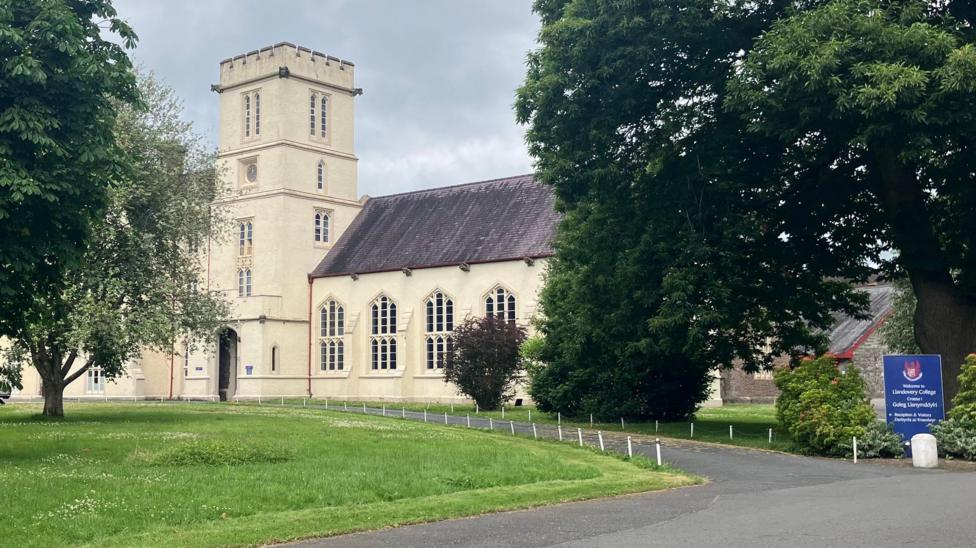
Last week, Llandovery College in Carmarthenshire reported a £1 million deficit due to declining pupil numbers and the impact of a 20% VAT rate on private school fees.
Impact on Pupils and Families
Fifteen-year-old Ruthin pupil Hari expressed his devastation, highlighting how the small class sizes made learning easier.
He was among approximately 240 pupils and had anticipated returning in September for his final year and to complete his GCSEs. Now, he must find a new school.
Hari's mother, Arwen, struggled to hold back tears, saying,
"I don't know what we're going to do. My children come on a scholarship because we couldn't afford the fees - we're a working class family."
She also has another child who was scheduled to start at Ruthin School in September.
Parents and staff were informed via email on the afternoon before the last day of lessons that the school would not reopen for the new term.
Fifteen-year-old pupil Joseph described the school as "a family and a community".

Parents have written to the Chinese owners, Galaxy Global Education Group, criticizing how the closure was handled.
The letter stated,
"The manner in which you did it has caused immeasurable pain. Parents have been left in tears. Children have been left frightened, confused and heartbroken."
Joseph shared his feelings of
"anger" and "devastation" and said he was "very anxious about what's going to happen."
He added,
"It's been a home for four years of our lives and it's gone in the blink of an eye."
His father John, from Hawarden, Flintshire, said,
"We just don't know what to do. We drive round in an old car so our sons can come here to give them a better start in life and just the flick of a pen, and it's gone."
VAT Rules Affecting Private Schools
Value Added Tax (VAT) is a primary source of revenue for the UK government, applied at a standard rate of 20% on many goods and services.
Previously, private schools were exempt from charging VAT on fees due to their educational status.
While some prestigious schools like Eton and Harrow charge around £50,000 annually, the average private school fee is approximately £15,000.
However, exemptions on these fees were removed as of 1 January 2025.
A UK government spokesperson stated,
"Ending tax breaks for private schools will raise £1.8 billion a year by 2029-30. This will help support public services, including helping the 94% of children who attend state schools to achieve and thrive."

The sector strongly opposed this change, warning it could lead to school closures.
Trustees of St Gerard's School in Bangor highlighted this in a letter to parents in May, announcing the school's closure within six weeks.
The letter explained,
"Over a sustained period, the school has faced increasing financial pressure. Recent changes, including the introduction of VAT on school fees, loss of charitable status, rise in National Insurance alongside other rising costs and the ongoing challenge of maintaining pupil numbers mean that the school is unfortunately no longer viable."
Staff at Llandovery College have agreed to temporary pay cuts to help alleviate financial pressures.
Challenges Facing the Independent Schools Sector
The Welsh Independent Schools Council (WISC), representing most of the 79 private schools in Wales, noted that while there is no single reason for school closures, tax changes have been a significant factor during an already difficult period.
WISC data indicates that the independent sector in Wales has 6,500 pupils, a 6% decline since last year, which is one of the largest drops in the UK outside the northeast of England.
Paul Norton, Chairman of WISC and Principal of Kings Monkton School in Cardiff, stated that many independent schools in Wales are small and community-focused, and closures could negatively impact the Welsh economy.
He explained that the sector offers educational choices not available through academies or grammar schools, which are more common in England.
He added,
"These are choices that middle-class parents struggle to make in order to do the very best for their children because other forms of education cannot meet their needs for whatever reason that is. I do think we'll see further reduction in private education unless changes are made."
Introducing VAT on fees has been described as "the biggest contributing factor" to financial pressures on independent schools by the sector's chairman.
Two other Welsh schools have closed in the past year: Oakleigh in Swansea and St Clare's in Porthcawl, Bridgend county, both owned by the same global company.
Rachael Harman, a former pupil of St Clare's whose son also attended the school, said the May 2025 closure announcement was a "complete shock."
The owners cited demographic changes leading to fewer school-age children and declining enrollment as reasons for closure.
Parents attempted to take over the 85-year-old school's management, but the bid failed, and the school closed in December 2025.
Rachael and others continued efforts to preserve the 11-acre site.
She said,
"It's just a really, really beautiful place - nobody wanted to see it become a building site."
New Beginnings and Future Outlook
Clare House School is set to open in September, initially serving nursery to year six students.
Chairwoman of Trustees Rachael anticipates "a rocky time" as the school establishes itself but remains optimistic about its future.
She commented,
"I think, honestly, for all independent schools, we are in a very tumultuous time."
Despite challenges, she believes demand for independent education persists.
While some independent schools face financial difficulties, significant investments continue in parts of the sector. Cardiff Sixth Form College is investing tens of millions of pounds in a new campus, including renovated historic buildings and a 17-storey student boarding center, scheduled to open in Cardiff Bay in September 2026.
The Welsh government stated it will continue monitoring the situation, emphasizing that independent schools govern themselves and must make financial decisions with learners' best interests in mind.
A Welsh government spokesperson said,
"Independent schools govern and manage themselves and financial decisions must always be taken with proper regard to learners' best interests."


