

Waltham Forest Schools Face Ongoing Industrial Action
Last week, South Grove primary school in Walthamstow, east London, closed its gates to pupils due to a strike by members of the National Education Union (NEU). This action is part of a broader wave of industrial disputes affecting schools across the Waltham Forest borough.
Other schools impacted include Henry Maynard primary school, South Chingford foundation school, Connaught school for girls, Leytonstone, and Belmont Park school, which serves pupils with special educational needs.
South Grove is scheduled to close for an additional five days of strike action next week, creating challenges for working parents who must find alternative childcare arrangements.
Despite the disruption, some parents joined staff on the picket line last Wednesday to express solidarity. The strike responds to a school-wide restructure that will result in job losses and reduced support for children with special educational needs.
The school, which is well-regarded and popular, has been operating at a deficit for several years. Financial pressures include a costly private finance initiative, increased expenses related to special needs provision, and a new catering contract expected to add £50,000 to £60,000 annually.

“We’re here because we love our teachers,”said Stephanie Cobb, a mother of two pupils at South Grove. On the previous Friday, parents and children took their concerns to Walthamstow town hall, where two newly elected Green Party councillors met with them to listen.
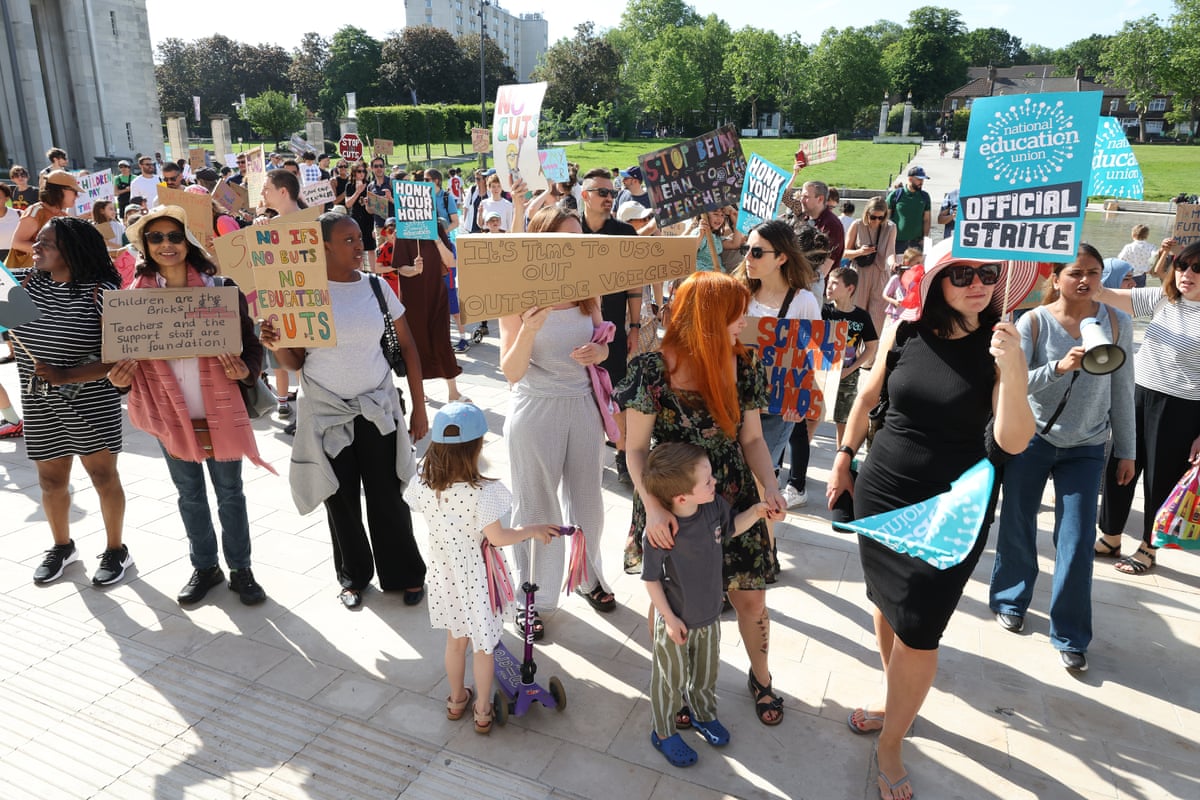
“When the strikes were announced it was a shock, as nothing like this had happened before and myself and my husband both have full-time jobs. I think the teachers have been very brave to take this action knowing it could be unpopular with families and leadership. They are standing up for our children and their school.”said Lottie Gammon, another parent with two children at South Grove.
Mixed Reactions Among Parents in the Borough
However, not all parents in Waltham Forest supportive stance. Some have expressed concern about the ongoing strike action, which addresses various grievances. At Connaught school, pupils recently organized a counter-protest calling for an end to the strikes.
NEU Perspective on the Industrial Action
Daniel Kebede, general secretary of the NEU, stated that the industrial action in Waltham Forest reflects a broader trend across London.
“It’s very easy to blame what’s happening in Waltham Forest on overactive trade union reps, but it’s not the case,”he said.
“The problem is, across London at the moment, we’ve got this perfect storm of record low birth rate [and] gentrification meaning that families can’t afford to live in the city any more, which means pupil numbers are declining significantly. If you look across London, we have an awful lot of industrial action and it is all relating to restructures and redundancies.”

According to NEU data, 13 workplaces in Waltham Forest have voted for strike action during the current academic year. Across London, there have been 26 disputes concerning redundancies, restructures, and school closures.
In England overall, the NEU has recorded successful strike ballots in 171 workplaces so far in the 2025-26 academic year, compared with 117 the previous year. Most disputes are resolved without strikes proceeding.
However, a formal national ballot of NEU members this autumn could lead to widespread school closures nationwide.
NEU Demands and Government Response
The NEU is calling for an above-inflation pay increase fully funded by the government. Kebede expressed confidence that failure to meet these demands would result in strong support for national industrial action.
“Strike action, including in Waltham Forest, is a last resort. It’s not where anybody wants to be. But unfortunately, the crisis is so deep at the moment, we’re often left with no alternative,”he said.
“I was elected during the 2023 strike and I never wanted to have to be involved in action of that size or significance ever again, and was hopeful that Labour would reset the dial. Now I am in complete despair. I thought Labour would prioritise education. I grew up under ‘education, education, education’, and that’s what I was hoping for, but unfortunately that’s not been the reality.
“Action is not something we want to take, and we hope that the government changes course and we can avoid it. But unless the government invests in education, and unless they fully fund an above-inflation pay award, they are going to shift schools from financial crisis to financial collapse.”
A Department for Education spokesperson described the NEU’s approach as “extremely disappointing,” adding:
“Ultimately, it will be children, young people and hard-working parents who will pay the price for any industrial action.”


