

Hosepipe Ban Enforced Across South-East England Due to Heatwave Strain
Hosepipe bans have been implemented in parts of south-east England as consecutive heatwaves have placed significant pressure on water supplies in sections of the UK.
Although spring and early summer have been relatively dry in much of the country, with temperatures frequently surpassing 30°C, the preceding winter experienced above-average rainfall.
Over eight million households are now subject to hosepipe bans, prohibiting the use of hosepipes for garden watering, vehicle and window washing, and filling swimming pools.
This situation has prompted discussions regarding the effectiveness of water resource management and the UK's preparedness for drier summers anticipated due to climate change.
Residents are keen to understand how their areas are faring and the proximity to drought conditions.
Understanding Drought and Water Scarcity
There is no universally accepted definition of drought; however, it generally results from an extended period of low rainfall, impacting ecosystems, agriculture, and water availability.
Environmental authorities in each UK nation assess current water levels and long-term weather forecasts to determine whether to declare drought or water scarcity conditions.
Both drought and water scarcity declarations can lead to hosepipe bans.
Drought refers to insufficient precipitation, whereas water scarcity involves an imbalance between water supply and demand, indicating that factors beyond weather contribute to shortages.
This summer, hosepipe bans have been introduced primarily to manage elevated water demand.
Mixed Conditions Across the UK
According to the Environment Agency, most areas in England currently maintain a "normal" water status.
To date, five water companies in England have announced hosepipe bans.
In East Anglia, the Cam and Ely Ouse, North West Norfolk, and North Norfolk catchments are classified under "prolonged dry weather," one level below drought. Similarly, parts of Hampshire and the Isle of Wight within the Solent and South Downs area are also experiencing prolonged dry weather.
Natural Resources Wales reports that all of Wales remains in a "normal" status, and Northern Ireland currently has no official drought declarations.
Scotland does not formally declare droughts but monitors "water scarcity" levels.
The River Lossie in north-east Scotland is categorized under the most severe level of "significant scarcity."
Rivers, Reservoirs, and Groundwater Status
Water supplies in the UK primarily derive from rivers, reservoirs, and groundwater sources.

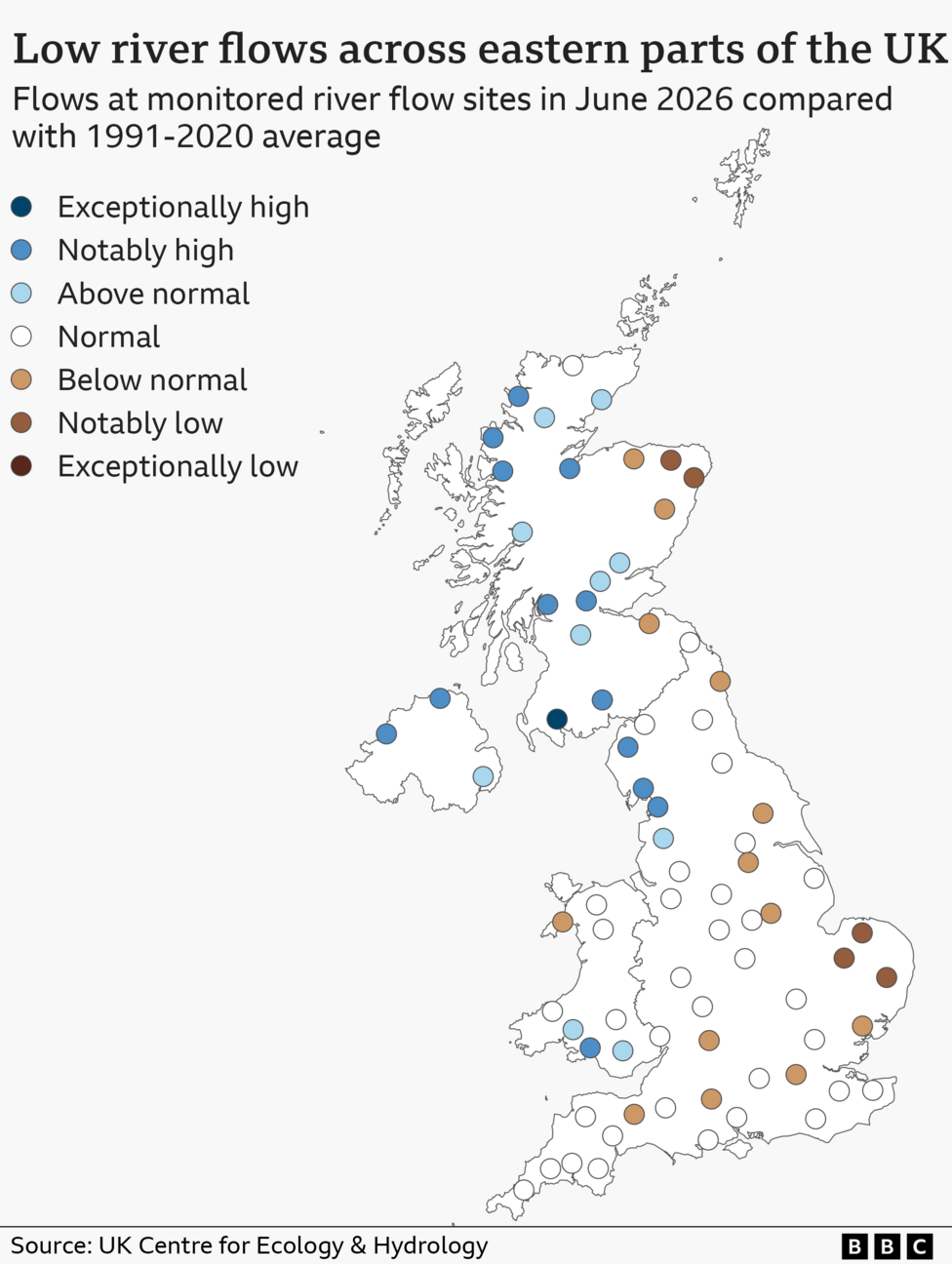
Following the recent hot and dry weather, river flows were notably low in June in certain UK regions.
"Without significant rainfall we could see increasing impacts on wildlife, agriculture and water resources as the summer progresses," said Steve Turner, a hydrologist at the UK Centre for Ecology & Hydrology (UKCEH).
Reservoirs play a vital role in water supply. Levels in Northern Ireland, Wales, and Scotland are currently "healthy" and above expected averages for this time of year.
Reservoir levels in England are approximately average for the season, though regional variations exist.
South-east England relies more heavily on groundwater than reservoirs.
Groundwater originates from rainfall and is naturally stored underground within rock pores and fractures.
In June, groundwater levels were generally at or slightly below normal, replenished by winter rainfall but reduced by a drier spring in most areas.
Water movement through certain rock types can be slow, sometimes taking years to reflect current conditions.
"These groundwater stores respond more slowly to changes in the climate than rivers, which is why they provide a useful buffer during periods of drought," said Prof Alan MacDonald of the British Geological Survey.
This explains why groundwater droughts in southern England typically develop more slowly but may persist longer once established.
Role of Climate Change
Droughts are complex events influenced by both natural variability and human activities.
The Met Office projects that the UK will experience generally drier summers in the future as global temperatures rise, although no definitive trend has been observed to date.
Higher temperatures can directly increase evaporation, extracting more moisture from soil.
"A warmer atmosphere is thirstier for moisture and this can mean water in the soil, rivers and reservoirs are depleted more effectively, leading to more rapidly onsetting droughts, heatwaves and wildfires," said Richard Allan, professor of climate science at the University of Reading.
Other factors influencing whether dry spells result in water shortages include water usage patterns.
A landmark review of the water sector in England and Wales criticized water companies for historic underinvestment in infrastructure.
To address water shortages, the government and water companies plan to construct nine new reservoirs in England by 2050, in addition to the reservoir currently under construction at Havant Thicket in Hampshire.
The Environment Agency has indicated that additional measures such as reducing water leaks, controlling demand through hosepipe bans, and expanding smart meter usage may be necessary in England.
Water companies in Scotland, Wales, and Northern Ireland, which operate as public or non-profit entities, have also reported initiatives to secure future water supplies.
Further Information

For ongoing updates on climate and environmental issues, readers can to the BBC's Future Earth newsletter, curated by Justin Rowlatt. International readers have access to a dedicated version of the newsletter.


