Tax Rebate for Pensioners and Welfare Spending Cuts
Scottish Conservative leader Russell Findlay has defended his party's proposal to provide pensioners with a £500 tax rebate while simultaneously reducing spending on child and disability benefits.
The Conservative manifesto for the upcoming Holyrood election includes plans for tax breaks alongside welfare spending reductions, with a commitment to eliminate "huge amounts of government waste".
Speaking on BBC Radio Scotland Breakfast, Findlay described it as "entirely reasonable" to offer pensioners on "modest incomes" a £500 boost. However, he expressed the hope that millionaire pensioners would not apply for this payment.
The manifesto proposes allowing pensioners to reclaim the first £500 they pay in tax on their pension income. This £500 amount would be "triple locked," increasing annually in line with earnings, inflation, or 2%—whichever is highest.
When questioned about the appropriateness of this public expenditure amid efforts to reduce waste, Findlay clarified that the payment would not be available to "those at the upper level of earnings." He further explained that pensioners would need to apply for the payment.
"It'd be up to each pensioner to apply for this," he said. "So I would like to think that if you were a millionaire pensioner, of which there are very few, you would not be seeking to get your 50 quid."
The Conservatives also plan to reduce income tax by raising the threshold at which Scots begin paying tax on their earnings.
Specifically, Scotland's starter (19%), basic (20%), and intermediate (21%) tax bands would be consolidated into a single 19% band. Additionally, the threshold for the higher rate (42%) would be increased to £50,270, aligning with the UK tax system.
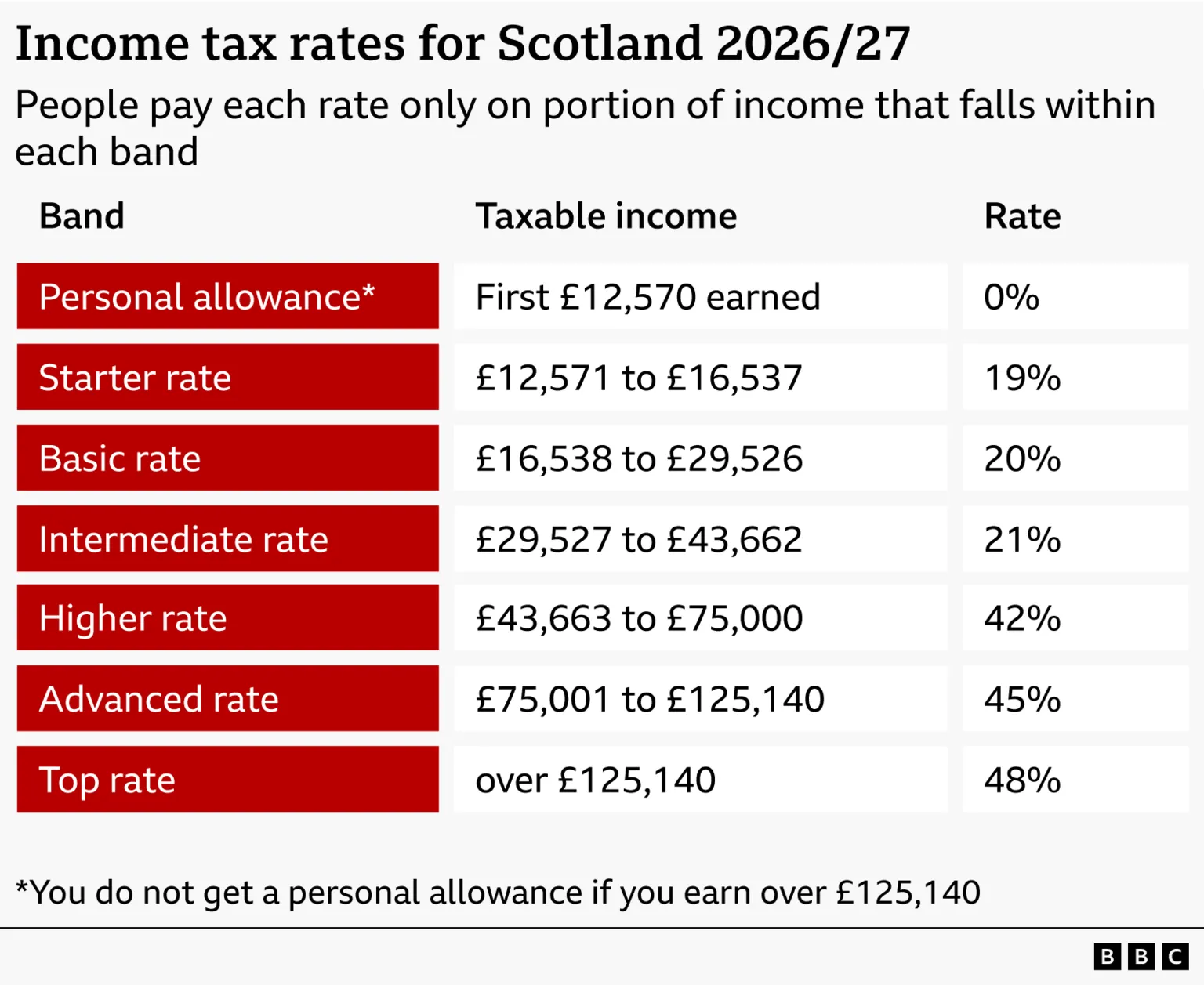
Findlay described the current Scottish tax system as "completely unfair and unaffordable," stating that his party has presented "costed and credible plans to bring that back down to a fair level."
"Fundamentally, this is about ensuring that work pays."
According to financial projections published alongside the manifesto, the income tax cut would cost £370 million in 2027-28, with total costs rising to nearly £2.8 billion by 2031-32.
To finance these tax reductions, the Conservatives propose a series of spending cuts. The manifesto identifies £1.3 billion in savings for 2027-28 through various measures.
These include imposing restrictions on adult mental health benefit claims (£592 million), introducing a two-child cap on the Scottish Child Payment (£62 million), and reducing the civil service to 2016 levels (£54 million).
The party anticipates that by 2031-32, cuts to adult mental health benefits could save nearly £2 billion, while civil service reductions could total £1.5 billion.
Concerns Over Benefits Spending
Findlay acknowledged that Scots are "extremely fortunate" to have a welfare safety net but characterized social security spending as "out of control."
The gap between Scottish government social security expenditure and the funds received from the UK Treasury for welfare spending south of the border is projected to reach £1.1 billion in 2026-27, increasing to £1.2 billion by 2030-31.
This shortfall must be addressed through reallocating funds from other areas, raising taxes, or borrowing.
The Conservatives have pledged to end what they describe as the Scottish government's "light touch" approach to benefits assessments.
Findlay asserted that there are "huge and rapidly increasing numbers" of "wholly unnecessary" disability payments being made to individuals with mental health conditions, including ADHD and autism.
As of October, approximately 200,000 people in Scotland received Adult Disability Payment due to "mental and behavioural disorders." Findlay stated to the BBC:
"We believe most of those claimants wouldn't be applicable."
He also criticized the Scottish Child Payment, which the government estimated helped keep 40,000 children out of relative poverty in 2025-26, describing it as "too generous."
Findlay indicated that further savings could be achieved by eliminating "huge amounts of government waste."
He expressed the party's intention to significantly reduce the number of quangos—public bodies operating at arm's length from the government, of which there are about 130 in Scotland.
Findlay identified the ferry procurement body CMAL, the Scottish Land Commission, and Community Justice Scotland as examples of organizations he would eliminate.
"Many of these aren't necessary," Findlay said. "When people are going to working hard to pay their taxes, they're doing so they want to see improved public services. They want to see the bins emptied. They want to see potholes filled. They want to see police officers on the streets. They don't want to pay for vast reams of a professional class that serve no purpose and add no value."

Radical Conservative Proposals and Fiscal Challenges
Despite the party's name, the Scottish Conservative proposals are notably ambitious. By 2031-32, they envision increasing annual spending by £6 billion on tax cuts for individuals and businesses, additional school staff, and expanded NHS capacity.
This increased expenditure would be offset by £6 billion in cuts to disability payments, the civil service, and government operating costs.
The Institute for Fiscal Studies (IFS) has highlighted the difficulty of achieving these savings, noting that while the plan is costed on paper, "whether it would survive contact with reality is far from clear."
The IFS stated that "giveaways on the scale proposed by the Scottish Conservatives cannot credibly be funded largely through back-office and administrative savings," suggesting that "substantial cutbacks" to public services would also be necessary.
The manifesto also references a looming £5 billion gap between spending and available funding by the end of the next term, warning that the nation's finances are unsustainable.
However, nearly all the proposed savings are allocated to new spending initiatives rather than addressing this funding gap.
This approach does not reflect austerity or small government policies but rather entails significant changes that may be challenging to implement.
BBC Scotland Leaders Debate Invitation
BBC Scotland will host a special episode of Debate Night, moderated by Stephen Jardine, from 19:00 to 20:30 on Sunday, 12 April, at Paisley Town Hall.
The leaders of the Scottish Conservatives, Scottish Greens, Scottish Labour, Scottish Liberal Democrats, Scottish National Party, and Reform UK have been invited to participate.
Members of the public can apply to attend the audience via bbc.co.uk/debatenight.