

Defence Secretary John Healey Announces Resignation
Defence Secretary John Healey has tendered his resignation from Keir Starmer's government.
In a letter addressed to the Prime Minister, Healey expressed concerns that the UK's defence investment plan "falls well short of what is required for defence and the country at this dangerous time."
This is a letter I never expected to write, and I do so now with great regret and reluctance.
He reflected on the achievements made during the Labour Government's tenure of less than two years, highlighting several key initiatives and accomplishments.
I'm proud of what we have done in less than two years as a Labour Government. We've stepped up to lead internationally for Ukraine with the Coalition of the Willing and Ukraine Defence Contact Group, established Britain as a leading voice for Europe in NATO, raised defence investment to 2.5% of GDP three years earlier than anyone expected, launched the deepest defence reforms in 50 years, won the biggest UK defence export deals for decades, published a first-of-its-kind Strategic Defence Review, gave our Armed Forces the biggest pay rise in nearly 20 years, boosted military morale, fixed over 1,200 of the worst forces family homes, reset relations with European allies and signed major defence agreements with Germany, Norway and France.
Healey acknowledged the leadership of the Prime Minister in these efforts.
You have led this as PM, earning wide respect at home and abroad. Like me, I know you are exceptionally proud of our Forces and all of those who work in UK Defence.
Context of Defence Challenges and Strategic Defence Review
The letter emphasized the recognition upon entering government that Britain faces a new era of threats, necessitating a corresponding evolution in defence strategy.
Healey referenced the Strategic Defence Review (SDR) jointly commissioned, which outlined a 10-year vision to transform the Armed Forces, strengthen alliances, invest in emerging technologies, and support British defence industry as a growth engine.
This new era for defence required further investment through the Defence Investment Plan (DIP). The excellent and extensive cross-government work that completed in January-overseen by you, me and the Chancellor - confirmed the scale of the challenge and the rising demands on defence.
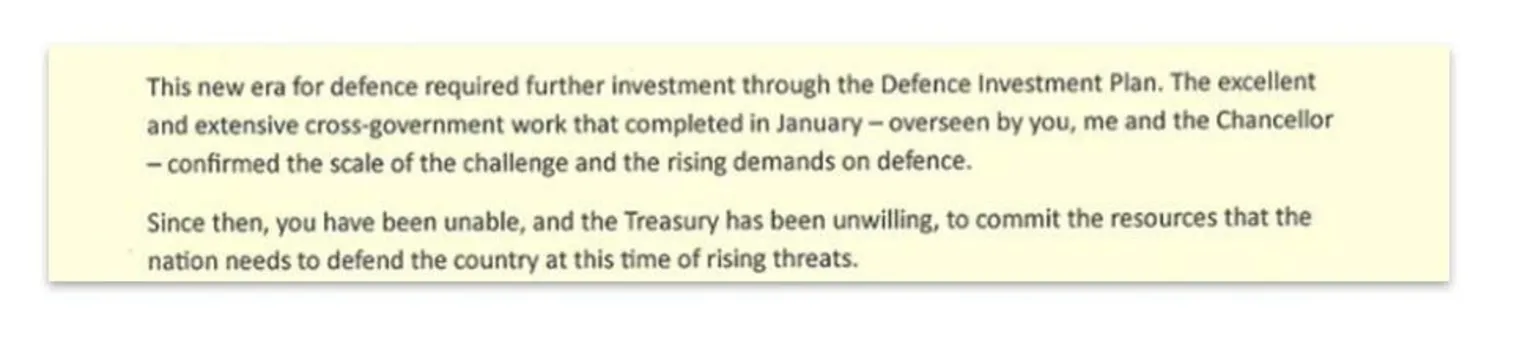
He noted that since the completion of this work, the Prime Minister has been unable, and the Treasury unwilling, to allocate the necessary resources to meet the nation's defence needs amid escalating threats.
Increasing Defence Demands and UK Commitments
Healey detailed the growing operational demands and commitments the UK has undertaken, including leading multinational missions and responding to heightened geopolitical tensions.

Since then, the demands on defence have increased still further, as have the UK commitments you have rightly made to allies. Conflict in the Middle East, with the UK now leading the multinational Strait of Hormuz military mission; High North security, with the UK now leading NATO's Arctic Sentry mission; increased Russian activity towards the UK and NATO nations and increased attacks in Ukraine, with the Paris Agreement confirming a British deployment to Ukraine after a ceasefire.

Defence Investment Plan and Funding Challenges
The Defence Investment Plan (DIP) was intended to address these operational demands and advance the Strategic Defence Review's objectives, while also setting a trajectory to meet NATO's commitment of 3.5% of GDP defence spending by 2035.
Healey advocated for a target of 3% of GDP on defence by 2030, a goal he believes would garner strong cross-party support and align with other European allies' efforts.
As we have regularly discussed, I am certain that a headmark date for 3% of GDP on defence in 2030 is what Britain must set. This commitment would have strong cross-party support. Other European allies are stepping up in this way.
He acknowledged the Prime Minister's efforts and the challenges faced by other departments in reallocating funds to defence.
I know how hard you have worked to get to this point. And in funding the DIP, I fully recognise the strain this places on colleagues in other Departments, both now as you have required spending switched into defence and in the future. I am very grateful to those colleagues who have supported this, and I appreciate how difficult their choices will have been.
Healey mentioned credible approaches to address mid-term funding challenges, including multinational cooperation similar to that of other European nations.
However, he expressed that the financial settlement offered in the DIP, which he received in full on the Monday afternoon of the week of his letter, is insufficient given the current threat environment.
Your DIP financial settlement - which I was first given in full on Monday afternoon this week - falls well short of what is required for defence and the country at this dangerous time. The extra support is backloaded when the pressure of operations and imperative to speed up readiness to fight is in the first two years and it rises to just 2.68% of GDP in 2030, when we will reach 2.6% next year with the investment we are already making.
Threat Assessments and Consequences of Insufficient Funding
Healey referenced the Prime Minister's recent statements on intelligence assessments regarding potential Russian aggression against NATO by 2030.
You spelled out the threats last week: "it is our intelligence assessment, and the assessment of other countries in NATO, that there could be an attack by Russia on NATO as soon as 2030."
He reiterated the Prime Minister's own arguments made at the Munich Security Conference earlier in the year regarding defence needs.
You know what defence needs. You made the argument for this powerfully in your speech at the Munich Security Conference back in February. Without a DIP that meets the moment in this way, I am being forced to make decisions that would reduce the readiness of our Forces and increase the risk to personnel on operations, and could make the country less safe.
Resignation and Closing Remarks
Having communicated his inability to accept a DIP settlement that fails to provide adequate resources, Healey stated that resignation was his only remaining option.
After explaining to you that I would not be able to accept a DIP settlement that does not give our Forces the resources they need, I am now left with no other option than to submit my resignation as your Defence Secretary.
He concluded by wishing the Prime Minister strength and reaffirming his support for the Labour Government.
I wish you all continuing strength in the exceptional challenges you face as Prime Minister.
As always, our Labour Government will continue to have my fullest support.


