

David Lloyd George’s 1936 Meeting with Hitler
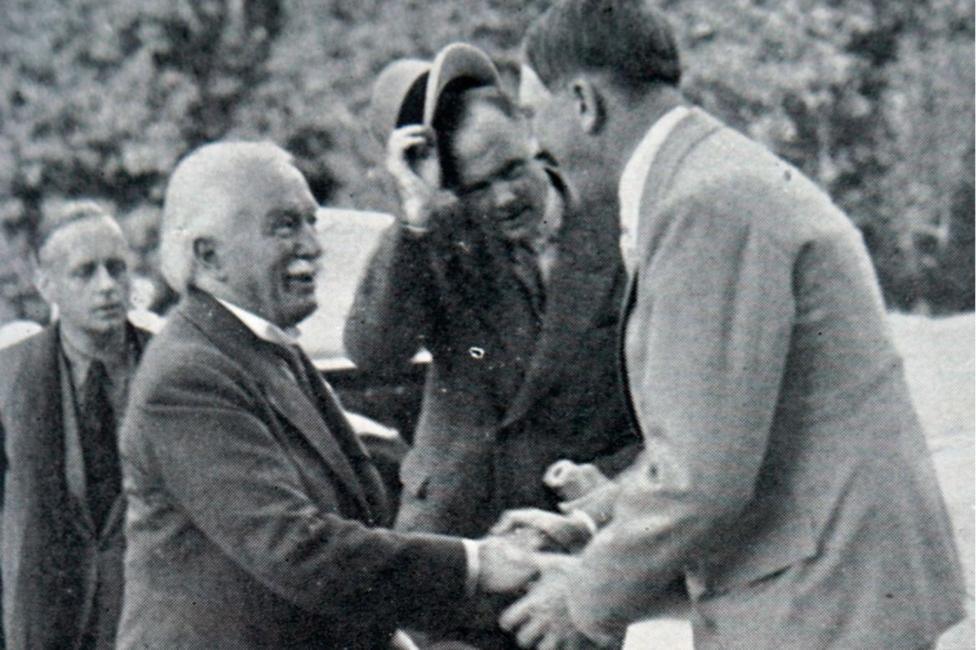
T.P. Conwell-Evans (left) served as translator for David Lloyd George (front, left) during the former Prime Minister's 1936 meeting with Adolf Hitler (front, right) in Germany.
When David Lloyd George met Adolf Hitler in 1936, a Welshman was acting as translator for both politicians.
T.P. Conwell-Evans held great respect for the German leader at that time, but over time his admiration faded, and he became involved in plots to replace Hitler.
Professor Peredur Lynch recounts the story of the man who changed his mind about Hitler.
Tea Party with the Führer
One of the most controversial episodes in David Lloyd George’s post-premiership life, after he left office in 1922, was his 1936 visit to Adolf Hitler.
By then, Lloyd George was politically marginalized in Britain, but his international reputation and prestige endured.
On 4 September 1936, Lloyd George spent three hours with Adolf Hitler at the Berghof, the Führer’s impressive Alpine retreat.
They discussed the international political situation extensively, but records clearly show that Lloyd George and Hitler were mutually impressed by each other. One historian described them as a ‘mutual admiration society’.
After returning to Britain, Lloyd George published an article about his visit, describing Hitler as ‘the George Washington of Germany’; a year later, he stated,
‘I have never doubted the fundamental greatness of Herr Hitler’.
It is important to note that Lloyd George was not attracted to Nazi political ideology but could not help admiring Hitler’s apparent success in addressing unemployment through public works such as road building.
Following the meeting on 4 September, Hitler’s enthusiasm was such that he invited Lloyd George and his entire party back the next day for a tea party, where cold ham and hard-boiled eggs were the main delicacies.
Eight people accompanied Lloyd George during his two-week visit to Germany that September. Two were Englishmen: Lord Dawson, the royal family’s physician, and A.J. Sylvester, Lloyd George’s personal secretary.
The other six were Welsh: Megan Lloyd George and her brother Gwilym Lloyd George, Thomas Jones, former Cabinet Under-Secretary, and the translator Dr T.P. Conwell-Evans.
The Pacifist and the Plotter
By 1939, one member of the 1936 party had gained deeper insight than anyone else in Britain into the mindset of the Nazi elite.
He had met Hitler and leading Nazis several times, had been an uncritical admirer until 1938, attended Nuremberg rallies, and socialised extensively with Joachim Ribbentrop and his wife Annelies.
Remarkably, he had also been on the fringes of a 1938 plot to replace the Führer.
His knowledge of the inner Nazi world led to a secret meeting in late August 1939 at Lloyd George’s office in Parliament with Winston Churchill and Anthony Eden.
The urgent question was whether any reconciliation with the Nazis was possible; the answer was negative.
The informant was Dr T.P. Conwell-Evans, Lloyd George’s translator in 1936.
Lloyd George’s visit was documented by A.J. Sylvester, who filmed it with a Ciné-Kodak camera. Conwell-Evans is the man in glasses entering the frame from the right near the end of the clip.
Until recently, Conwell-Evans’s historical footnotes were little known. However, in 2022 historian Charles Spicer published Coffee with Hitler, detailing the efforts of a small group of idealists attempting to avoid another war during the 1930s.
Their lofty, if naïve, goal was to civilise the Nazis through friendship and reintegrate Germany into the community of peace-loving nations. Conwell-Evans played a central role in this story.
Thomas Philip Conwell-Evans was from Carmarthen. Born in Cynwil Elfed, his father Thomas Conwil Evans was a tailor with a shop at 44 King Street and also a singing conductor and deacon at Penuel Baptist Chapel.
After brief studies in France and Germany, Conwell-Evans attended Jesus College, Oxford in 1912, graduating in Modern and Medieval Language and Literature in 1915. A committed pacifist and politically left-wing, he was appointed political secretary to Labour MP Noel Buxton in 1924.
During the 1920s, Conwell-Evans became an expert on international affairs and in 1929 published The League Council in Action: a study in the methods employed by the council of the League of Nations to prevent war and to settle international disputes.
He was clearly inspired by the idealism of the 1920s and the hope of avoiding war through a new international order under the League of Nations.
In 1930, sponsored by Buxton, he visited East Prussia and spent 1932-34 – the period when Hitler came to power – lecturing at the University of Königsberg.
This experience deepened his affection for German culture and confirmed his view that the country had been harshly treated by the Treaty of Versailles.
He resolved to devote all his energy to preventing another war between Britain and Germany.
‘Walking a Morally Ambiguous Path’
In the following years, Conwell-Evans came into contact with Ernest Tennant, a banker and industrialist who had been a member of the Intelligence Corps during World War I, and Group Captain Grahame Christie, one of Britain’s most distinguished wartime pilots.
Despite their different backgrounds, the three shared the goal of avoiding war by building bridges between Britain and Nazi Germany.
One organisation they used from 1935 onwards to pursue this goal was the Anglo-German Fellowship. Its membership included politicians, business magnates, and aristocrats, and prominent Germans were welcomed in London and some British noble houses.
Conwell-Evans was the Fellowship’s salaried secretary from its inception.
As depicted in the novel and film Remains of the Day, the Fellowship has often been portrayed as a group of British Nazis. However, according to Charles Spicer, only about 10% of members were ideologically attracted to Nazism, and the Kristallnacht pogrom in November 1938 was a blow to the Fellowship, causing many members to resign.
Lloyd George, Hitler, and the Carmarthen Welshman
Professor Peredur Lynch discusses T.P. Conwell-Evans on the Dei Tomos programme on BBC Radio Cymru.
Conwell-Evans and his colleagues walked a morally ambiguous path from the outset. He instigated Lloyd George’s 1936 visit to Hitler, but by then German Jews had already lost their civil rights.
By 1938, Conwell-Evans judged Hitler to be a madman. Early that year, he unsuccessfully attempted to arrange for Germany to compete in the National Eisteddfod in Cardiff.
By summer, through his contacts with German diplomat Erich Kordt, he acted as an intermediary between the organisers of the Oster Conspiracy – a plot by some senior German military officers to replace Hitler – and the British government.
A key condition for the coup was firm British opposition to Hitler’s intentions in the Sudetenland, which Neville Chamberlain ultimately failed to provide.
During the Phoney War (1939-40), Conwell-Evans twice travelled to Lausanne, Switzerland, to conspire with German opponents. However, all efforts to replace Hitler were unsuccessful.
‘It Did Not Do Any Good’
Conwell-Evans was a quiet man who often lived on edge. Like Lloyd George and others, he was captivated by Hitler until 1938.
In September 1939, he asked Lloyd George to use his influence to secure him a political secretary position with Winston Churchill.
Nothing came of this, and by October he was critical of Lloyd George’s lukewarm attitude toward the war. He described Hitler and the Nazis as the greatest threat to European civilisation in 1,500 years.
After 1940, Conwell-Evans disappeared from the political stage and lived a reclusive life in Notting Hill, devoting himself to his two main hobbies – piano and painting.
He corresponded in 1964 with Gwynfor Evans. The letters were in English, and he expressed regret about his deficient Welsh, stating,
‘up to the age of six we spoke Welsh at home and no other tongue’.
He was evidently eager to create a portrait of Gwynfor and asked for a good photograph of him. He had already completed an oil portrait of Aneurin Bevan and a pastel sketch of Lloyd George for his own amusement.
Reflecting on his 1936 experience, he said,
‘I had spent a fortnight in LlG's company in 1936, when we visited Hitler in his mountain fastness! It did not do any good’.
Conwell-Evans died peacefully in his sleep in the early hours of 11 November 1968.
A version of this article was published in the magazine Barn in November 2024.
Follow Cymru Fyw on Facebook, X, Instagram, or TikTok.
Send story ideas to cymrufyw@bbc.co.uk or contact via WhatsApp at 07709850033.
for the latest news from Wales on your mobile device.
Also of Interest
Peredur Lynch discusses Lloyd George, Hitler, and the Carmarthen Welshman on Dei Tomos on BBC Radio Cymru.
The Welshman who helped deceive Hitler.


