

Is Andy Burnham Labour's saviour, or just its best bet?
"Do you want a chat about the saviour?"a long-time Labour contact joked when asked about their old colleague Andy Burnham, who is set to enter No 10 in less than a month.
It is certainly time to discuss the Greater Manchester mayor. Just 10 days ago, he achieved an impressive victory in what one former minister described as a "Russian roulette" by-election in Makerfield, defeating Reform and defying Labour's general lack of popularity.
But can Burnham accomplish the much larger challenge ahead and truly be the "saviour" Labour seeks?
Labour MPs are eager for Burnham's project to succeed. This was evident as they crowded Westminster Hall to surround him for a large photo on his first day back in Parliament.
One MP says Parliament has had a "strange atmosphere all week, with people crawling over each other to try to get to him".
Another government member said, "ministers are sweating their connections to try to get an audience".
It is not just about official documents and government car seats. Labour MPs have been eagerly embracing the "Burnham Kool-Aid" this week, transforming hope into belief that as prime minister, he can confront Nigel Farage, help Labour retain its seats, and maintain at least a significant portion of its substantial 2024 majority at the next election.
The main reason for this optimism is that Burnham is a popular politician at a time when most politicians are not. This does not imply universal public admiration. Another colleague from Burnham's earlier tenure at Westminster noted,
"He'll have to go from cock of the north to national champion".
The "north" in this context is broader than just Manchester.
Another contact remarked, "He needs to drop this man of the north a bit – he'll hack off people. It's deeply upsetting to people from Leeds and Newcastle to think that Manchester is THE north, let alone Scotland. It's trite."
Burnham possesses a rare ability to capture public attention and make voters feel heard – often quite literally.
An ally from his time in Manchester said, "It used to drive me mad that he was late, but every conversation is important to him. I could be stuck waiting having to make small talk with an ambassador, because he was stuck outside having a conversation with someone about the buses."
In a profession where politicians often speak ill of each other, Andy Burnham is well liked.
Described as "affable" and "warm," a close ally calls him a "really nice person – politics is a contact sport and it's not contrived."
One MP called him a "good bloke," adding that "sound would be the Manchester word." They highlighted his "social dexterity": an ability to communicate effectively with colleagues and the public both in person and on social media.
However, there is a persistent question among many colleagues, neatly expressed on his Facebook page where a member of the public wrote:
"I have no doubt I'd enjoy a beer with you and we could talk about Joy Division and other important cultural things. But when did that become the thing that determined whether someone becomes the prime minister or not?"
There are concerns within Labour about what Burnham would actually do with power. One old friend said,
"Andy has huge skills but there have been questions about the extent to which [his] thinking on some of the really tricky stuff has been properly developed".
Another questioned,
"Can he shake off the perception that he is a bit of a lightweight?"
Not everyone is convinced of his capability.
One senior party figure said, "The eyelashes will deliver for a day, maybe a week. But the scrutiny is brutal. Won't last three months, never mind three years."
Multiple sources view Burnham's appointment of his old flatmate and fellow New Labour cabinet minister James Purnell as chief of staff positively. This is not only due to Purnell's experience but also because it has stirred unease on the left (Purnell has recently worked with big business and is seen as a Blairite).
This choice was cited as evidence that Burnham is willing to make decisions that may upset people, which has reassured some within the party. The role of prime minister requires making choices that will inevitably anger some groups, and there is concern that Burnham might struggle with this.
Burnham could be leader in weeks under Labour timetable
Burnham on course to be PM, but what would his No 10 operation look like?
What are Andy Burnham's potential policies for No 10?
One government source said,
"The thing is he loves to be loved and likes to be liked. He has to be ready to be unpopular – and he will have to face the trade-offs – mayors don't face trade-offs".
One of his former colleagues added,
"He is quite emotional, he has feelings."They questioned,
"how you balance that with the need for tough skin, the need to see things through and to take very exposed positions".
However, spending over two decades in politics requires more than just pleasing people. Burnham regularly challenged the Labour leadership during Keir Starmer's tenure.
An ally who worked closely with him in government in the late 2000s said his talent was not only being nice:
"He never takes no for an answer".
They recalled conflicts between the government and "hostile permanent secretaries" near the end of Labour's time in power, who were "hoarding money for the incoming Tory government." Burnham
"went to war with them and won,"which the ally described as "astonishing."

Some doubts arise from a perceived lack of clarity about Burnham's objectives beyond reaching No 10, which he clearly desires.
This would be his third attempt after unsuccessful leadership bids in 2010 and 2015. His rhetoric about change, promoting equality, and supporting communities left behind like Makerfield, his new constituency, is familiar. The campaign tagline is "Vote Andy - For Us."
However, specifics often seem vague.
This has sparked intense political speculation about who he will appoint as chancellor. Westminster buzzes with talk of whether he will choose Ed Miliband from the soft left, Wes Streeting from Labour's right, or Home Secretary Shabana Mahmood. Alternatively, it could be someone else like Welfare Secretary Pat McFadden, who is less inclined to seek the spotlight. This decision is viewed as a proxy for Burnham's overall direction.
The lack of clarity concerns some party members. One source said,
"Is the political north star still missing? The contenders talked about are in entirely different places on all sorts of things."
Burnham is expected to deliver a speech on the economy on Monday, which may provide more insight. Many sources say his time as Manchester mayor has transformed him and that he possesses significant confidence and conviction about his goals. A close colleague said,
"He thinks about things more deeply than people give him credit for - don't underestimate how much he has thought about it."
There is considerable evidence about his intentions. He frequently cites his Manchester track record: the public bus network, the MBacc qualification, and partnerships with business that have fostered economic growth.
He has also been clear about unfinished business regarding social care reform in England. As health secretary, his efforts to unite parties on reform were thwarted by political realities before the 2010 general election. It is likely he will revisit this issue in office.
Burnham co-authored a book with Liverpool Mayor Steve Rotheram outlining his vision. They passionately argue about the country's growing inequality and propose a 10-point plan that would be radical if implemented.
The plan includes passing a "basic law" to allocate equal funding to all regions based on need, establishing a written constitution, adopting proportional representation, and abolishing party voting whips. They advocate for greater powers to mayors and councils through devolution.
They propose treating technical and university education equally, establishing a legal right to basic needs starting with housing, introducing a "Grenfell law" alongside the Hillsborough Law to compel public officials to tell the full truth, and revitalizing northern industry to create jobs and support Net Zero goals.
While this ambitious agenda is unlikely to be Burnham's immediate focus, the book signals his long-term reform vision.
However, there remain gaps in knowledge about specifics. Will he find the additional £10 billion the Ministry of Defence says is necessary for security? Will he maintain the government's recently announced social media ban for under-16s? Will he attempt to tighten benefit rules to reduce welfare spending? Will he reverse new immigration policies proposed by the home secretary?
His approach to foreign affairs is also unclear. It is hard to imagine significant departures from current government positions on war and peace, but how he would handle figures like Donald Trump is unknown.
Burnham is expected to assume office amid significant international turmoil, facing challenges such as demographics, debt, division, and widespread public disillusionment with the political system.
One former colleague stated,
"There is no escaping there are some bloody awful issues to deal with. He is going to have to make very tough decisions which are going to be really unpopular – you can't govern on vibes."
The ultimate test for any prime minister is how they respond to unforeseen events.
Success or failure often depends less on initial plans and more on reactions to uncontrollable circumstances and correcting mistakes under pressure.
"He's more steely than people think,"said one ally.
Burnham's 30-year political career demonstrates resilience. He lost leadership bids in 2010 and 2015, failed to win in Gorton and Denton, took a significant risk running in Makerfield, won, and is now on course for No 10.
Following recent turmoil when Keir Starmer's rivals sought to oust him, Labour MPs and insiders express renewed hope. Some remain skeptical of Burnham's ability, with one colleague stating,
"I just really wonder if he's up to it."
However, after the challenges of 2026, a member of Starmer's circle said,
"We have to pull our socks up, get behind him and on we go."
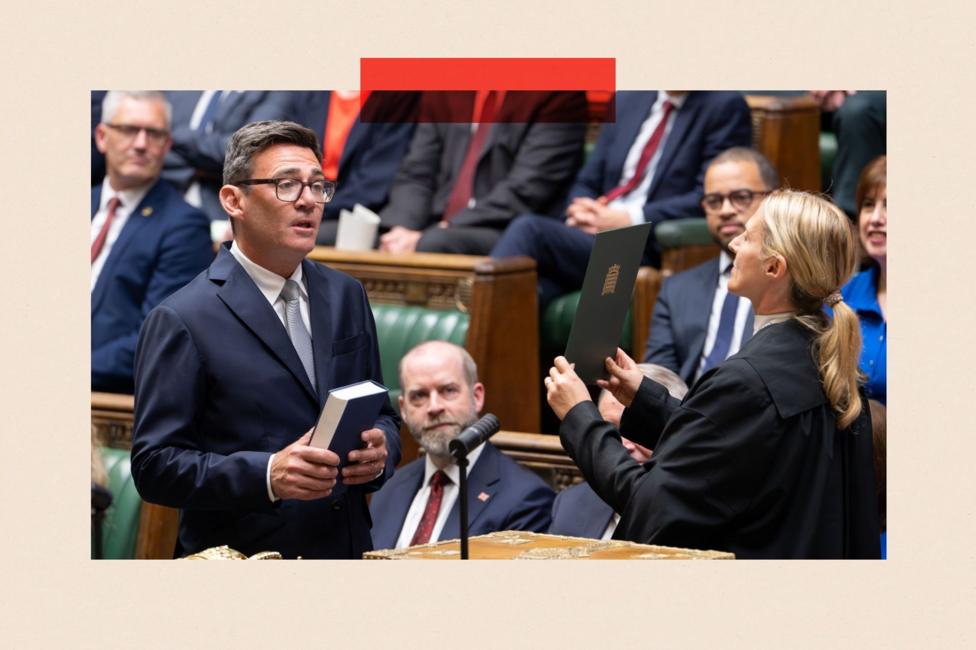
An MP shouted during Burnham's swearing-in this week,
"He's not the Messiah."
Yet, after two difficult years, Andy Burnham's talent and enduring ambition offer him a chance at No 10 and Labour an opportunity for revival.
The term "saviour" may be overstated, but the party's mood suggests he is their best option.
More from InDepth
- Ten years on, Brexit's economic impact is becoming clearer
- How the social media ban could reshape how all of us use the internet
- A decade on from Brexit, the new PM has big calls to make on Europe
Top picture credits: and PA
BBC InDepth is the home on the website and app for the best analysis, with fresh perspectives that challenge assumptions and deep reporting on the biggest issues of the day. Emma Barnett and John Simpson bring their pick of the most thought-provoking deep reads and analysis, every Saturday. for the newsletter here

Get in touch
Are you personally affected by the issues raised in this story?


