

US Naval Blockade and Fee Announcement
President Donald Trump announced that the United States is reinstating a naval blockade of Iranian ports and will impose a 20% charge on all cargo passing through the Strait of Hormuz. He stated that this measure is intended to prevent "Iran's ships or customers" from entering or leaving this crucial oil shipping route, while ensuring that "all other countries will have fair and open use of the Strait." The blockade is set to commence at 16:00 Eastern Time (20:00 GMT) on Tuesday.
Following the announcement, Iran's foreign minister responded by asserting that those providing safe passage "should be compensated for this service," but emphasized that Iran would continue to be the strait's "," adopting the terminology used by President Trump.
Escalating Tensions in the Region
The announcement came amid heightened tensions between Tehran and Washington, following an exchange of strikes in the region overnight. The US reported conducting strikes against Iranian military targets, including air defence systems, coastal radars, and missile and drone installations.
Iran claimed to have retaliated by targeting US military bases in Kuwait, Jordan, and Bahrain, as well as radar installations in Oman.
Trump's Statements on the Strait of Hormuz
In a post on his social media platform Truth Social on Monday, President Trump asserted that the Strait of Hormuz "will remain OPEN, with or without Iran."
"The U.S.A. will be, from this point forward, known as ' OF THE HORMUZ STRAIT,' but as such, and as a matter of FAIRNESS, will be reimbursed, at the rate of 20% on all cargo shipped, for any and all costs necessary to do the job of providing safety and security to this very volatile section of the World," he wrote.
He added that "the process and formation will begin immediately."
Earlier, in an interview with Fox News, Trump indicated that the US would "probably run" the Strait of Hormuz, citing that Iran had "broken" a prior agreement with the US. He declared, "We are taking over the strait."
US Central Command Statement
Later on Monday, the US Central Command (Centcom) announced that its forces "will resume blockading maritime traffic entering and exiting Iranian ports" starting 14 July.
"The US military continues to support traffic flow through regional waters for all vessels not violating the blockade," the Centcom statement said.
Iran's Response
In response to President Trump's announcement, Iranian Foreign Minister Abbas Araghchi posted on X:
"POTUS is absolutely right. Whoever provides secure and safe passage of commercial vessels through the Strait of Hormuz should be compensated for this service."
"Iran has always been of the Strait and will remain so FOREVER."
"20% is of course too much. We will be fair," Araghchi added.
International Maritime Organization's Position
A spokesperson for the International Maritime Organization (IMO), the United Nations agency responsible for regulating global shipping, was quoted by as stating that "IMO stands firmly against charging fees for passage through straits used for international navigation."
"There is no legal basis through which to introduce mandatory tolls simply to transit through a strait," the spokesperson added.
Iran's Military Stance
Prior to President Trump's announcement, Iran's top military headquarters declared it would not permit US interference in the management of the Strait of Hormuz.

In a statement reported by Iranian media, Ebrahim Zolfaghari, spokesperson for Khatam al-Anbiya, condemned "repeated adventurism and malicious actions" by the US in the strait, stating these have "seriously endangered regional security, international trade and the passage of oil tankers and commercial vessels."
"Any cooperation with the US would be considered an act of 'war' against Iran's sovereignty," he said, warning that if the conflict escalates, "the flames of war will engulf all the countries of the region."
Current Maritime Traffic Status
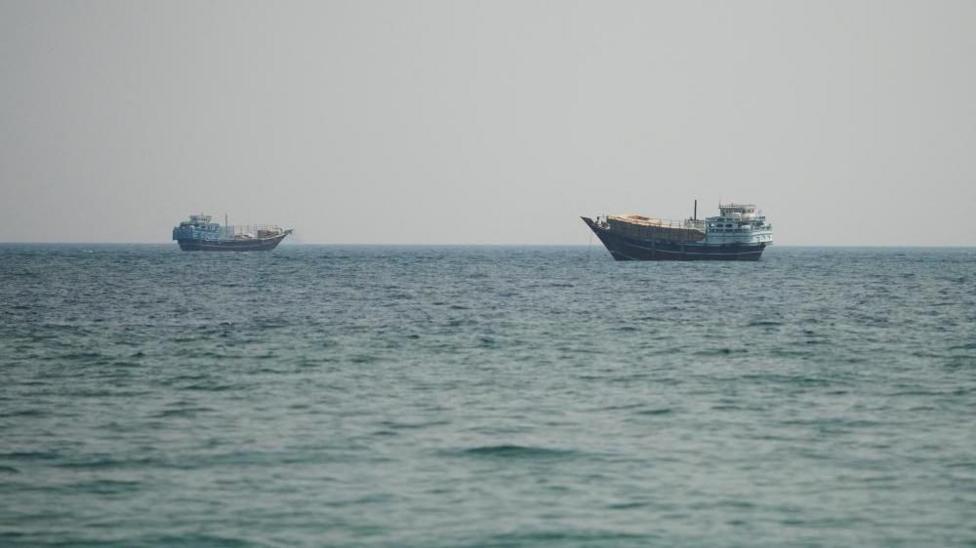
While a limited number of vessels appear to be transiting the Strait of Hormuz, traffic remains restricted, according to the ship tracking website MarineTraffic.
Legal and Geographical Context
The practical implications of President Trump's announcement remain unclear. United Nations regulations permit countries to exercise control over territorial seas extending up to 12 nautical miles (13.8 miles) from their coastlines. At its narrowest point, the Strait of Hormuz and its shipping lanes are entirely within the territorial waters of Iran and Oman.
Iran effectively closed the strait after US and Israeli strikes against Iranian targets on 28 February. In response, Tehran launched missile and drone attacks on Israel and US military bases located in several Gulf countries.
Iran's Islamic Revolutionary Guards Corps (IRGC) also fired upon commercial vessels attempting to transit the strait without permission and seized two ships. This led to a significant reduction in maritime traffic through the strait, which previously accounted for approximately 25% of the world's oil and 20% of global liquefied natural gas shipments, causing oil prices to rise.
History of the Blockade and Ceasefire
The US initially imposed a naval blockade on all Iranian ports in April to exert pressure on Tehran but lifted it in June as part of a memorandum of understanding aimed at ending hostilities between the two countries.
Although the initial agreement halted fighting, disputes over control of the strait persisted. On 7 July, President Trump notified Congress of the resumption of military action against Iran.
Political and Economic Implications
Many US allies may resist the prospect of reimbursing the US and paying a 20% fee on all cargo shipped through the strait. Critics of President Trump, both domestically and internationally, are likely to highlight that the strait was accessible and unencumbered prior to the onset of the conflict.
The announcement may also present political challenges for the president within the United States. Some lawmakers, including members of his own Republican Party, have questioned the benefits of the ceasefire, its extension, and ongoing negotiations.
Additionally, many Americans may be concerned about rising oil prices, despite repeated assurances to the contrary. Although President Trump is not a candidate in the upcoming midterm elections, other Republicans will face constituents worried about energy costs.
This move could also be interpreted as an attempt to restart negotiations and encourage greater involvement from other countries, a strategy President Trump has employed previously.
Additional reporting by Ghoncheh Habibiazad


