

Supreme Leader Calls for Vengeance
Mojtaba Khamenei has not appeared publicly since the conflict began in February.
Iranian Supreme Leader Ayatollah Mojtaba Khamenei has issued a call for revenge following the death of his father and predecessor, Ayatollah Ali Khamenei.
In a written statement broadcast on state television, he declared that vengeance is the "will of the nation." This marked his first public message since the commencement of his father's funeral ceremonies earlier this week.
Ayatollah Ali Khamenei, aged 86, was killed in an air strike on 28 February, which was the first day of the US-Israeli war against Iran.
US-Iran Tensions Escalate
US President Donald Trump has issued a warning that any Iranian attempt to assassinate him would result in the US "decimating and destroying all areas" of Iran in retaliation.
The threats followed a series of strikes exchanged between the US and Iran earlier this week, triggered by attacks on three commercial tankers, which were allegedly carried out by Iran.
These exchanges have heightened tensions between the two nations, leading Trump to declare the ceasefire over, although he indicated that negotiations aimed at ending the war would continue.
Funeral and Public Appearances
Ali Khamenei was laid to rest in his hometown of Mashhad on Friday after nearly a week of funeral ceremonies.
His son, Mojtaba Khamenei, has not been seen in public since before the war and is rumored to have been disfigured in the strike that killed his father.
Despite this, his statement on Saturday was resolute.
"We pledge to avenge the blood of the martyred leader and all the martyrs of these two wars from the criminal and disgraced killers,"
"Vengeance is the will of our nation and must inevitably be carried out.
"The matter depends neither on my personal existence nor on that of other officials. Whether we are present or not, it will come to pass."
Those responsible "will take the wish for a peaceful death in their beds to their graves," he added.
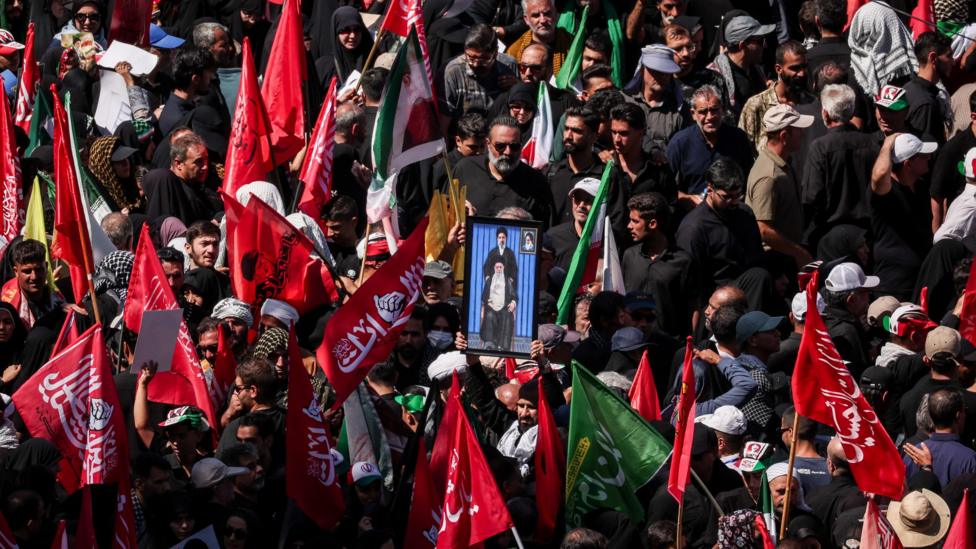
There have been open calls for the assassination of Donald Trump during the funeral ceremonies.

Calls for the assassination of Donald Trump were heard at funeral ceremonies for Ayatollah Ali Khamenei in Mashhad
US Response to Assassination Threats
In the early hours of Saturday, President Trump responded to reports that Iran had plans to assassinate him.
He stated that the US would "completely decimate and destroy all areas" of Iran in retaliation to such an attack.
The Wall Street Journal and other US media outlets reported this week that Israel had shared intelligence with Washington indicating that Iran had recently devised a plan to assassinate the US president.
However, Trump denied that Tehran had formulated a new plan or that Israel was the source of any such intelligence. In an interview with the New York Post, he said he had been "No. 1 [on Iran's kill list] for a long time."
Ongoing Mediation Efforts
Despite the exchange of threats, mediators continue to work towards reviving talks, with Iranian Foreign Minister Abbas Araghchi currently in Oman for discussions.
US officials have conveyed through intermediaries the demand that Iran publicly declare the Strait of Hormuz, a critical international shipping route, is open and pledge to cease attacks on commercial vessels.
According to US media reports, Iran informed American officials that the attacks on the tankers were a mistake and attributed them to a rogue internal group.
Recent Military Strikes and Casualties
The tanker attacks prompted a series of US strikes targeting approximately 90 locations across Iran. On Saturday, Iran's Health Ministry reported that 17 people were killed and 115 injured in these strikes.
In response, Iran launched strikes against US allies in the Gulf region.
The conflict began with US and Israeli attacks on 28 February, which led Iran to retaliate against Israel, US targets, and their allies in the Gulf.
In June, the US and Iran signed a ceasefire agreement that included provisions for Iran to guarantee safe passage for commercial ships.


