

Strait of Hormuz Central to US-Israel-Iran Conflict
The Strait of Hormuz has emerged as a critical point in the ongoing US-Israel conflict with Iran after Tehran effectively restricted access to one of the world’s most vital maritime routes. This strait handles approximately 20% of the global oil and liquefied natural gas shipments.
A ceasefire agreement was reached on Tuesday evening, contingent upon the guarantee of "safe passage" through the strait. However, analysis by BBC Verify indicates that only a limited number of vessels have traversed the waterway since the ceasefire's inception.
The disruption over the past five weeks has caused significant global economic repercussions, elevating energy prices and highlighting the international supply chains’ dependence on the strait, which narrows to about 33km (21 miles) at its slimmest point.
Beyond energy commodities, the Gulf region is essential for transporting chemicals critical to manufacturing products such as microchips, pharmaceuticals, and fertilizers.
Although oil prices declined following the ceasefire announcement, shipping experts caution that vessel traffic is expected to remain minimal for the time being.
"Most shipping lines would want to get details and reassurances on what it actually takes to transit and those details are not available,"Lars Jensen of Vespucci Maritime told the BBC.
Since the ceasefire took effect, the shipping brokerage SSY has confirmed to BBC Verify that Iran’s navy issued a warning to vessels in the Gulf, stating that any ship attempting to cross without authorization "will be targeted and destroyed."
By 14:00 BST on 8 April, only three tankers—the NJ Earth, Daytona Beach, and Hai Long 1—had passed through the strait since the ceasefire was declared late Tuesday night.
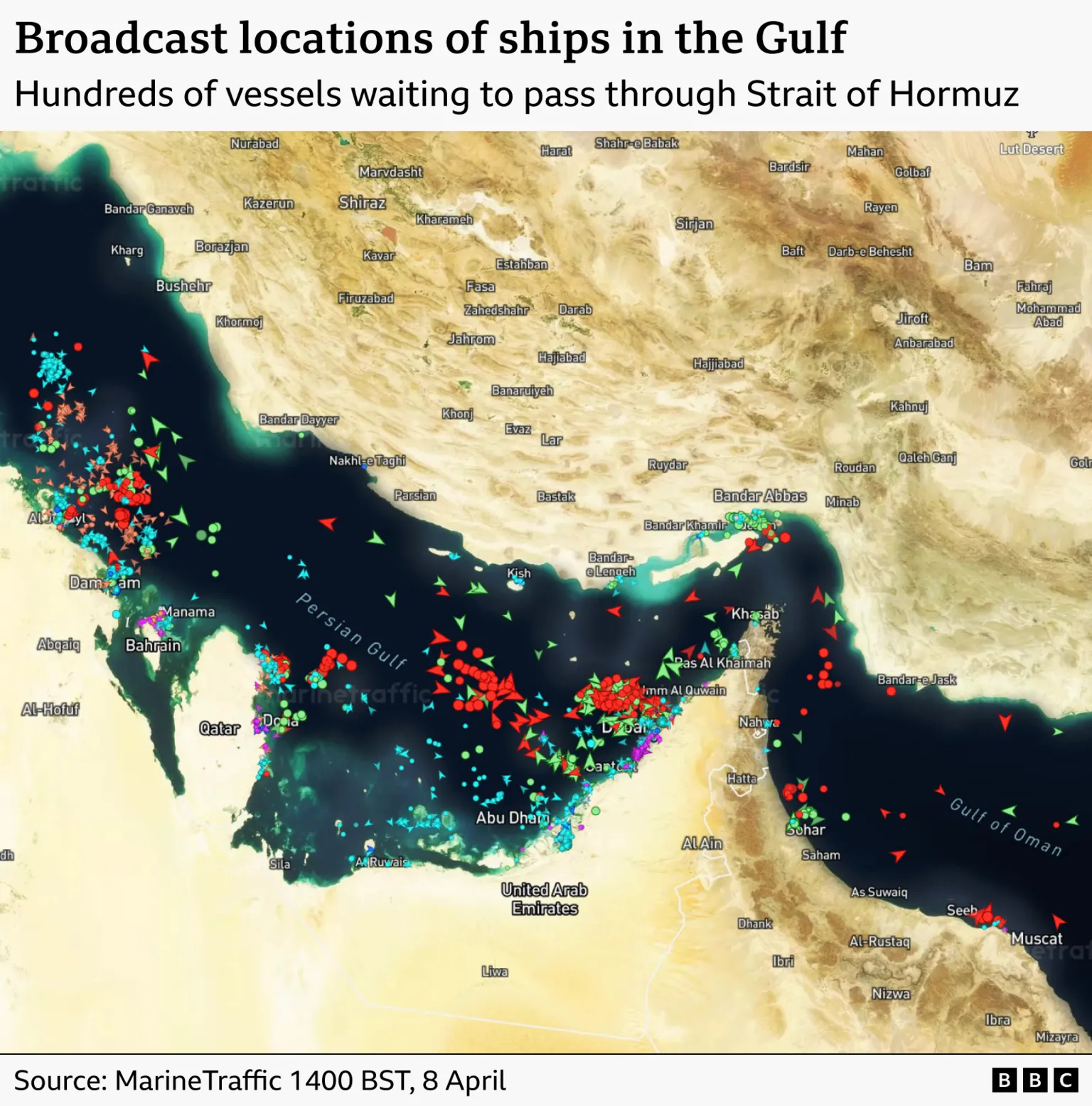
This information is based on BBC Verify’s analysis of ship-tracking data from MarineTraffic.
In comparison, an average of 138 ships passed through the strait daily before the conflict began on 28 February.
It remains unclear whether the three vessels that crossed on Wednesday were permitted under the ceasefire or had prior clearance to make the journey.
"It is still too soon to tell whether this reflects a broader ceasefire-driven reopening or a previously approved exception,"said Ana Subasic from shipping analytics firm Kpler.
"Nothing has really changed yet,"Jensen added, emphasizing that it will take time for crews to feel confident about safe passage.
Richard Meade, editor-in-chief of Lloyd’s List, shared a similar perspective, describing the situation as "very dangerous" for ship owners who continue to face substantial uncertainty.
"We know Iran is essentially still in control of the strait, and the assumption is that ship owners will still need to seek permission from the IRGC [Islamic Revolutionary Guard Corps]… and how that's going to work is still not clear."
BBC Verify’s examination of the routes taken by the three vessels shows them navigating a northern path close to Iran’s coastline, entering its territorial waters. Prior to the conflict, ships typically used a more central, southern route through the strait.

Nearly 800 Ships Remain Stalled
If maritime traffic resumes, Meade anticipates that fully loaded tankers stranded in the Gulf will be prioritized for passage.
"You've had nearly 800 ships stuck in there for several weeks. Most of them are now loaded with cargo, so the priority is going to be to get them out."
The two-week duration of the ceasefire also contributes to uncertainty, according to Niels Rasmussen, a shipping analyst at BIMCO.
"I doubt there will be a large influx of ships into the Gulf… because they do not want to risk being trapped after the two-week window closes."
Another concern is the potential presence of sea mines, noted Thomas Kazakos, secretary general of the International Chamber of Shipping.
"We need to make sure that we have clear confirmation that the safety of navigation for the ships and the seafarers are being agreed,"he told BBC Verify.
Concerns Over Toll Payments
In addition to navigational risks, vessels face uncertainty regarding possible toll payments to Iran as part of the ceasefire arrangement.
"The Iranian negotiation position seems to be that you need to pay a toll to go through the strait and shipping lines will also be hesitant in going down the path of paying that toll,"Jensen explained.
Several countries, including India, Malaysia, and the Philippines, have secured agreements for safe passage of their vessels in recent weeks.
However, toll payments could complicate matters for other nations and shipping companies, as such transactions might violate US sanctions on Iran, potentially leading to repercussions for shipping lines.
James Turner, a shipping lawyer from Quadrant Chambers, clarified the legal implications.
"Sanctions work by criminalising payments to individuals, companies and organisations,"he said.
"A sanction violation occurs when payment is made to anyone on the list, so paying a toll to them would be a violation unless the US makes an exception."
Market Reaction and Outlook
Despite limited vessel movements, markets responded positively in the hours following the ceasefire announcement.
Benchmark Brent crude oil prices declined approximately 13% to $94.80 (£70.73) per barrel, while US-traded oil dropped over 15% to $95.75.
Nevertheless, Meade advises caution regarding expectations for a swift return to normal shipping volumes.
"Oil prices responded because it is a positive directional move, but I don't think it in any way suggests that we're going to see that 20% of global energy flowing back through at normal levels any time soon."
Additional reporting by Tamara Kovacevic



