

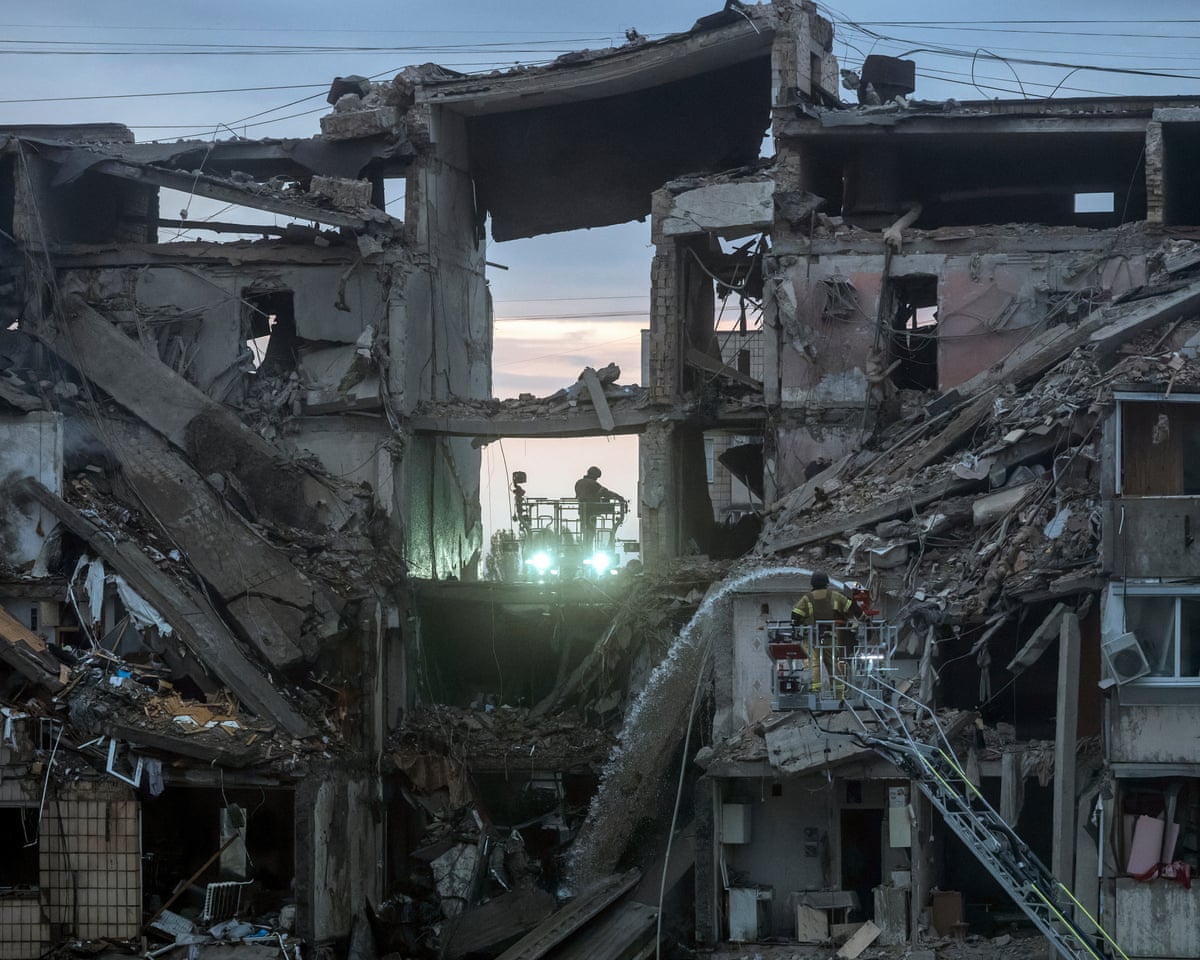
Death toll from Kyiv attacks rises to 21
The death toll from the attacks on Kyiv last night has increased to 21, with 15 fatalities in the capital and six in the surrounding regions, according to various agencies.
Closing summary
Here is a summary of the day's key developments:
At least 22 people were killed and dozens injured in a significant Russian attack on Kyiv, with Ukraine’s President Volodymyr Zelenskyy calling on NATO leaders to make
“strong decisions”and support Ukrainian air defence units.
These remarks come ahead of NATO's annual summit scheduled to begin in Ankara, Turkey. NATO Secretary General Mark Rutte stated that the summit will focus on discussions about defence spending and support for Ukraine.
On the sidelines of the summit, Zelenskyy is expected to meet with former US President Donald Trump, who earlier suggested that ending Russian aggression in Ukraine is
“much closer than people realise”.
For tips, comments, or suggestions, contact jakub.krupa@the.com. The correspondent is also available on Bluesky at @jakubkrupa.bsky.social and on X at @jakubkrupa.
The latest update on casualties indicates at least 22 deaths, with 15 in Kyiv and seven in the wider region.
Earlier, Trump mentioned having had a
“good call”with Russian President Vladimir Putin.
Moscow has indicated that further communications between Putin and Trump are planned in the coming days. When asked on Monday about a potential conversation following Trump’s meeting with Zelenskyy in Ankara, Kremlin spokesperson Dmitry Peskov told reporters that
“they have agreed that their contacts will continue in the near future.”
Rutte was repeatedly questioned about Trump and consistently credited him for increasing defence spending.
This concluded the press conference.
Rutte was also asked about Belarus’s role in the conflict and Zelenskyy’s warnings regarding its involvement. He refrained from detailed comments but stated,
“let’s not be naive about the role Belarus is playing.”
He added,
“They are under huge influence from Russia, from Moscow, so I think what happens in Minsk is very much inspired, to use that word, by Putin.”
Regarding peace talks, Rutte reiterated his usual stance:

“When it comes to the peace process, obviously you need two to tango. Volodymyr Zelenskyy, the President of Ukraine, is willing to sit down with Putin in whatever format to solve this terrible war and word, and obviously, so far Putin has declined to sit down.”
“The Ukrainians are doing better and better on the battlefield, but in the end, I cannot predict what needs to happen for Putin to come to the negotiating table. I think nobody in this room can predict [that].”
He noted that Putin is willing to sacrifice
“crazy”numbers of troops on the battlefield but praised the US for
“breaking the deadlock”in talks, without elaborating further.
When questioned about Ukraine’s shortage of interceptors, which increases vulnerability to Russian attacks on Kyiv, Rutte stated that current delivery mechanisms, including NATO’s Purl scheme, are functioning as intended, specifically praising the US, but acknowledged that more interceptors need to be produced.
Rutte was also asked about Trump’s frustrations and whether the US is causing divisions within the alliance. He denied this, emphasizing that all changes to US force posture in Europe are discussed and agreed upon with allies.
“So, no worries there,”he said.
Regarding US plans to review its force posture and implications for deterring Russian threats, including drones and hybrid provocations, Rutte said these topics will be discussed during the summit’s sessions on Tuesday and Wednesday.
He described changes to the NATO Force Model as
“a planning tool”that have made it more realistic.
“What the US has done, and I think this was important, is assessed again what they can provide to NATO in case of a two theatre conflict, let’s say a conflict in the Indo-Pacific and in the Euro-Atlantic, and as General Grynkewich, the Supreme Allied Commander, has already stated, it makes us stronger that we know what we can count on.
It’s not a massive drawdown in terms of what they will provide, but we now know much more exactly what the Americans can provide, and already the Europeans are backfilling.”
He emphasized that it is
“not sustainable”for Europe to rely solely on the US for its defence and that a balanced partnership is necessary.
Ending Ukraine war 'much closer than people realise,' Trump says after calls with Putin, Zelenskyy
Meanwhile, Donald Trump spoke in the US, stating:
“We are getting much closer than people realise to reaching a deal on ending the warf.
President Putin wants it to end. I will tell you that very strongly. What a good call. And president Zelenskyy actually wants it to end now.
We’re going to be going to NATO, and we’re going to be talking about it, and we, I think, we’re going to get it, I think we’re going to get it ended.”
He later added,
“we are getting close to getting it done.”
Rutte was also questioned about Turkey’s crackdown on public life, including actions against journalists and activists. He responded cautiously, stating,
“when it comes to democracy, democracy is more than elections,”but also highlighted the importance of
“free media … and for people to be able to organise demonstrations if they so choose.”
He stressed the importance of media access, saying,
“when it comes to media, it is very important for that media can attend major events in person.”
When asked about the risks if the alliance does not increase support as requested, Rutte expressed confidence that this is not a genuine risk and noted several areas where
“the Europeans are stepping up,”along with the Canadians.
Rutte was also asked about reports that British F-35 fighter jets intercepted a Russian plane that flew close to the HMS Prince of Wales aircraft carrier at low altitude in the Norwegian Sea. He commended the British military for
“doing exactly what needed to be done,”and criticized Russia’s
“reckless”actions.
Russia's strikes on Kyiv show Putin is 'desperate,' NATO's Rutte says
Regarding last night’s strikes on Kyiv, Rutte described them as evidence that Putin is
“desperate,”noting that
“Ukrainians are doing well on the battlefield.”
He stated that Ukraine has been effective in targeting the Russian economy and conducting deep strikes, as well as preventing significant Russian advances.
He condemned the attacks, saying,
“What happened last night is an indiscriminate attack on innocent civilians, on infrastructure, cities, … with people getting killed,”but added,
“this is not the way can ever win this war.”


