
June Heatwave Forces Early Closure of Eiffel Tower
On 23 June, one of France's hottest days on record saw residents painting white chalk on their windows to block out the sun. Paris's iconic Eiffel Tower closed earlier than usual due to the intense heat.
In Ergué-Gabéric, Brittany, temperatures near 40°C overwhelmed an electric transformer, causing it to malfunction. This incident initially left over 100,000 people without power.
Local authorities described the event as "heat related." Videos circulating on social media showed smoke rising from the affected transformer. A spokeswoman for the power company RTE confirmed to the BBC that the footage depicted one of their facilities.
The day before the malfunction, RTE had issued a statement assuring there was "no concern" about electricity availability across its network for the summer.
Technology Has Temperature Limits Like Humans
Just as people have limits to tolerate heat, so does technology. Electrical and telecommunications equipment, as well as railway signalling cabinets, can fail during heatwaves. Extreme temperatures can even trigger false alarms on security systems.
Heat-related technological issues are a significant concern. For example, six NHS trusts in England declared critical incidents last week after hot weather adversely affected their IT systems, scanners, and cancer and laboratory equipment.
With climate change causing more frequent and intense heatwaves, engineers are increasingly adapting infrastructure to withstand higher temperatures.
Impact on Electricity Networks and Generation
"Anything to do with the electricity network – the power lines, the interconnectors and transformers – they all struggle to keep themselves cool enough," explains Iain Staffell at Imperial College London. "It reduces the efficiency of everything."
Staffell and his team estimate that at 40°C, gas-fired power stations produce roughly 10% less output compared to at 20°C.
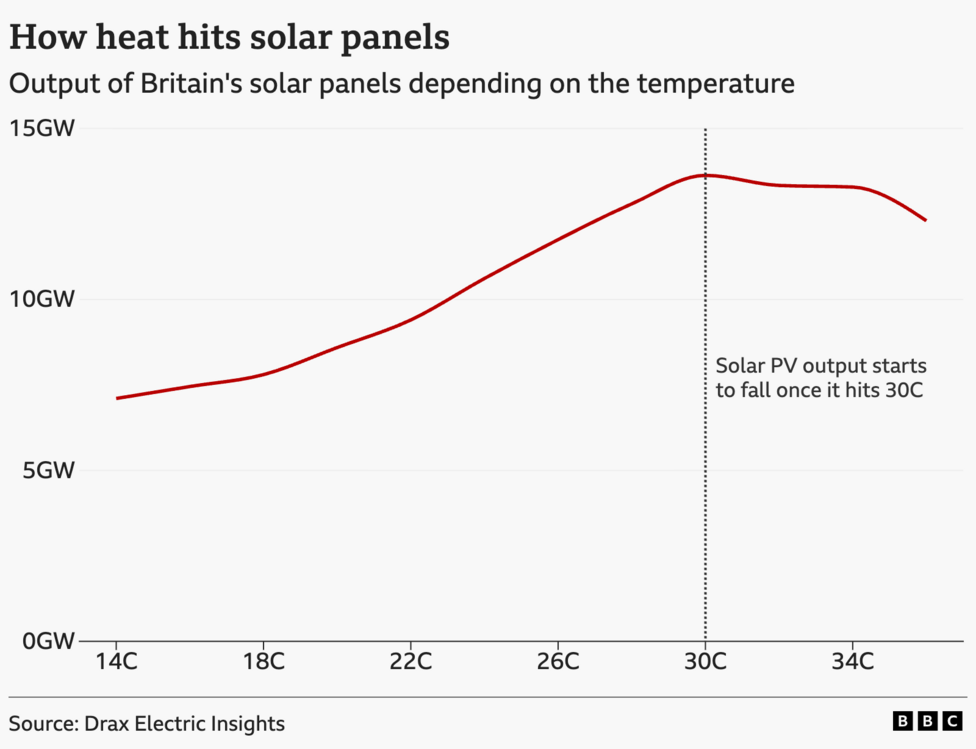
The efficiency of solar panels also declines as temperatures rise, although newer generations of panels have reduced this effect.
Data analyzed by Staffell and colleagues, shared with the BBC, shows that in Great Britain, solar output plateaus and then slowly decreases once temperatures exceed 27°C.
"Once the UK gets above 27C, our solar output plateaus and starts to slowly fall [as temperatures continue to rise]," says Staffell.
Nevertheless, prolonged sunny conditions during heatwaves can still increase solar energy production compared to cloudier periods before the heatwave, as noted by comparison website Utility Bidder last week.
Beyond generation facilities, power lines across the country face challenges during heatwaves. These metal cables expand in heat, causing them to sag. The flow of electricity through them generates additional heat.
"There is a limit to how much droop you can allow," says Simon Hogg, a consultant and professor emeritus at Durham University.
If sagging cables come into contact with trees or buildings, it can cause accidents or power failures. This was the cause of a massive blackout in North America in 2003.
To mitigate this risk, operators reduce the electricity load on power lines during heatwaves, which limits supply.
The Energy Networks Association, an industry body, states that UK energy networks are implementing climate resilience strategies. Hogg describes the UK's ability to cope with heatwaves as "a success story."
Heat-Related Failures in Recent Years
Despite these efforts, heat has caused problems in various systems recently. During the historic July 2022 heatwave, temperatures exceeded 40°C in some UK areas.
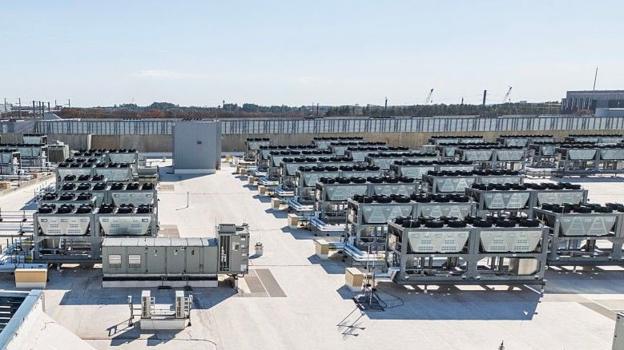
Overheating equipment led to power cuts affecting thousands. In London, data centres for Guy's and St Thomas' hospitals failed, resulting in cancelled operations.
A report published the following year detailed the events, including this moment at 13:30 on 19 July:
"Attempts to cool the St Thomas' datacentre begin by hosing cooling units with cold water, but are hampered by difficulty connecting the hose to a water supply."
Less than an hour later, the datacentre temperature reached 36.2°C. Conditions were worse at the nearby Guy's datacentre, where air conditioners failed and temperatures soared to 50.3°C.
Heat-Induced Glitches in Security and Electronics
Hot weather can also cause unusual glitches. Security alarm motion sensors sometimes misinterpret sudden temperature changes as movement, triggering false alarms, according to security firms.
Nigel Linge, professor emeritus at the University of Salford, explains that computer processors and electronic circuit boards are designed to handle elevated temperatures but can suffer damage beyond certain thresholds.
"Above certain thresholds, tiny metal connections on circuit boards can expand and eventually form tiny cracks," he says.
Thermal noise, which increases data errors (bit errors) in computer and telecoms equipment, also rises with heat. While many errors can be corrected, extreme heat increases the risk of failures.
"In extreme heat, the thermal noise signature goes up," says Linge.
Metal telecoms cabinets outdoors can become very hot on sunny days. Linge has observed operators placing additional shielding, such as umbrella-like covers, over cabinets at exposed sites to reduce heat exposure.
Cooling Innovations for Railway and Telecoms Equipment
Metal cabinets housing railway signalling equipment can reach temperatures exceeding 70°C during heatwaves.
Last year, Southeastern rail company began trialling liquid-based cooling technology inside these cabinets, which operates without electricity.
William Webb, former Ofcom director and current CEO of consultancy Commcisive, notes efforts to insulate or ventilate telecoms cabinets as temperatures rise and more heat-generating equipment is installed.
"I don't think it's actually prevalent or particularly likely [that communications systems will suffer widespread problems due to overheating]," Webb says.
While some reports suggest extremely hot weather can reduce broadband speeds, Webb points out that many households have broadband connections significantly faster than required, so any capacity reductions might not be noticeable.

Preparing for Increasingly Harsh Conditions
Climate change means that the UK's infrastructure and essential technology will face more severe conditions in coming years.
The independent Climate Change Committee warned in a May report that outages from heat-induced power cuts could disrupt digital payments, transport, and public services, potentially costing billions.
Improving ventilation, installing fans, and upgrading electrical equipment are among the adaptations needed. Expanding the capacity of electricity networks would also provide greater flexibility during hot days.
"There's going to be more and more summers like this," says Staffell. "We are going to have to adapt."


