Dispute Over Druzhba Pipeline Halts EU Loan to Ukraine
A contentious disagreement involving Hungary and Slovakia against Ukraine is delaying a vital €90bn (£77.95bn) European Union loan to Ukraine.
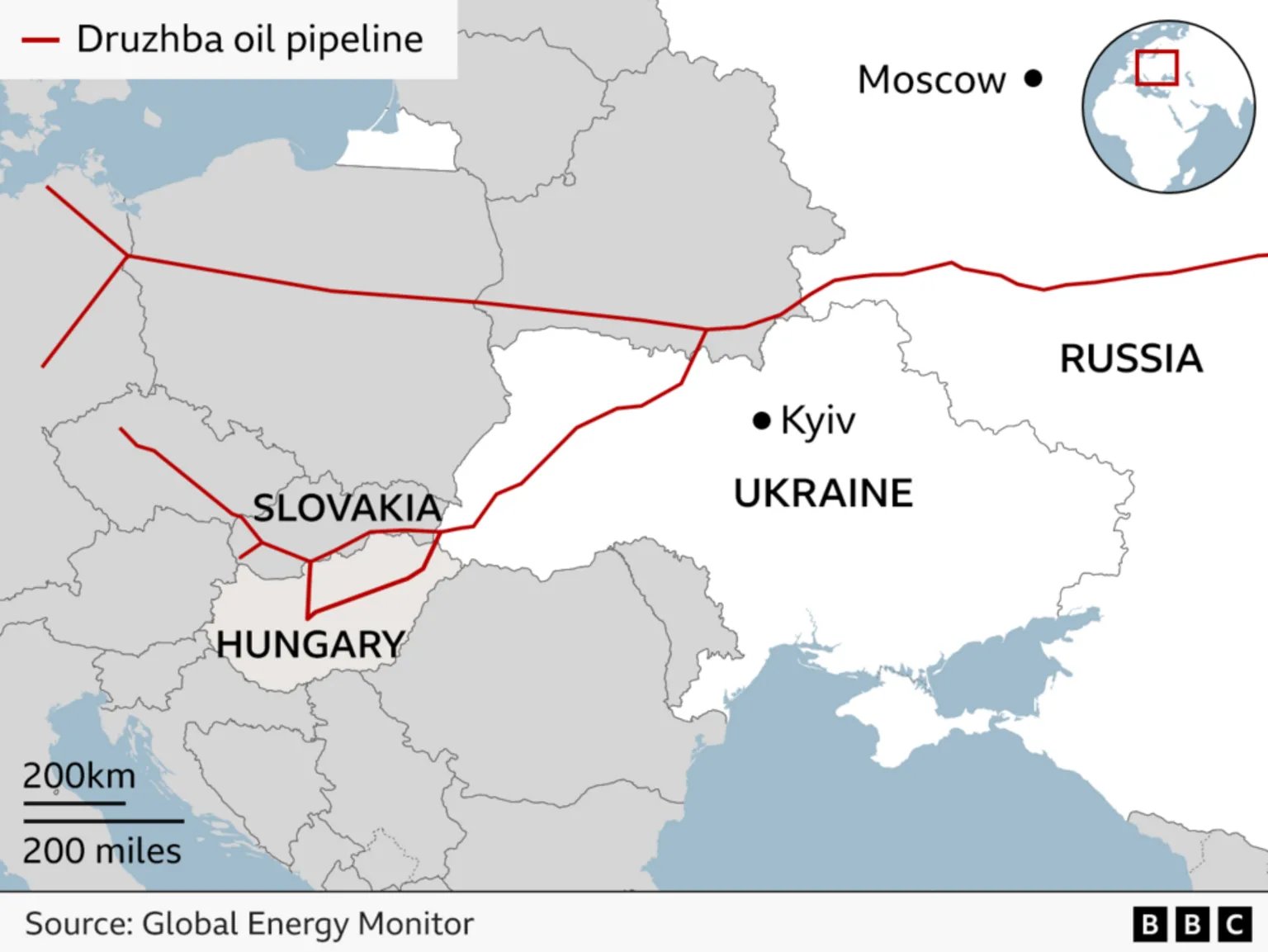
No oil has been transported through the Druzhba (Friendship) pipeline, which runs from Russia to Hungary and Slovakia via Ukraine, since the major oil hub at Brody in western Ukraine was damaged during a Russian attack on 27 January.
Ukraine states it requires an additional six weeks to repair the damage and resume oil flow, while Budapest accuses Kyiv of deliberately delaying the process as retaliation for Hungary's pro-Russian and anti-Ukrainian stance.
This dispute highlights how one or two countries can obstruct EU decision-making. It also reveals fuel supply issues in Hungary and Slovakia, which have resisted following other EU members in reducing dependence on Russian oil since 2022.
Damage to Brody Pumping Station and Its Importance
The Brody pumping station, situated in Ukraine's western Lviv region, is critical for the transit of Russian oil to Hungary and Slovakia.
Satellite images obtained by the BBC indicate that the Russian strike on 27 January damaged a key component—a large oil storage tank essential for maintaining pipeline pressure and operation.
The photographs appear to show the tank smouldering after the attack, suggesting a fire burned for several days.
This tank is the largest oil tank in Ukraine, with a capacity of 75,000 cubic meters.
Ukrainian energy expert Henadiy Ryabtsev describes the damage to the Brody pumping station as severe and potentially extending beyond the oil tank itself.
He explained that the intense heat from the fire may have harmed other systems at Brody, including pumps and the pipeline infrastructure.
"The oil was on fire for about a week, which means that during that time everything around it was affected by the high temperature,"
he told the BBC.
Ukraine's Position on Repairs and Resource Constraints
The Ukrainian government asserts that the damage at Brody is significant and that Ukraine lacks the resources to expedite repairs.
"This is a technical issue,"
Ukrainian Foreign Ministry spokesman Heorhy Tykhy told the BBC.
"Our infrastructure is being damaged every day... Ukraine repairs all of that, but we do not have unlimited resources. We are in a full-scale war, which Hungary decides to ignore for some reason,"
Mr Tykhy added.

To accelerate repairs, the EU has offered Ukraine technical support and funding. European Commission President Ursula von der Leyen stated,
"The Ukrainians have welcomed and accepted this offer. European experts are available immediately,"
in a message posted on X.
Zelensky's Reluctance and Hungary's Accusations
Earlier, President Volodymyr Zelensky expressed reluctance to restore the pipeline.
"I'll be honest, I wouldn't restore it... because it's Russian oil,"
he told journalists on 5 March.
The Hungarian government accuses Ukraine of politically motivated delays in restoring oil flow through the pipeline. Hungarian Prime Minister Viktor Orban maintains close economic and political ties with Moscow and openly expresses his opposition to Volodymyr Zelensky. Hostility toward Ukraine is a key element of the ruling Fidesz party's re-election campaign ahead of the 12 April vote.
Hungary's Claims on Pipeline Integrity
Hungary bases its argument that the pipeline remains intact on several points.
"We can say this with a clear conscience: the pipeline itself has not been damaged,"
Zsolt Hernadi, CEO of the Hungarian energy company MOL, told the ATV channel on 2 March.
"Ukrainian colleagues …asked us to quickly take over this crude [from the tank] to prevent further escalation and avoid an even larger fire. We took over 35,000 tons of Ukrainian-origin crude, which flowed through the Druzhba pipeline without issue. Oil continued to arrive through the pipeline for at least two to three days.
Later, when we asked why the pipeline had still not restarted, we were told that no decision had yet been made regarding the restart. And the absence of a decision can hardly be described as a technical issue."
A study commissioned by MOL from a US company, excerpts of which have been reviewed by the BBC, concluded that pumping oil from the burning tank would be "unlikely" to damage the underground pipeline, which is robust and designed to withstand extreme temperatures.
Contrasting Expert Opinions on Damage
Conversely, András Rácz, a security analyst at the German Council on Foreign Relations, offered a different perspective.
"The superheated oil (from the burning tanks) cooked the system from inside, damaging the sensors, the valves, all the safety systems inside the pipeline,"
he told the BBC, citing discussions with Hungarian and Ukrainian pipeline engineers.
"The pipe itself is intact, but it cannot be operated safely because everything inside needs to be replaced or at least double checked to assess the extent of the damage."
Challenges Faced by Ukrainian Repair Teams
Ukrainian engineers working on repairs can only operate during daylight hours due to nightly air raids. Additionally, there is a shortage of experts caused by ongoing damage from Russian attacks on Ukraine's energy infrastructure.
"I think its very promising that the Ukrainian side is now showing more transparency,"
said András Rácz.
Hungary's Alternative Oil Supplies and Refining Limitations
Meanwhile, Hungary has started receiving non-Russian seaborne Brent crude oil from Norway, Saudi Arabia, and Libya through the Adria pipeline from Croatia.
However, MOL refineries lack the necessary equipment to process non-Russian oil, which has a lower sulphur content.