

Overview of the Conflict
The war in Ukraine has entered its fifth year. In recent months, Russian forces have gradually expanded their territorial control, primarily in eastern Ukraine, while continuing air strikes on Kyiv and other cities.
Ukrainian President Volodymyr Zelensky has reported approximately 55,000 Ukrainian soldiers killed. The BBC has verified nearly 160,000 fatalities among Russian combatants.
Four years following Russia's full-scale invasion, the following provides an analysis of the current situation on the ground in Ukraine.
Russia Advances in Eastern Ukraine
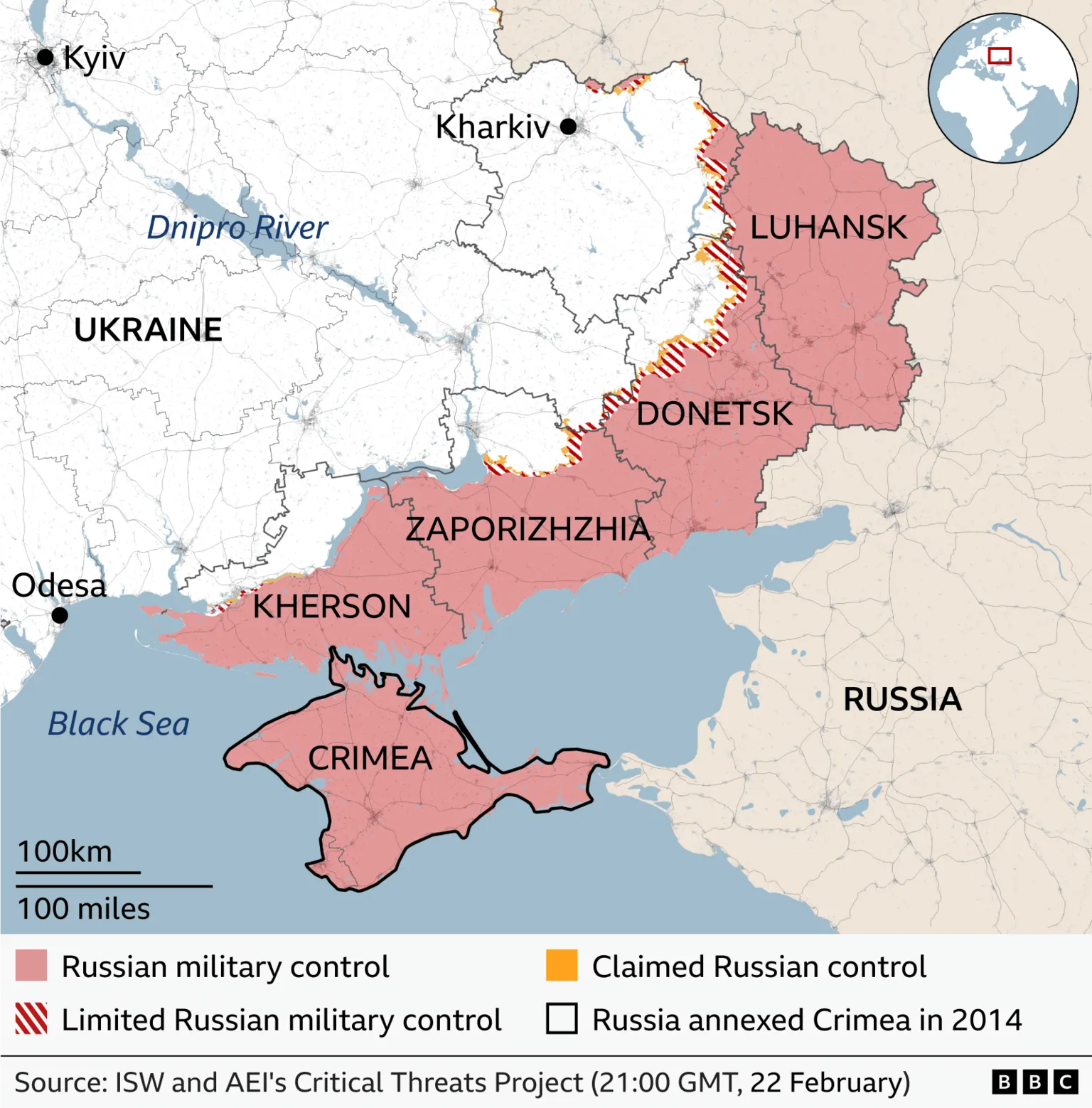
According to analysts at the US-based Institute for the Study of War (ISW), Russia captured about 4,700 square kilometers (1,800 square miles) of territory in 2025, roughly twice the size of Moscow city, although Russia claims to have taken 6,000 square kilometers.
In eastern Ukraine, Russian military operations have progressed incrementally through the expansive fields of the Luhansk and Donetsk regions—collectively known as the Donbas—surrounding and overpowering villages and towns.
Russia aims to secure full control over the Donbas as well as the Zaporizhzhia and Kherson regions to the west. Following the invasion, Russia conducted referendums to annex these regions, similar to the 2014 annexation of Crimea, but has never fully controlled them.
Evidence suggests that Elon Musk's decision in early February to deny Russian forces access to his Starlink satellite internet service has benefited Ukraine. Ukraine requested this action amid concerns that Starlink was facilitating increasingly precise Russian attacks, including instances where Russian units were linked to drones via real-time video feeds to guide strikes.
In certain sectors along the extended front line, particularly east of Zaporizhzhia city, Russian forces appear to have retreated.
Ukraine anticipates that any territorial gains will enhance its negotiating position.
This follows a US-backed peace proposal introduced in November, which suggested Ukraine could cede control of all of Luhansk, Donetsk, and Crimea, along with Russian-occupied areas of Zaporizhzhia and Kherson, to Moscow.
Under this plan, Ukrainian forces would withdraw from parts of Donetsk still under their control, which would become a demilitarized zone under de facto Russian control. Russian forces would withdraw from small Ukrainian territories outside these regions.
"Ukraine will not hand over the Donbas in exchange for peace," Zelensky has stated consistently, cautioning that such a concession could serve as a base for future Russian attacks.
Key Towns Under Attack
A recent ISW report describes a "fortress belt" extending 50 kilometers (31 miles) through western Donetsk.
"Ukraine has spent the last 11 years pouring time, money, and effort into reinforcing the fortress belt and establishing significant defence industrial and defensive infrastructure," the report states.
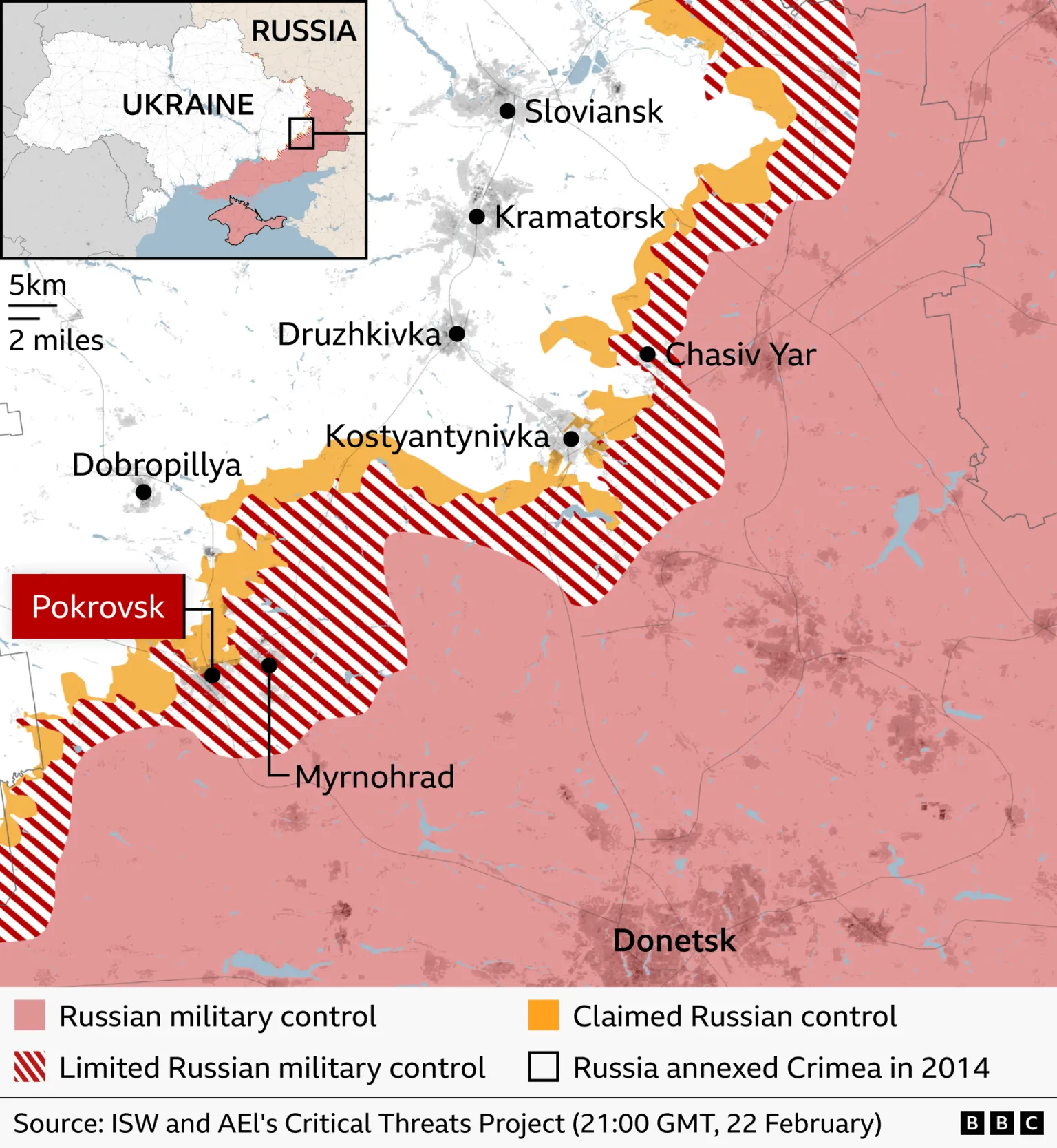
A Russian summer offensive near the eastern town of Pokrovsk achieved rapid advances north of the town, with recent progress within Pokrovsk itself and east of nearby Kostyantynivka.
Once a critical logistics hub for Ukraine's military, Pokrovsk is now largely in ruins.
Russian officials have claimed capture of Pokrovsk (known in Russian as Krasnoarmeysk), which includes a major road and railway junction connecting northern Donetsk with western cities such as Dnipro.
However, Ukraine maintains control over northern parts of the town.
The fall of Pokrovsk would represent Russia's largest battlefield victory since seizing Avdiivka—approximately 40 kilometers (25 miles) east—in early 2024, potentially enabling Moscow to advance north toward Kramatorsk and Sloviansk, the two largest Ukrainian-controlled cities in Donetsk.
While Ukraine is losing ground, ISW notes that Russia has attempted to capture Pokrovsk—a town of about 23 square kilometers—for nearly two years, and that the cities within the fortress belt are significantly larger.
The ISW suggests it could take Russian forces another two years to seize the remainder of Donetsk at considerable cost.
Russian Advances North of Kharkiv
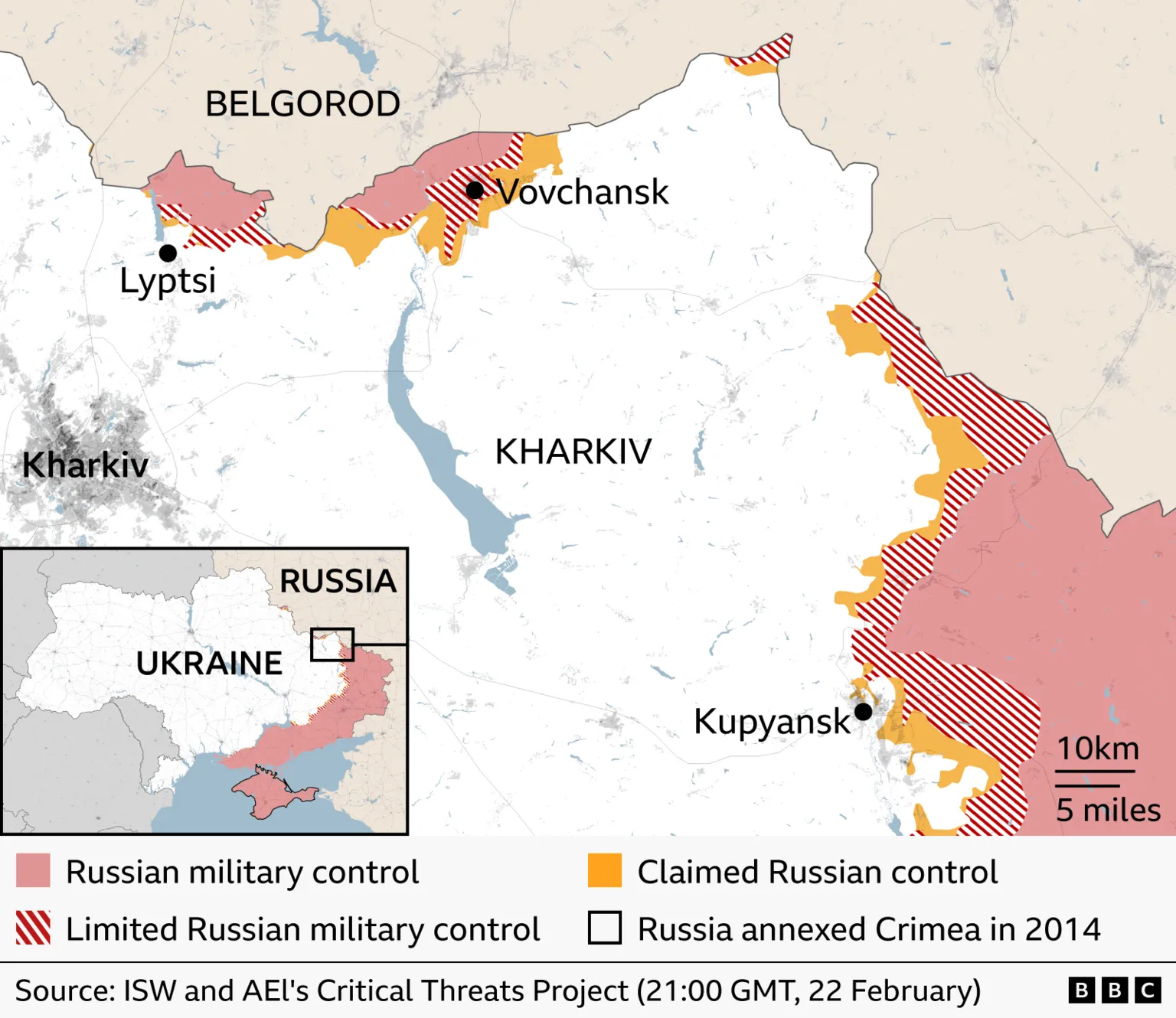
Further north along the main front line, Russia has sought to advance on Kupyansk, which analysts believe could enable encirclement of northern Donetsk.
Russian forces have also attempted to push Ukrainian troops back from the border with Russia's Belgorod region.
ISW analysts indicate that Russia aims to establish a buffer zone inside Ukraine's northern borders and position artillery within range of Kharkiv, Ukraine's second-largest city.
Recently, Russian forces gained limited control over a land corridor south of Vovchansk, bringing them closer to this objective.
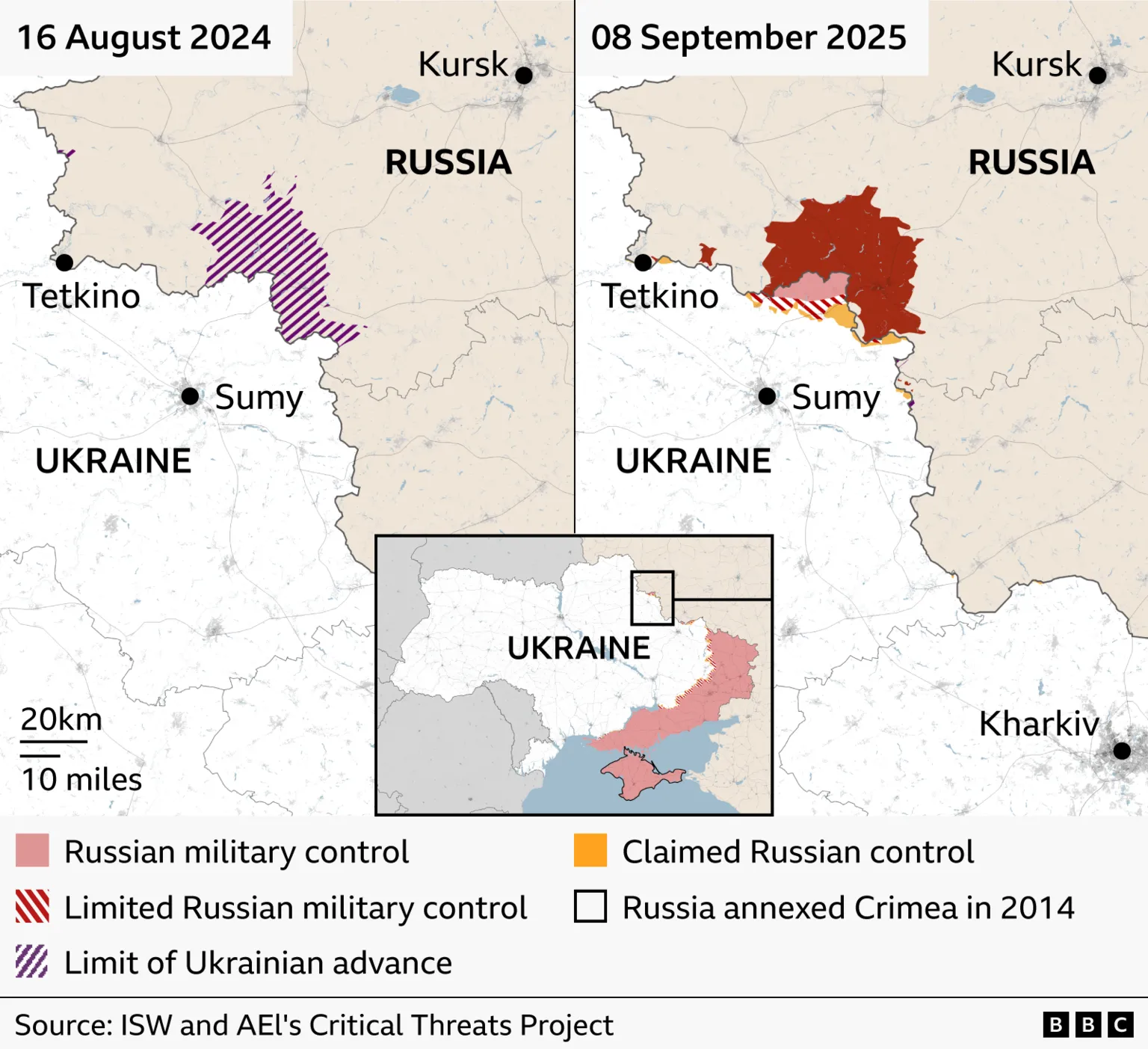
Russian President Vladimir Putin has expressed the desire for this buffer zone to protect Russia, following Ukrainian territorial gains in Kursk in summer 2024. Russian forces, aided by North Korean troops, eventually expelled Ukrainian forces from Kursk.

Alongside the counteroffensive in Kursk, Ukraine has conducted air strikes deep inside Russia, including an attack involving 100 drones targeting nuclear-capable long-range bombers.
The Russian Defence Ministry confirmed attacks in five Russian regions—Murmansk, Irkutsk, Ivanovo, Ryazan, and Amur—reporting damage to planes only in Murmansk and Irkutsk, with other attacks repelled.
Most recently, on 22 February, an overnight Russian attack targeted Kyiv and surrounding areas, with dozens of strikes focusing on energy infrastructure.
Prior to this, on 11 February, Ukrainian drones launched a significant strike on Volzhsky in Russia's Volgograd region.
Deep strikes are a critical component of the conflict, with Ukraine aiming to disrupt Russia's war economy and slow front-line advances.
Conversely, Russia has targeted Ukrainian infrastructure, particularly energy facilities such as substations and power plants.
These attacks have resulted in fatalities and have left tens of thousands of Ukrainians without electricity, running water, or heating during some of the coldest winter months.
Ceasefire Negotiations
Hostilities paused for a week following a request from US President Donald Trump to Russian President Vladimir Putin.
Trump has led efforts to negotiate an end to the war, and Zelensky stated in February that the US aims to conclude the conflict by June.
However, the latest round of talks between Russia, Ukraine, and the US in Geneva, Switzerland, ended without a breakthrough on 18 February.
Some progress was made on "military issues," including front-line location and ceasefire monitoring, according to a Ukrainian diplomatic source.
White House spokeswoman Karoline Leavitt later commented that "there was meaningful progress" on both sides and an agreement to "continue to work towards a peace deal together."
Nonetheless, an agreement on territorial issues—essential for any ceasefire—remains elusive, with Moscow and Kyiv maintaining divergent positions.
Three Years of Conflict
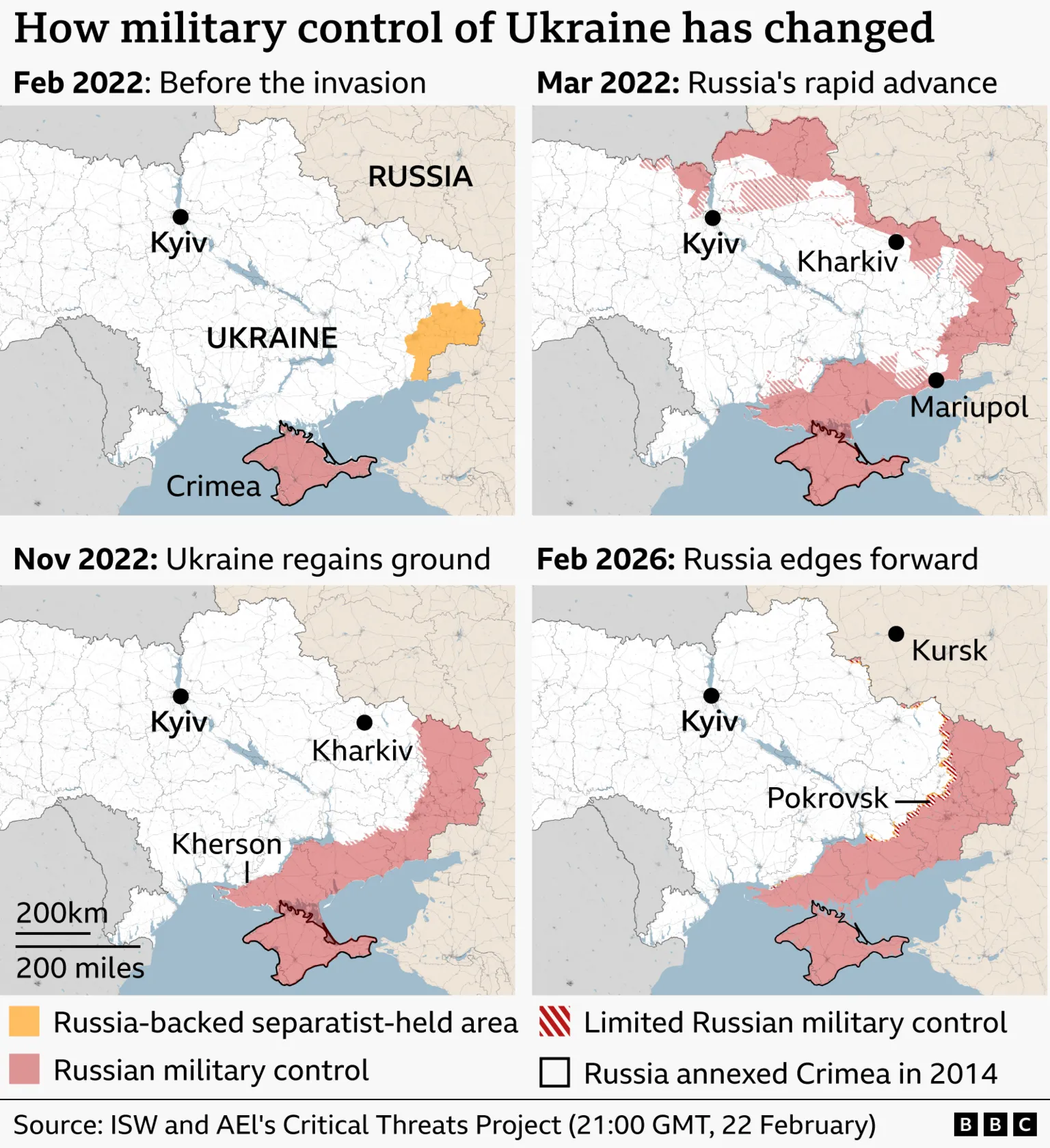
Russia's full-scale invasion commenced with widespread missile strikes across Ukraine before dawn on 24 February 2022.
Russian ground forces advanced rapidly, seizing large areas and reaching Kyiv's suburbs within weeks.
Russian troops bombarded Kharkiv, secured territory in eastern and southern Ukraine up to Kherson, and besieged the port city of Mariupol.
However, they encountered strong Ukrainian resistance nationwide and faced logistical challenges, including shortages of food, water, and ammunition among poorly motivated troops.
Ukrainian forces quickly deployed Western-supplied weapons such as the NLAW anti-tank system, which proved effective against Russian advances.
By October 2022, the situation shifted significantly: after failing to capture Kyiv, Russia withdrew entirely from northern Ukraine. The following month, Ukrainian forces recaptured Kherson in the south.
Since then, fighting has concentrated in eastern Ukraine, with Russian forces gradually gaining ground over many months.
Both Kyiv and Moscow regularly publish estimates of enemy losses but rarely disclose their own.
Six months ago, Ukraine's interior ministry recorded over 70,000 people officially missing—both soldiers and civilians—though detailed breakdowns are unavailable and actual figures may be higher. Zelensky reported 55,000 soldier fatalities as of early February.
By Dominic Bailey, Mike Hills, Paul Sargeant, Chris Clayton, Kady Wardell, Camilla Costa, Mark Bryson, Sana Dionysiou, Gerry Fletcher, Kate Gaynor, and Erwan Rivault
About These Maps
The maps indicating areas under Russian control are based on daily assessments from the Institute for the Study of War and the American Enterprise Institute's Critical Threats Project.
Given the fluid nature of the conflict, changes may occur that are not immediately reflected in the maps.


