Morning opening: New Russia sanctions on hold
The European Union is increasingly unlikely to finalize the 20th package of sanctions against Russia before the fourth anniversary of the full-scale invasion of Ukraine, as Hungary continues to block the package.
EU foreign policy chief Kaja Kallas acknowledged this morning that
"there is not going to be progress”on the sanctions today due to Budapest's opposition.
“We are doing our utmost to have the sanctions package … through … and we are looking for ways how we can do it. But as we have heard some very strong statements from Hungary, … I don’t really … see they are going to change this unfortunately today,”she said.
Hungary opposes the proposed sanctions and the payment of the €90bn loan for Ukraine amid an escalating dispute over oil transit via the Druzhba pipeline.
Hungarian foreign minister Péter Szijjártó stated on Sunday that
“until Ukraine resumes oil transit to Hungary and Slovakia via the Druzhba pipeline, we will not allow decisions important to Kyiv to move forward.”
This standoff occurs just six weeks before Hungary’s parliamentary election, which could end the 16-year tenure of pro-Russian prime minister Viktor Orbán.
Orbán, currently trailing opposition leader Péter Tisza by 10 points, has increasingly adopted anti-Ukrainian rhetoric, alleging a conspiracy between Kyiv and Brussels aimed at removing him from office and warning of the risk of war expanding to Hungary.
The EU’s failure to agree on the new sanctions package would be politically embarrassing as leaders, including European Commission president Ursula von der Leyen, plan to visit Kyiv on Tuesday to mark the invasion’s anniversary.
I will provide key updates from Brussels and other European stories, including Rob Jetten’s expected swearing-in as Dutch prime minister, Finland’s Alexander Stubb’s meeting with France’s Emmanuel Macron in Paris, and the European Parliament’s discussions on the future of the EU-US trade deal.
It is Monday, 23 February 2026. I am Jakub Krupa, and this is Europe Live.
Modern warfare has dramatically changed ways in which wars are fought, Zaluzhnyi says
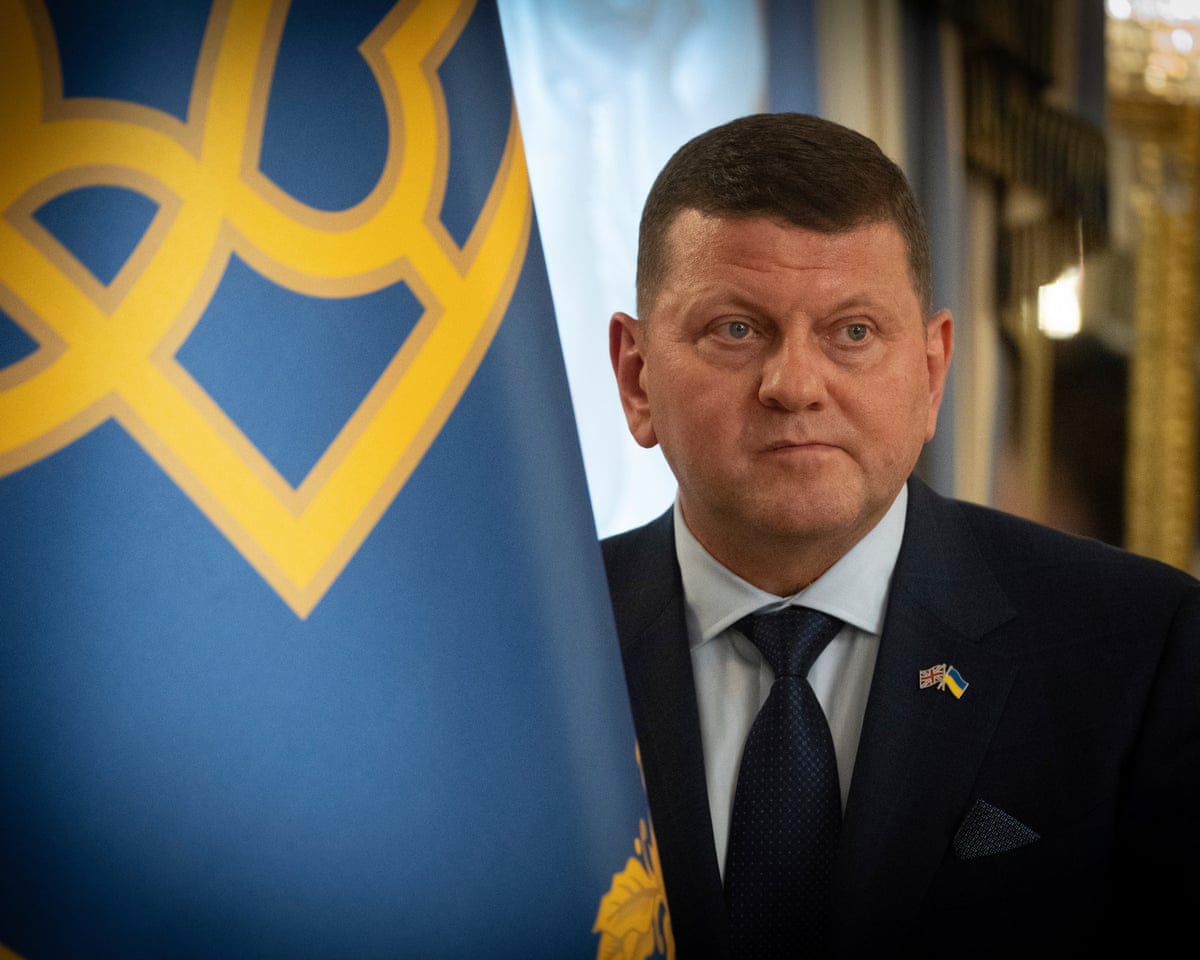
Former Commander-in-Chief of Ukraine’s Armed Forces and current Ukrainian ambassador to the UK, Gen Valerii Zaluzhnyi, spoke about the evolution of warfare in a rare public appearance at Chatham House in London, a day before the fourth anniversary of Russia’s invasion.
Zaluzhnyi emphasized that nuclear weapons are not as decisive as commonly perceived, describing them as
"a fig leaf of Atlas’s body, disguising the true capabilities of the one who possesses it."
He noted that ballistic missiles are the most expensive weapons in a war of attrition, requiring costly defense systems despite their high production costs.
Zaluzhnyi discussed the limited role of air forces in the conflict, highlighting that Russia’s theoretical air superiority is constrained as its aircraft rarely penetrate deep into Ukrainian territory due to the risk of being shot down, which has significantly altered their operational role.
He stressed that any country engaged in war must adopt a
"war footing,"which remains Ukraine’s greatest challenge.
Ukraine has successfully mobilized in this manner, with Zaluzhnyi stating,
"we experience the consequences of this move every day and every night,"describing Ukraine as an
"almost unstoppable military steamroller."
He criticized traditional defense industrial models with centralized factories and long supply chains as outdated, creating vulnerabilities and lacking flexibility, particularly exposing Ukraine’s energy sector.
"Protecting energy facilities becomes as important as protecting territory,"he said.
Zaluzhnyi observed that ultra-expensive precision weapons, which were game changers in the 20th century, have been supplanted by cheap, mass-produced weapons of attrition that deplete rapidly.
This shift alters strategic calculations and raises questions about the ability of even resource-rich countries to sustain prolonged conflicts against smaller adversaries.
He emphasized the importance of economic resilience and energy supplies to maintain military potential amid constant tensions, complex logistics, and accelerated technological change.
Modern warfare has dramatically changed ways in which wars are fought, Zaluzhnyi says
Zaluzhnyi elaborated that modern and future warfare challenges previous conceptions of combat, integrating unmanned and robotic systems, distributed sensor networks, electromagnetic solutions, and artificial intelligence.
He described a
"robotic kill zone"extending at least 25 kilometers from the frontline, with deeper strikes targeting logistics.
The nature of troop mobilization and management has evolved, requiring fewer personnel as technological superiority becomes paramount.
"Technological evolution towards the robotisation of warfare has offered an alternative that allows for the preservation of combat effectiveness while radically reducing human involvement and as a result, human losses,"he said.
Opening his speech, Zaluzhnyi stated his intent to communicate insights not only to policy experts but also to civilians in bomb shelters in Ukraine, aiming to provide an accurate understanding of the war’s progression without sensationalism.
EU's message on US trade is 'deal is a deal,' spokesperson says
Regarding EU-US trade relations, EU spokesperson Olof Gill emphasized that
"a deal is a deal,"underscoring the obligation of both parties to honor their commitments.
"The most important thing in there, I would say, is five words: ‘a deal is a deal’. Both sides have agreed to and indeed have a duty to honour their part of the agreement we made with the US.
So now we are simply saying to the US, it’s up to you to clearly show to us what path you are taking to honour the agreement."
EU interested in 'returning to stability and predictability' in trade with US
Gill explained that the EU is engaging with relevant interlocutors within the EU and globally to understand the implications of a recent US Supreme Court ruling affecting trade.
He stated that clarity on the US’s intended measures is necessary for the EU to assess and decide on next steps.
"We’re interested in is returning to a situation of stability and predictability as quickly as possible.
We have a framework for doing that, which is the EU-US joint statement, and we look forward to our American counterparts explaining to us precisely what is happening so that we can return to a situation where companies in the EU and in the US can continue doing what they do best trade, invest, create jobs, create prosperity on both sides of the Atlantic."
EU needs clarity on US trade after supreme court ruling
Gill further noted that full clarity on the recent developments is the minimum requirement for the EU to make an informed assessment and determine next steps.
He mentioned ongoing engagements with the US and upcoming discussions involving EU trade commissioner Maroš Šefčovič with G7 trade ministers, EU ambassadors, and the European Parliament’s trade committee.

"So we’re very clear about what needs to happen here. The US needs to tell us precisely what is going on. Our intention is to honour and continue implementing the, aspects of the agreement we made with the United States on our side. And by the same token, we expect them to be able to tell us precisely what is happening in order that they can continue implementing their side of the agreement."
Energy spokesperson Anna-Kaisa Itkonen supported Ukraine in its dispute with Hungary over the Druzhba pipeline, stating that Russia caused the damage and Ukraine is committed to repairs.
"Ukraine has committed to repairing the pipeline, and the decision on the timeline is for them to make,"she said.
Hungary's block of €90bn loan for Ukraine would breach principle of loyal cooperation, EU says
European Commission chief spokesperson Paula Pinho criticized Hungary’s attempt to block the €90bn loan for Ukraine, emphasizing that the decision was approved by the European Council and should be respected.
"There was only ‘one and only condition that three member states would not participate financially in the programme.’
This condition has been met, and therefore, we expect all leaders to honour their commitments. And not respecting those … would be a breach of loyal cooperation,"she said.
She added that the EU expects all leaders, including Prime Minister Orbán, to abide by their political commitments.
Merz says he expects Trump to respect EU-US deal struck last year
German Chancellor Friedrich Merz expressed expectations that Donald Trump will honor the tariff deal reached last July at Trump’s Scottish golf course.
Amid global confusion over the implementation of a new 15% US tariff announced on Saturday, Merz’s spokesperson stated:
"We expect the US to follow the Supreme Court of the US decision with clear policies,"he said.
The EU on Sunday urged the US to honor the July agreement, reiterating
"A deal is a deal."
The new 15% tariff rate, effective from tomorrow, is authorized under the 1974 Trade Act, distinct from the unilateral tariffs imposed last year, which require congressional approval after 150 days.
The European Commission’s press briefing is scheduled to address this issue.
European parliament set to pause implementation of EU-US trade deal amid uncertainties over tariffs
The European Parliament plans to pause the ratification process of the trade deal with the US following the recent Supreme Court ruling that struck down certain tariffs as illegal.
Bernd Lange, chair of the International Trade Committee, convened an extraordinary meeting on Monday to address the situation.
Željana Zovko, lead trade negotiator for the European People’s Party group, stated that
"we have no other option"but to delay approval to seek clarity.
Russia's Putin 'not winning war' in Ukraine, Finland's Stubb says
Finland’s President Alexander Stubb, speaking in French, addressed Arctic security concerns and the ongoing war in Ukraine.
He said that Putin
"is not winning the war, but he is not [ready to] make peace"either.
Stubb described the war as a disaster for Russia, with significant soldier losses and economic failure, and urged continued support for Ukraine.
He highlighted strong bilateral ties between Finland and France, receiving enthusiastic applause and a warm embrace from President Emmanuel Macron.
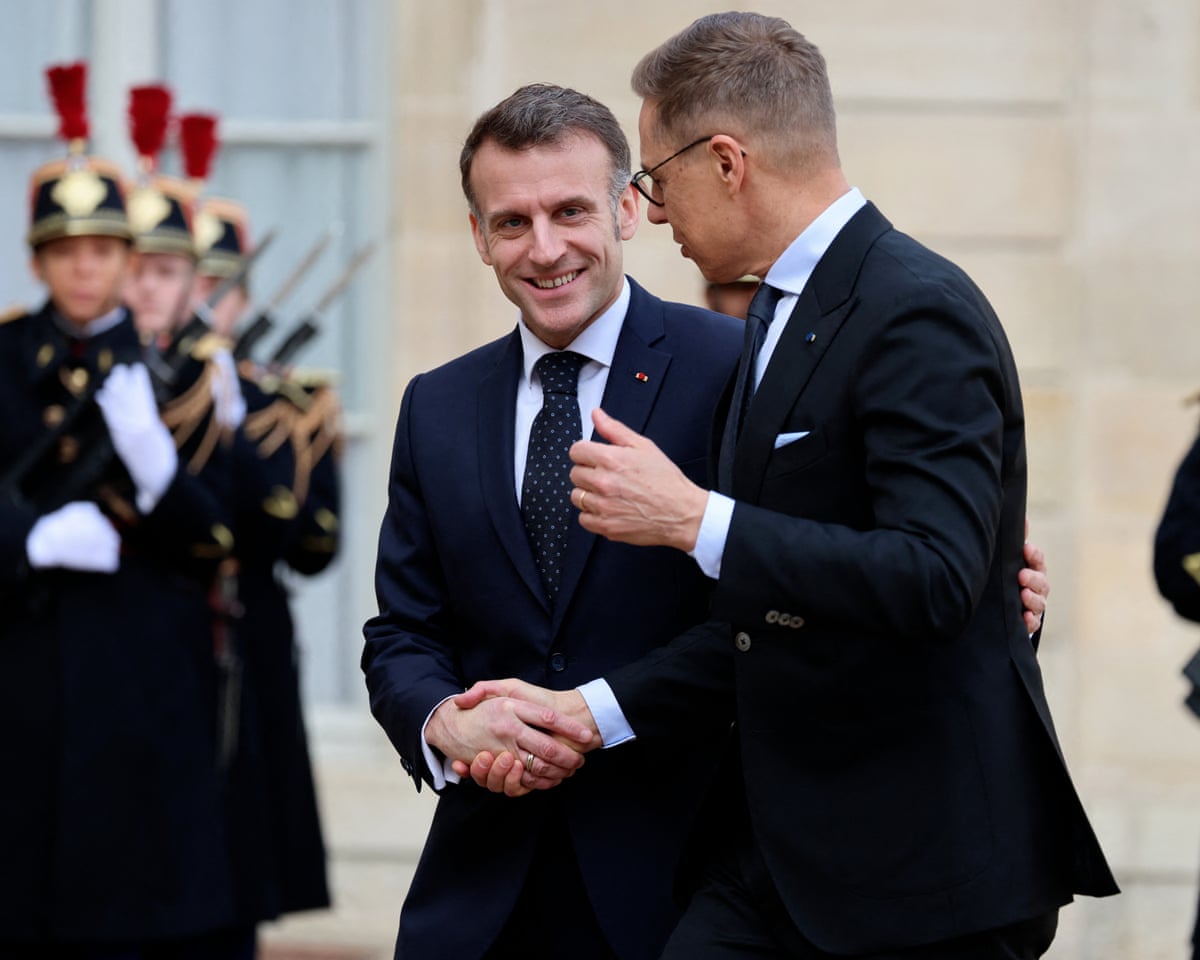
'Cannot be otherwise,' Macron says as he hopes to see EU loan for Ukraine, Russian sanctions agreed
President Macron stated that their discussions would focus on supporting Ukraine as it enters the fifth year of full-scale war defending against Russian aggression.
He expressed determination to see progress on the €90bn loan for Ukraine and the 20th sanctions package against Russia, emphasizing that
"It cannot be otherwise."
Macron also addressed Arctic security and the need for increased EU investment in defense and competitiveness reforms.
Finland's Stubb expected at Élysée for talks with Macron soon
Finland’s President Alexander Stubb was expected at the Élysée Palace for talks with President Macron, focusing on navigating relations with the US administration under Donald Trump, ahead of the invasion anniversary.
Press statements from their meeting will be provided.
Confusion reigns on US tariffs after last week's supreme court ruling
Uncertainty persists regarding whether Donald Trump’s new 15% tariffs will take effect tomorrow in the UK and EU, despite assurances from US Trade Representative Jamieson Greer that existing tariff deals remain unchanged.
Andy Haldane, president of the British Chambers of Commerce, told the BBC that the 15% tariffs likely apply from tomorrow unless the government advises otherwise.
"We are 10% [tariff rate with the US]. If he [Trump] follows through tomorrow, that will be 15% and that will mean UK sits towards the bottom the league table in terms of who’s been made worst off by the measures of the weekend,"he said.
The German Business Confederation (BDI) called on the EU to urgently seek clarity from the US on tariffs and trade rules.
BDI president Peter Leibinger stated:
"These decisions create significant new uncertainty for transatlantic trade. Businesses on both sides of the Atlantic urgently need planning certainty and reliable trading conditions. The EU, with the support of the German government, should quickly approach the United States and provide clarity on tariffs and trade rules. Only through dialogue can transparency be established and trust in transatlantic economic relations be secured."
US Trade Representative Greer told CBS that the US will uphold tariff deals with countries including the UK, EU, Japan, and Switzerland.
"We want them to understand these deals are going to be good deals,"Greer said.
"We’re going to stand by them. We expect our partners to stand by them."
The EU has called on the US not to retract the July agreement, emphasizing its role as the US’s largest trading partner and expecting the US to honor its commitments.