Meloni Concedes Defeat in Judiciary Reform Referendum
Italian Prime Minister Giorgia Meloni has conceded defeat in the judiciary reform referendum, affirming her intention to respect the voters’ decision while describing the outcome as “a lost chance to modernise.”
“We will move forward, as we have always done, with responsibility, determination, and respect for the Italian people and for Italy,”she stated.

'Italians Have Expressed Themselves Clearly,' Meloni Says as She Concedes Referendum Defeat
In a brief social media video, Meloni remarked:
“Sovereignty belongs to the people, and Italians have expressed themselves clearly today. The government has done what it promised: advanced a justice reform that was in our manifesto.
We supported it to the fullest and then put the choice back to the citizens, the citizens have decided, and we, as always, respect their decision.
There is clearly still regret for a missed opportunity to modernise Italy, but this does not change our commitment to continue working with seriousness and determination for the good of the nation and to honor the mandate entrusted to us.
We will move forward as we always have: with responsibility, determination, and above all, with respect for Italy and its people.”
No Campaign's Lead Holds at 7 Percentage Points as More Votes Are Counted
The latest projection by Rai, based on 73% of ballots counted, shows the No vote firmly ahead with 53.6%, while the Yes vote trails at 46.4%.
According to Rai’s data, sourced from Consorzio Opinio Italia poll, 88.8% of voters from Meloni’s Fratelli d’Italia party supported the proposed reforms, with 11.2% opposing them.
Similarly, over 80% of voters from Lega and Forza Italia also backed the reform.
Opposition parties demonstrated strong cohesion, with approximately 90% of Democratic Party voters rejecting the proposal, alongside 87% of Five Star Movement supporters.
The poll indicated that the youngest voters, aged 18 to 34, decisively opposed the reform by 61% to 39%. The 35–54 age group was narrowly against the change (53% to 47%), while voters aged 55 and older were nearly evenly split, with a slight advantage for the Yes side at 51% to 49%.
Former Prime Minister Matteo Renzi commented on Radio Leopolda, emphasizing the importance of heeding the public’s voice, drawing from his own experience resigning after a failed 2016 constitutional referendum.
He also cautioned against complacency or disregarding the political message of the referendum result.
Several demonstrations calling for Meloni’s resignation were anticipated across Italy in cities including Rome, Milan, Naples, Turin, and Bologna, although Meloni has ruled out resigning.
Meanwhile, Giuseppe Conte, leader of the opposition Five Star Movement, celebrated the referendum outcome on social media:
“We did it, long live the constitution!”

Referendum Loss Leaves Meloni More Politically Vulnerable
Although Giorgia Meloni has firmly dismissed calls to resign following the referendum defeat, avoiding the abrupt end experienced by former premier Matteo Renzi, analysts suggest the loss will increase her political vulnerability.
The timing of the referendum posed challenges for Meloni, with public disapproval of her ally, former US President Donald Trump, and concerns that the US-Israeli conflict with Iran could exacerbate already high domestic energy prices.
Had the referendum passed, Meloni would likely have been emboldened to pursue further constitutional reforms, including proposals to make the prime minister directly elected.
According to , the likely rejection weakens her domestic position amid a stagnant economy and complex international challenges, potentially diminishing her standing in Europe, where she was previously viewed as unexpectedly resilient.
Sky TG24 Broadcaster Calls Referendum for No Campaign
As more partial results emerged, the Sky TG24 broadcaster declared the vote in favor of the No campaign.
'No' Campaign's Lead Extends to 7.8 Percentage Points, New Rai Projection Shows
Rai’s second projection, updated with votes from 37% of polling stations, indicated the No campaign’s lead widening to 53.9% against 46.1% for the Yes side.
'No' Lead Widens According to Rai Projection with First Partial Results
Using actual results from the first 12% of polling stations reporting, Rai projected a final result of 53.1% for No and 46.9% for Yes.
However, these figures are preliminary and subject to change as additional results are reported.

Exit Polls Suggest Meloni Narrowly Lost Contentious Referendum — Snap Analysis
Exit polls on Monday suggested that Italy’s prime minister narrowly lost the referendum on judicial reform.
Pollsters estimated the No camp, supported by a significant portion of the opposition, received between 49% and 53% of the vote, compared to 47% to 51% for the government-backed Yes camp.
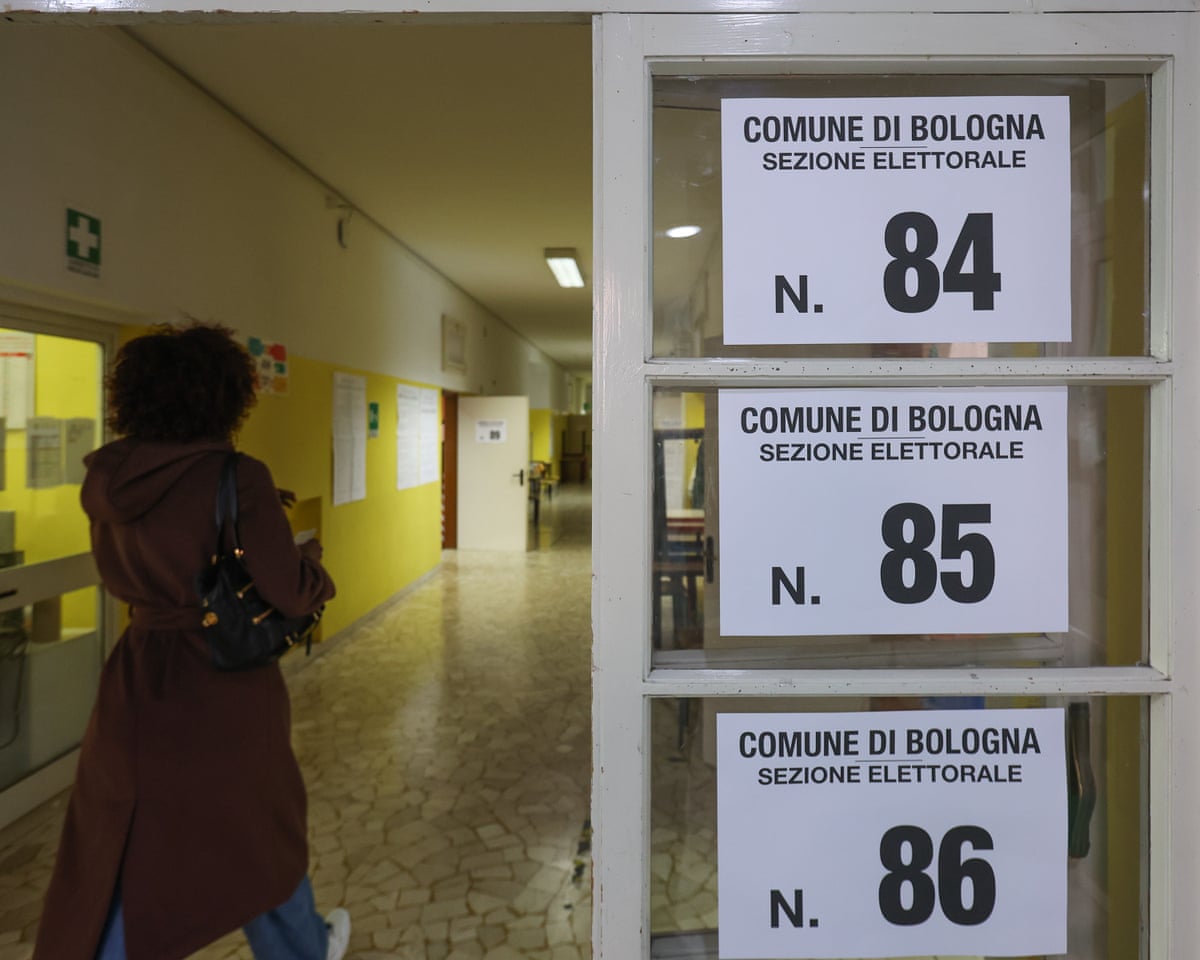
Turnout in the two-day referendum reached a record 58.5%, according to the Italian interior ministry, contradicting earlier forecasts of low participation.
A defeat would be a setback for Meloni, who aimed to advance an electoral law that could secure her coalition a comfortable victory in next year’s general election.
The proposed judicial reforms were technical and complex, with the campaign marked by heated rhetoric directed at the judiciary.

Early Data Show 58% Turnout in Italian Referendum
Early turnout data indicated that 58.4% of eligible voters participated in the referendum.
Results Too Close to Call, but 'No' Win Would Mark Big Setback for Meloni — Snap Analysis
The results remain very close, making it difficult to declare a definitive outcome at this stage.
Nonetheless, all three main polls show the No campaign leading, which, if confirmed, would represent a significant setback for Prime Minister Giorgia Meloni.
'No' Campaign Ahead in LA7 Poll
The SWG poll for La7 broadcaster reflected similar numbers, with the No campaign in the lead.
‘No’ Campaign Also Leads in Rai Instant Poll
The Consorzio Opinio Italia poll for Italian public broadcaster Rai also indicated a lead for the No campaign.
'No' Campaign with Narrow Lead in Instant Poll for Sky TG24
Instant polling for Sky TG24 similarly showed the No campaign holding a narrow lead.
Polls on Italian Referendum Expected Imminently
According to Italian media, three polls were expected: Opinio for Rai, SWG for La7, and YouTrend for Sky.
A popular Italian journalist remarked, “Here – we – go!” as the polls were anticipated.
What Is the Italian Referendum About?
The referendum concerned proposed changes to the recruitment and governance of judges and prosecutors, including separating their career paths, establishing two governing councils selected by lottery, and creating a court to handle disciplinary matters.
Meloni argued these reforms were essential for impartiality, aiming to eliminate what she described as left-wing political “factions” controlling the judiciary.
Opponents contended the reforms would weaken judicial independence and increase government control, drawing comparisons to Hungary under Viktor Orbán.
Italian Referendum Result Will Be Important for Domestic Politics — Analysis
Opinion polls prior to the blackout period indicated a close race, with the No camp gaining an edge as the debate intensified.
In the final campaign days, Meloni intensified her rhetoric, accusing judges of leniency towards crime and irregular immigration.
She stated that rejecting the changes would risk public safety by allowing “more immigrants, rapists, paedophiles and drug dealers being freed.”
Last week, she warned that a failed ballot would result in “even more negligent judges and even more surreal sentences.”
Meloni remains popular in surveys, an uncommon position for Italian leaders at this stage of their administration. A referendum victory could strengthen her coalition’s prospects in the general election scheduled for next year.
Mattia Diletti, a politics professor at Sapienza University in Rome, commented,
“If she loses, it will be upsetting because it will be much harder for her to prepare for the elections.”
In an effort to engage younger voters, Meloni appeared on an irreverent podcast hosted by a rapper, emphasizing that the vote concerned justice rather than her personally.
Matteo Bruno, a master’s student in Rome, expressed skepticism, stating,
“I’m going home to Catania specifically to vote because this is a constitutional reform that might have important consequences for the future of our democracy.”
Voting was scheduled to close in less than 90 minutes, with exit polls expected around 2pm UK time (3pm local time). Updates will be provided as results become available.