

Introduction
This documentary about NATO’s preparedness for potential conflict appears designed to evoke a combination of apprehension and admiration in viewers inclined toward military themes. However, it ultimately presents a rather monotonous portrayal.
As the world’s largest military alliance, NATO currently faces reputational vulnerabilities. Given its reliance on US stability and support, the disruption of the so-called “rules-based order” under Donald Trump poses a significant existential challenge. In this context, NATO could benefit from a straightforward public relations success, and ’s Frontline: Our Soldiers Facing Putin attempts to deliver one.
Premise and Context
This two-part series is premised on the idea that after four years of conflict in Ukraine, preparations must be made for future developments. Should Vladimir Putin be encouraged by the outcome of that war, there is concern he might target another former Soviet border state, Estonia, a long-standing NATO member, which would trigger a NATO response. The documentary sets out to assess NATO’s readiness for such a scenario. Any doubts about the current US administration’s stance are set aside as the program presents exclusive behind-the-scenes access to NATO’s exercises over the past year. The conclusion presented is a firm affirmation of NATO’s preparedness, suggesting that Putin should reconsider any aggressive intentions.
Estonia-Russia Border Scene
The program opens at what narrator Jonas Armstrong describes as “the very edge of Europe,” the Estonia-Russia border. Here, a guard named Peter is depicted as “staring directly at the Russian threat.” On the day of filming, this threat is represented by a Russian border patrolman appearing on the opposite side of the barbed wire and pacing. Despite the narration’s claim that this is a stark reminder of “just how close danger lies,” the scene does not convincingly convey a frontline or direct confrontation with Russian forces.
Military Jargon and NATO’s Capabilities
The remainder of the documentary functions largely as a showcase of NATO’s hypothetical military capabilities, likely to appeal to viewers with an interest in military terminology but offering little in the way of critical analysis. For those intrigued by terms such as “Enhanced Forward-Presence Battle Groups” (EFPBGs), this program provides extensive coverage. The EFPBGs include 1,300 British troops permanently stationed in Estonia, and the documentary follows their training in trench warfare. General Sir Richard Shirreff, NATO’s former deputy supreme allied commander in Europe, comments on the nature of such conflict:
“This is total war, a war of absolute utmost brutality.”

He notes, however, that 1,300 troops alone could not withstand a Russian invasion for long, emphasizing the need for rapid reinforcements. To explore NATO’s command structure for such reinforcements, the documentary shifts location.
Joint Force Command Naples
Armstrong introduces the audience to Joint Force Command Naples, describing it as a highly secure facility requiring top-level clearance, with cameras rarely permitted inside. The interior, however, appears to be a standard office environment, aside from a laminated red sign stating “SENSITIVE AREA.” This command center is where NATO’s largest planned operation for 2025, Exercise Steadfast Dart, was conceived.
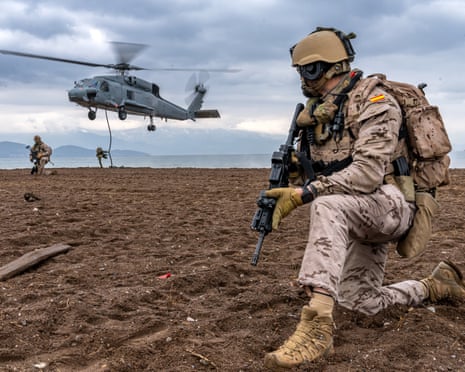
Steadfast Dart serves as a rehearsal for deploying troops to a new eastern front. The first phase involves transporting an army ferry from Southampton to Alexandropoulis, Greece, where the rapid unloading of personnel and equipment is critical should a Russian offensive occur.
Exercise Steadfast Dart and Logistics
The documentary embeds with Sergeant Heath of the NATO Allied Reaction Force, who directs khaki trucks equipped with oversized wheels, and Craftsman Peters of the Royal Electrical and Mechanical Engineers, who inspects the vehicles. Both complete their duties efficiently. Additionally, the program features the chef at a convoy support center in Romania, responsible for feeding large numbers of soldiers on the move. Attempts are made to inject a sense of urgency and competition reminiscent of reality television, but the logistical operations depicted remain uneventful and routine.
Conclusion and Advocacy
The documentary concludes with both General Shirreff and the program itself openly advocating for an expansion of British military capabilities. However, viewers not already supportive of this viewpoint may find the presentation unengaging. The only likely “casualty” of the program might be the Russian military analyst tasked with reviewing it for intelligence, who is unlikely to find much of interest.
“They are about to have a rather dull day at work.”


