Anti sex-selective abortion bill challenged by medical experts
Obstetricians and gynaecologists have criticized the anti sex-selective abortion bill introduced in New South Wales, describing it as "predicated on misinformation" with an "underlying aim to restrict access to abortion."
John Ruddick, a New South Wales Libertarian party Member of the Legislative Council (MLC), has proposed legislation that would impose prison sentences or substantial fines on health practitioners who perform abortions based on the sex of the foetus.
However, medical experts, existing evidence, and historical precedent indicate that such laws tend to disproportionately affect immigrant communities, increase stigma surrounding abortion, and curtail reproductive rights.
Currently, in NSW, abortion is a woman's choice up to 22 weeks of pregnancy. The proposed law would require health practitioners to inquire about the reasons for abortion, potentially deterring women from seeking care and practitioners from providing abortions.
Ruddick acknowledges that the law would be difficult to enforce.
“If a mother still wants to abort because of their child’s sex they can obviously say it’s for any other reason and no one will know,” he says.
When asked about the purpose of the debate, he stated it was to send a message.
“It will send a message that girls and boys are equal when it comes to abortion,”
One Nation MP Barnaby Joyce expressed a similar sentiment, stating:
“This law in NSW must be passed or otherwise we all accept that sex selection is appropriate. Girls are not as good as boys.”
Royal Australian and New Zealand College of Obstetricians and Gynaecologists (RANZCOG) president Nisha Khot said the bill was based on misinformation, noting that abortions for non-medical reasons already exist and that the bill’s true intent is to restrict abortion access.
Is sex-selective abortion occurring in NSW?
State Health Minister Ryan Park stated on Wednesday that there is no evidence of sex-selective abortion occurring in NSW.
A 2020 NSW review found such cases to be exceedingly rare. Of 15,973 abortions performed in the year to September 2020, 13 were recorded as being for sex selection; however, the review noted that 10 of these were likely reporting errors, leaving possibly only three cases.
Ruddick references a different study from Edith Cowan University, which analyzed data from 1994 to 2015 and found "indirect evidence" but not causality of sex-selective abortion, particularly among Indian and Chinese immigrants.

The authors of that study recommended limiting non-invasive prenatal testing that reveals foetal sex to medical reasons only and encouraged culturally sensitive discussions on reproductive decision-making.
Effectiveness of banning sex-selective abortion
A 2025 US study published in JAMA Network Open found that bans on sex-selective abortion stigmatized Asian immigrant mothers and amplified racial stereotypes, leading to increased maternal stress and poorer birth outcomes.
The study also concluded that such bans did not significantly change the infant sex ratio.
The authors clarified that while sex-selective abortion practices may exist, their prevalence has been overstated and mischaracterized, and evidence does not support claims of widespread occurrence even among groups historically associated with son preference.
Political activism and imagery at anti-abortion rallies
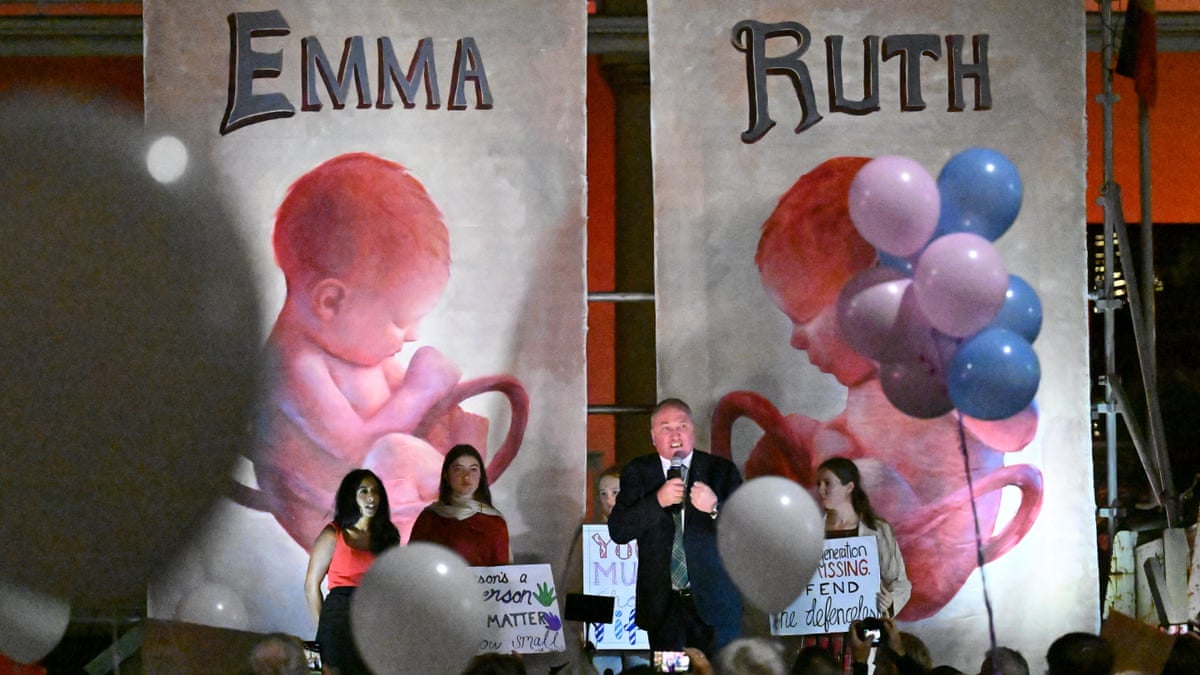
At an anti-abortion rally in Sydney on Wednesday, Barnaby Joyce was flanked by two large posters labeled "Emma" and "Ruth."
These names were assigned by Joanna Howe, an anti-abortion activist, to what she believed were tiny human foetuses no more than nine weeks old. However, the posters depicted them as much more developed, with hair and clearly defined fingers and toes.
Despite criticism, state and federal politicians continue to collaborate with Howe and others on nearly a dozen pieces of anti-abortion legislation, including Ruddick’s bill.
Such legislation has been condemned by RANZCOG and other medical organizations as misinformation lacking evidentiary support.
When questioned about the use of images resembling sugar gliders, Howe responded:
“Even if … the picture of Ruth and Emma is sugar gliders, like, does it really even fucking matter?”
Medical and midwifery organizations, including RANZCOG, the Australian College of Midwives, and MSI Australia, have stated that the goal of these legislative attempts is not to protect girls like "Ruth" or "Emma," but to incrementally restrict abortion access.
Howe herself has indicated that this is only the beginning, with plans to next target late-term abortions.
“Every year in this state, we will introduce a bill until we protect all the babies,” Howe said.