NASA Names Artemis III Crew for Revised Lunar Mission
NASA has announced the crew for its upcoming Artemis III mission, which will not involve astronauts walking on the Moon or traveling near its surface.
Initially, Artemis III was planned as the first crewed lunar landing since Apollo 17 in 1972, with two astronauts scheduled to land near the Moon's south pole and spend a week exploring the surface.
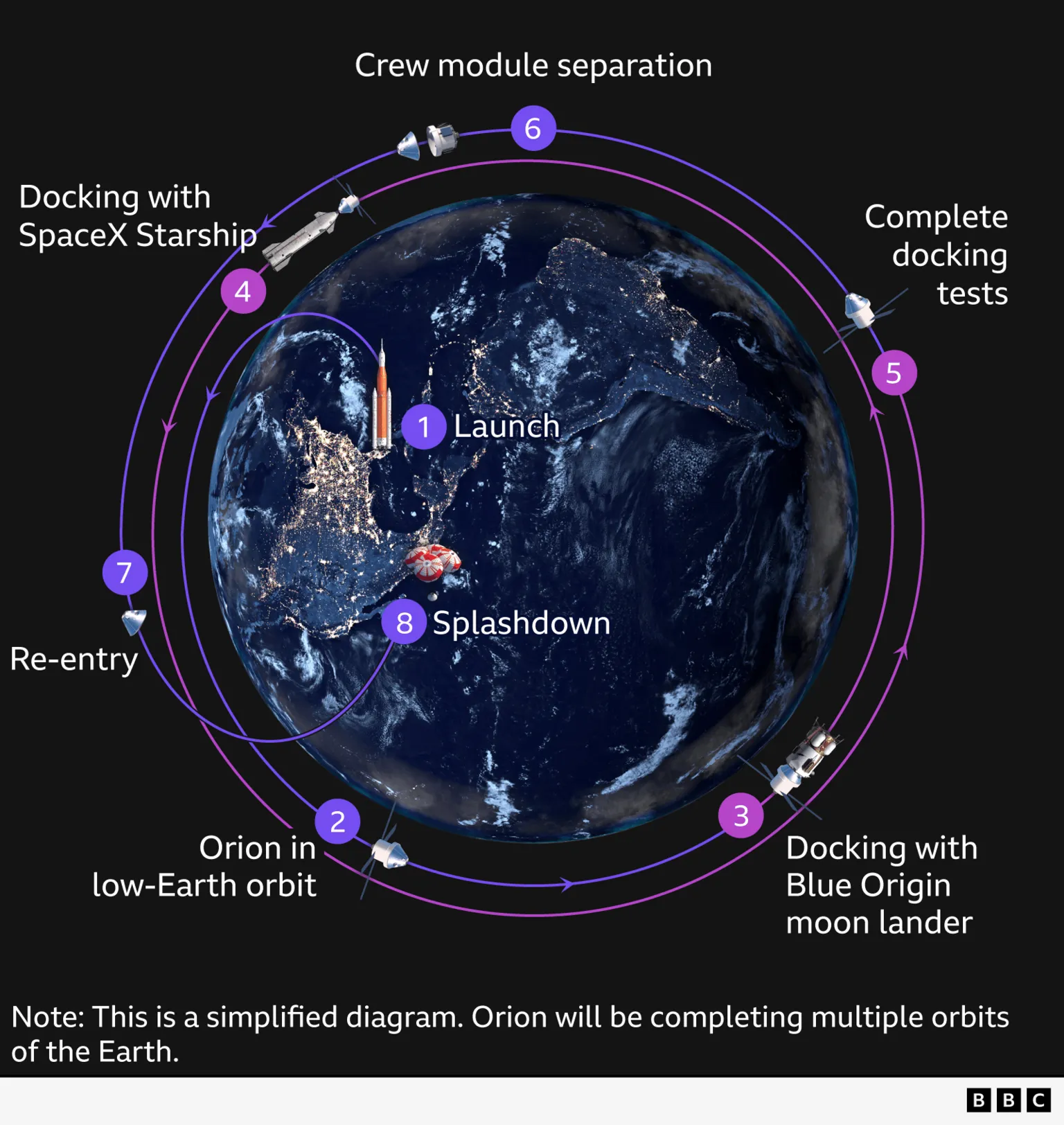
However, in February, NASA revised the mission plan to fly only in low Earth orbit, a region just beyond the International Space Station, where the crew will dock with prototype lunar landers.
"This mission will require the most awe-inspiring coordination of heavy-lift rocket launches in history, drawing on the talent and capability of teams across government and the spaceflight community,"said NASA Administrator Jared Isaacman.
Randy Bresnik, a NASA astronaut, will command the Artemis III mission.
Luca Parmitano, representing the Italian Space Agency and with over 300 days in space, will serve as the pilot.
Americans Andre Douglas and Frank Rubio will be mission specialists.
Bob Heintz, a test pilot with 170 days in space, will act as a backup crew member and is prepared to assume any role required during the mission.
The change from a historic crewed lunar landing to a technology demonstration in Earth orbit was driven by delays in the development of SpaceX's Starship rocket, the vehicle intended to transport astronauts from lunar orbit to the Moon's surface.
NASA also determined that it was too great a leap to proceed directly from Artemis II's lunar orbit mission to a lunar landing without first testing docking procedures with lunar landers in Earth orbit.
In March 2026, the Government Accountability Office reported that SpaceX had made "limited progress maturing the technologies needed for in-orbit refueling and cryogenic propellant storage."
Starship's mass requires refueling in Earth orbit to reach the Moon, involving a fleet of tanker vehicles transferring cryogenic liquid methane and liquid oxygen in sequence—a complex maneuver yet to be tested.
NASA's Moon mission program encountered another setback last month when Blue Origin's New Glenn rocket exploded during a routine engine test.

No injuries occurred, but the launch pad sustained extensive damage.
Blue Origin currently has no alternative launch facilities for New Glenn, and repairs could take several months.
When SpaceX experienced an explosion in September 2016, it took 15 months to resume operations, but SpaceX had multiple launch pads available; Blue Origin does not.
The immediate consequences include potential delays to the Blue Moon cargo lander, which was planned for a Moon flight possibly as early as this autumn; uncertainty around the crewed lander for Artemis IV; and questions about the lander pathfinders Artemis III is intended to test.
NASA's most optimistic schedule anticipates Artemis III flying in 2027 as a demonstration mission, Artemis IV targeting a lunar landing in early 2028, and Artemis V, designed for a second landing and the start of base construction, later that year.
John Couluris, a vice president at Blue Origin, stated that NASA and Blue Origin are working continuously to prepare for a 2027 launch.
However, most independent experts consider this timeline ambitious.
The urgency is partly driven by geopolitical factors. China has announced a goal of a crewed Moon landing by 2030. Additionally, a December 2025 executive order under the Trump administration directed NASA to return astronauts to the Moon by 2028 and establish initial base elements by 2030.
"It would not surprise me at all if China gets there first,"Dr. Simeon Barber, a lunar scientist at the Open University, told .
NASA's margin for error is narrow. The refueling technology for Starship remains unproven, a key commercial partner lacks a functioning launch pad, and the first lunar landing depends on a sequence of unprecedented operations all succeeding in order.
Following last month's explosion, NASA Administrator Jared Isaacman affirmed the agency's commitment to assist Blue Origin's recovery efforts.
"We are committed to helping the Blue team recover,"he said.
The critical question now is how long recovery will take and whether the mission schedule can accommodate delays.