

An artist's impression of what the new supercomputer site will look like when it is finished next autumn
Construction has commenced on the UK's new £750 million national supercomputer.
Project leaders state it will become the most powerful computer in the UK and rank among the most powerful globally upon completion by the end of next year.
The supercomputer will be housed within University of Edinburgh facilities located on the outskirts of Penicuik and Roslin in Midlothian, near the institute renowned for cloning Dolly the sheep.
This development marks a significant advancement for a project that was initially shelved by the UK government following Labour's rise to power, only to be reinstated a year later.
What is a supercomputer?
When completed, the UK's new supercomputer will be comparable in scale to the JUPITER system, which was finalized last year in Jülich, Germany.
The team managing the supercomputer project, along with researchers anticipating its use, express strong enthusiasm about its potential.
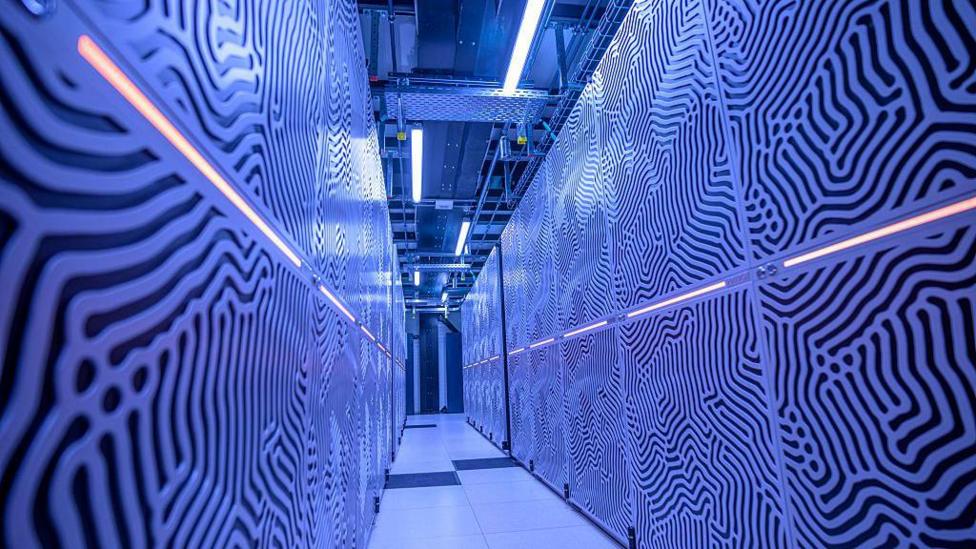
As implied by its name, a supercomputer is an exceptionally powerful machine. The specifications for this new system are staggering.
Professor Mark Parsons, director of the supercomputer project at the University of Edinburgh, describes it as approximately the size of a medium-sized supermarket.
The system will contain thousands of processors and will be capable of performing a billion-billion calculations per second, equating to 1,000,000,000,000,000,000 operations.
Prof Parsons said the computer would help researchers and commercial companies to "simulate the world around them".
The supercomputer will process vast amounts of data to create models of phenomena that are difficult to replicate experimentally in laboratories.
He added: "Supercomputers model things that happen too quickly, like quantum; that are too large, like an earthquake; or too long - like the expansion of the universe."
What will the new supercomputer do?
The new supercomputer site is adjacent to the existing computer facilities on the outskirts of Penicuik and Roslin.
The UK's previous national supercomputer, ARCHER2, is also located at this site and is expected to reach the end of its operational life by the end of this year.
ARCHER2 contributed to modelling aircraft engines for Rolls Royce and the materials used in mobile phones. It also played a role in the global response to the Covid-19 pandemic.
The new supercomputer will be 50 times more powerful than ARCHER2. Professor Parsons states it will address challenges that are "simply not possible on other computers."

It will support advancements in quantum computing and climate change modelling. Prof Parsons encourages the UK scientific community to propose ideas for its application.
The supercomputer will consume substantial amounts of electricity. Surplus heat generated on-site will be repurposed to heat university buildings and potentially nearby residences.
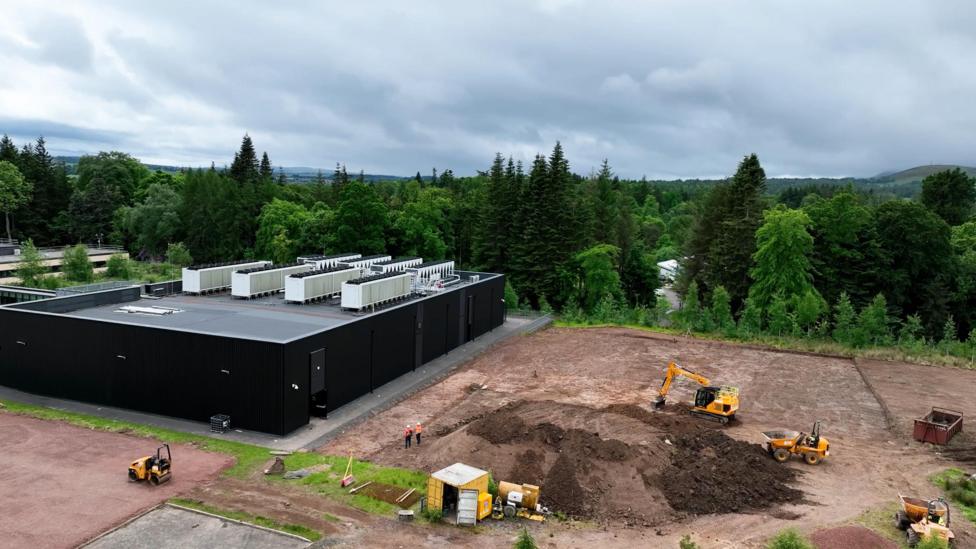
Prof Mark Parsons says the new supercomputer will, for the first time, model every single part of a Rolls Royce gas turbine engine
One of the researchers planning to utilize the supercomputer is Professor Joe Zuntz, a cosmologist at the University of Edinburgh.
Prof Zuntz emphasizes the need for increased data processing capacity and computational power to analyze data collected from advanced telescopes.
He collaborates with the Vera C Rubin telescope in Chile and has experienced delays of weeks when transferring data to supercomputers in the United States.
With the new supercomputer located locally, UK research will benefit from dedicated computational resources.
Cosmologists are investigating significant questions. Prof Zuntz notes that for approximately 25 years, it has been known that the universe's expansion is accelerating, not merely expanding but doing so at an increasing rate.
"We have no idea why, and we are trying to understand why," he added.
Currently, there is notable excitement as observations suggest this acceleration may be changing, as if "someone is taking their foot off the pedal."
"This supercomputer will let us analyse the data that will hopefully answer that question of why."
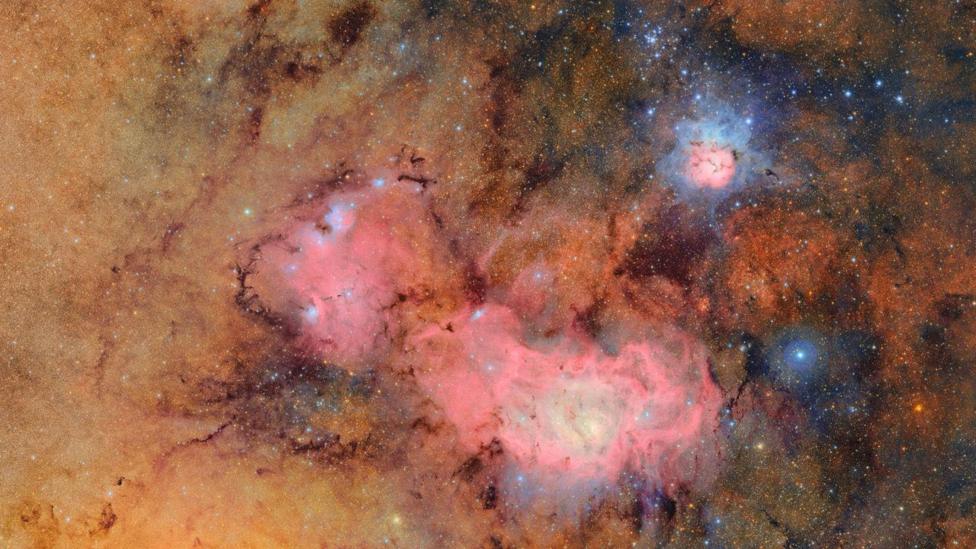
The first image revealed by the Vera Rubin telescope in 2025 displays the Trifid and Lagoon nebulae in remarkable detail.
The supercomputer project is funded with £750 million from the UK government.
Initially supported by the previous Conservative government, the project was shelved in August 2024 following Labour's electoral victory in Westminster.
The new government described the £1.3 billion pledged by the Conservatives for technology projects, including the supercomputer, as an "unfunded commitment."
Prof Parsons recalls the difficulty of informing his superior about the funding suspension.
However, in June of the following year, the government reinstated funding for the project.
Kanishka Narayan, the government's minister for online safety and AI, stated to the BBC:
"Edinburgh and Scotland has been the home of frontier computing research for decades.
"The supercomputer is going to be focussed on making a real difference - whether that is in healthcare, to make sure we are finding cures to new diseases, or in space to find new innovations.
"It is a huge moment for Scotland, and a huge moment for the UK."


