Introduction to Anlife and Its Origins
A distinctive piece of software has recently appeared on the PC gaming platform Steam. Describing it simply as “software” seems the most accurate, as it exists somewhere between a comprehensive life simulation, a scientific experiment, and a kind of eerie digital aquarium. This project might have passed unnoticed if not for a notable incident several years ago when some of its developers were sharply criticized on camera by one of Japan’s most revered animation figures.
In 2016, Hayao Miyazaki, the acclaimed director behind films such as Princess Mononoke and Spirited Away, was introduced to new technology that employed artificial intelligence to animate models. When shown a zombie-like figure that moved by banging its head against the ground and writhing its body like a fish, Miyazaki famously described the demonstration as
“an insult to life itself”.
The clip of this reaction is striking, and it left a lasting impression. Now, nearly a decade later, the developers who faced that critique have recovered enough to release their work to a broader audience.
Context of Anlife’s Release and AI in Gaming
Among the discussions sparked by Anlife’s launch, some users are intrigued by what the game might reveal about the evolving relationship between video games and artificial intelligence. While the term AI is often used broadly, understanding its role in gaming is important, especially given concerns about job displacement and the increasing number of games created with AI assistance appearing on platforms like Steam.
However, there is a challenge in interpreting Anlife’s significance. The game itself is a lighthearted and seemingly inconsequential experience, which makes it difficult to draw substantial conclusions from it.
Gameplay and Visuals of Anlife
Anlife presents itself as an evolution simulator where “AI-driven block creatures move in unexpected ways.” The core gameplay involves placing various creatures into a contained environment and observing how they learn to navigate.
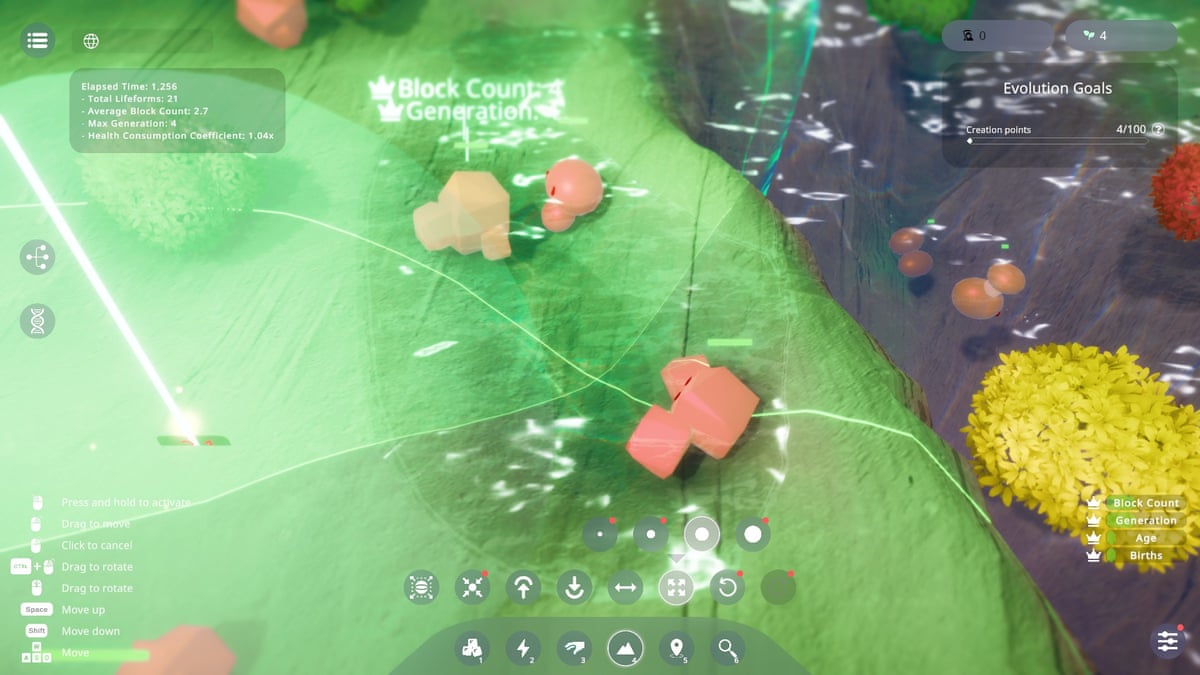
Visually, Anlife is minimalistic, featuring serene landscapes of green valleys and shimmering water that resemble the calming images often used in MRI facilities during scans. The audio complements this atmosphere with gentle bloops, bleeps, and popping sounds, reminiscent of the soundtracks found in many early 2000s day spas.

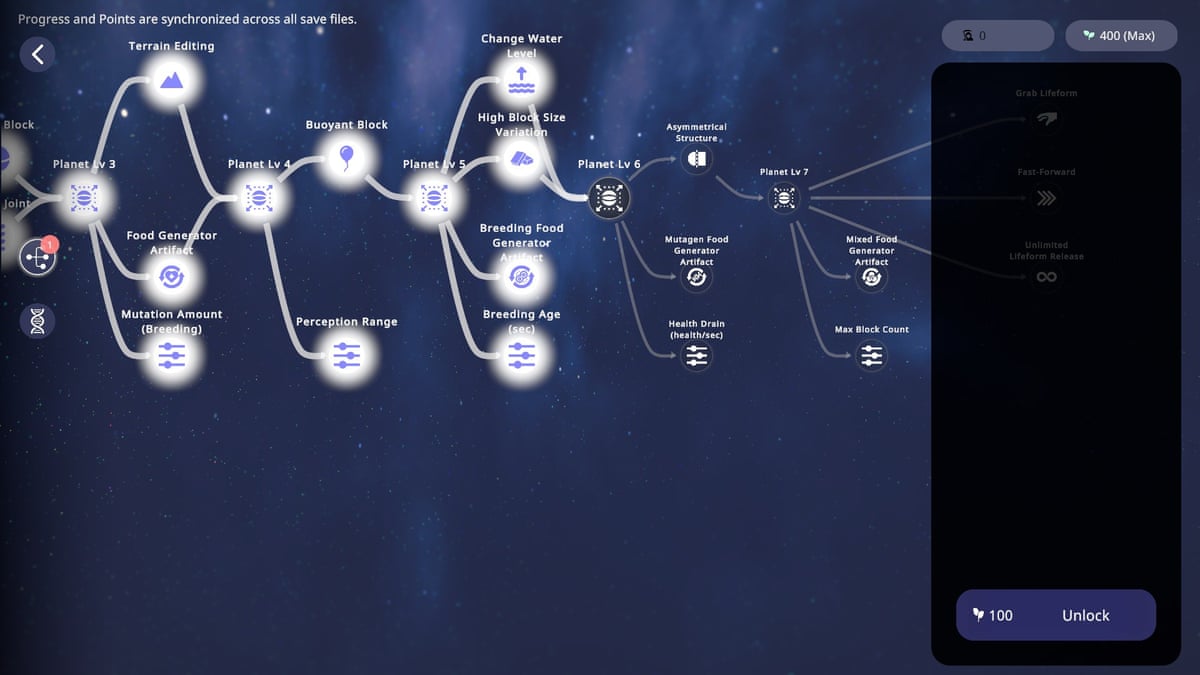
This calming aesthetic extends to the game mechanics. Over a relaxed morning session, players can introduce simple creatures into the environment and provide food that encourages breeding or mutation. Expanding territory and guiding creatures toward water or into the air fosters the emergence of new variations. The game includes numerous unlockables, including a hidden skill tree that allows players to eliminate their digital creatures if they prefer, rather than simply watching them thrive. Overall, the ecosystem remains straightforward, focusing on observing how creatures move toward food.
The Role of AI and Evolution in Anlife
The primary interest lies in the “how” of the creatures’ movement, which likely involves the game’s somewhat enigmatic use of AI. After several hours, players will notice Anlife’s blob-like creatures experimenting with new joint configurations and body structures as they swim, fly, and roll around in pursuit of food.
AI has a history in animating creature movement, often utilizing small neural networks and evolutionary algorithms. For example, in 2009, the UK-based company NaturalMotion developed a bipedal model that learned to walk through evolved neural networks. This company was later acquired by Zynga in 2014.
Challenges in Gameplay and Procedural Generation
Despite these innovations, two main issues arise. First, the emphasis on unlocking the skill tree gives the early gameplay a repetitive, clicker-like quality that is difficult to overcome. Second, the game encounters what is known in procedural generation studies as “the oatmeal problem.”
The oatmeal problem, a concept introduced by writer, developer, and academic Kate Compton, highlights that while every bowl of oatmeal is unique, the differences are not particularly interesting. Similarly, when Anlife’s creatures discover new ways to move—rolling, bouncing, or flapping toward food—they are ultimately still just moving toward food. This results in a game experience that either demands intense focus on subtle variations or allows players to zone out and enjoy the tranquil visuals and sounds. During my time with Anlife, I often began by scrutinizing the details but found myself drifting into a more relaxed, passive engagement after about ten minutes.
Reflections on AI’s Potential and Anlife’s Place
Playing Anlife also brought to mind insights from an early AI researcher I spoke with in 2013. They suggested that the true value of AI lies in its potential to become a completely alien form of intelligence. This would offer humans a new perspective on ourselves, revealing quirks and cognitive biases that are difficult to detect when interacting only with minds similar to our own.
Since then, many companies, including OpenAI, appear to have focused on creating AI that mimics human behavior, often producing outputs that simply reinforce existing beliefs and desires.
Anlife occupies a small, distinct niche. It does not attempt to conceal its use of AI; rather, it highlights how AI enables its creatures to move. It is not merely a game created with AI but one that is, in part, about AI itself. The game embraces AI’s inherent otherness and does not seek to ingratiate itself with players but instead invites examination of AI’s unique nature.