Government to Pilot New Approach Replacing Traditional GP Fit Notes
General Practitioner (GP) fit notes that currently declare individuals unable to work will be replaced with enhanced support aimed at helping patients remain in their jobs under a government pilot scheme.
In this initiative, GPs in two regions of England will refer patients to support services alongside issuing fit notes, while in two other areas, GPs will cease issuing fit notes entirely.
The government has described the existing system as "broken," citing that too many people are signed off work without receiving assistance to facilitate their return.
This move is part of broader efforts to address the rising number of individuals out of work due to health issues.
Concerns have been raised about the economic impact of this trend, as well as its contribution to increased benefit payments and added pressure on the National Health Service (NHS).
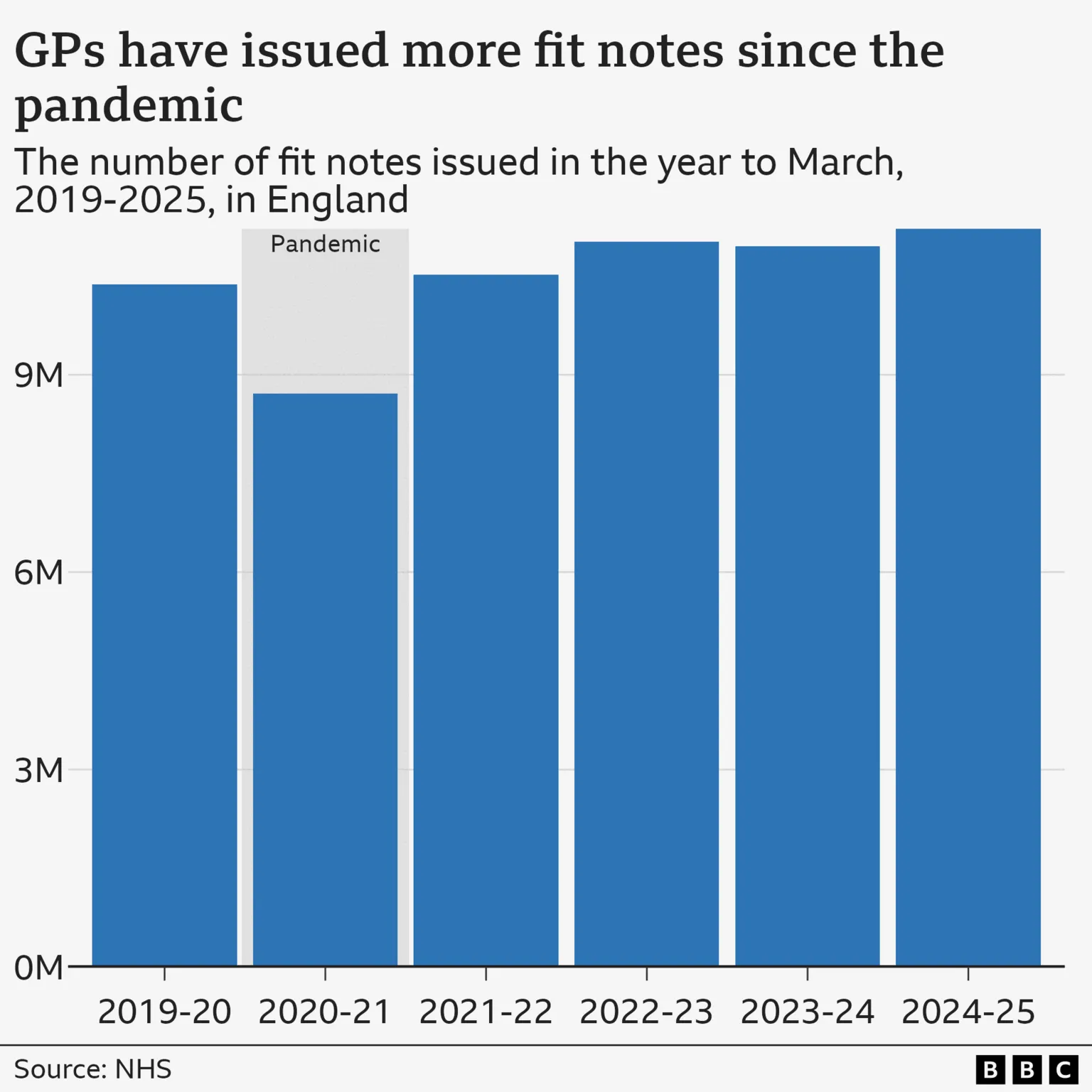
More than 11 million fit notes are issued annually, with numbers rising since the Covid-19 pandemic.
Fit notes are authorized when a person is unwell or unable to work for more than seven days. They provide advice on how health problems affect the patient's capacity to work and can facilitate access to certain benefits and sick pay.
A patient may be declared "not fit for work" or "maybe fit for work" with adjustments; however, the government reports that over 90% of fit notes fully excuse individuals from work.
Earlier this year, hundreds of GPs informed the BBC that they had never refused to sign off a patient for mental health reasons. Many also expressed concerns that issuing fit notes should not be part of a GP's responsibilities.
The four pilot schemes, which will run for up to a year, encompass up to 100,000 appointments and are supported by £3 million in funding.
The pilots aim to test various approaches to identify the most effective methods to address the increasing issuance of fit notes.
In Birmingham and Solihull, as well as Coventry and Warwickshire, GPs will initially issue fit notes where necessary but will also refer patients to support services.
In Cornwall and the Isles of Scilly, along with Lancashire and South Cumbria, GPs will refer patients directly to support services without issuing fit notes.
The pilots will evaluate whether support should be led by healthcare professionals or non-clinical staff such as work coaches and social prescribers, who may recommend community groups or activities to improve patients' health.
Additionally, the pilots will involve discussions with employers regarding workplace adjustments to facilitate employees' return to work.
The pilots will be delivered through existing NHS WorkWell sites, which connect patients with services including physiotherapy and counselling.
This initiative follows a review conducted earlier this year on strategies to assist people in returning to work, which recommended a new approach to fit notes.
The review, led by former John Lewis chairman Sir Charlie Mayfield, concluded that the current system is "not working as intended," noting that most GPs lack the training and time to adequately assess a patient's ability to work.
It also found that fit notes often hinder communication between employers and employees.
Work and Pensions Secretary Pat McFadden said: "Fit notes are too often a dead end - a piece of paper that tells people they can't work but does nothing to help them get better.
We're changing that. By bringing employers, the NHS, and patients together we can help people recover faster, stay connected to their jobs, and get the economy firing on all cylinders."
Prof Victoria Tzortziou Brown, president of the Royal College of GPs, stated: "The current system can involve significant administrative work that takes time away from patient care.
However, any reform of the fit note process must put the health and wellbeing of patients first, be fully resourced and avoid creating additional workload for general practice."
John Foster, representing the Confederation of British Industry, which advocates for businesses, welcomed the pilot, commenting that the current system "fails employers, workers, and the economy."
Conservative shadow health secretary Stuart Andrew remarked that it was "good to see Labour finally waking up to fit note reform."
He added: "The Conservatives have long argued that too many people are being written off work when they could be supported to recover, stay independent and contribute."
The government has been managing a rapidly increasing benefits bill, as more people are out of work due to a rise in mental health issues among young people and musculoskeletal problems in older populations.
Last year, amid opposition from Labour MPs, the government abandoned major welfare reforms, including proposed restrictions on disability benefit eligibility, which were expected to save £5 billion annually.