

April's Full Pink Moon Peak Time
The full Pink Moon in April will reach its peak in the UK at 03:12 BST on Thursday 2 April.
Although it is a visually striking night sky event, the Moon is unlikely to appear very pink.
The name, like many other full Moon names, originates from a tradition of naming full Moons after seasonal natural events to track the passing months.
Specifically, the Pink Moon is named after a pink flower found in North America that blooms during this time of year.
The April full Moon also holds significance in determining the dates for Easter and Passover.
Pink ground phlox blooms widely over North America in April and is where the Pink Moon gets its name

On the evening of 1 April, the Moon will rise low on the horizon and is more likely to appear orange rather than pink.
This coloration occurs because the sunlight reflected by the Moon passes through a denser part of Earth's atmosphere, which scatters blue and violet light, allowing only the redder hues to reach observers.
Other names for the full Pink Moon around the world include the Sprouting Grass Moon and Egg Moon, both indicating the start of spring. The full Fish Moon refers to the time when shad fish swim upstream to spawn, and the Breaking Ice Moon highlights the arrival of warmer weather.
These full Moon names date back to ancient traditions predating modern calendars and served as useful markers for changing seasons. The names often relate to significant seasonal events, such as the Hunter, Harvest, and Flower Moons.
Will the Skies Be Clear to See the Full Moon?
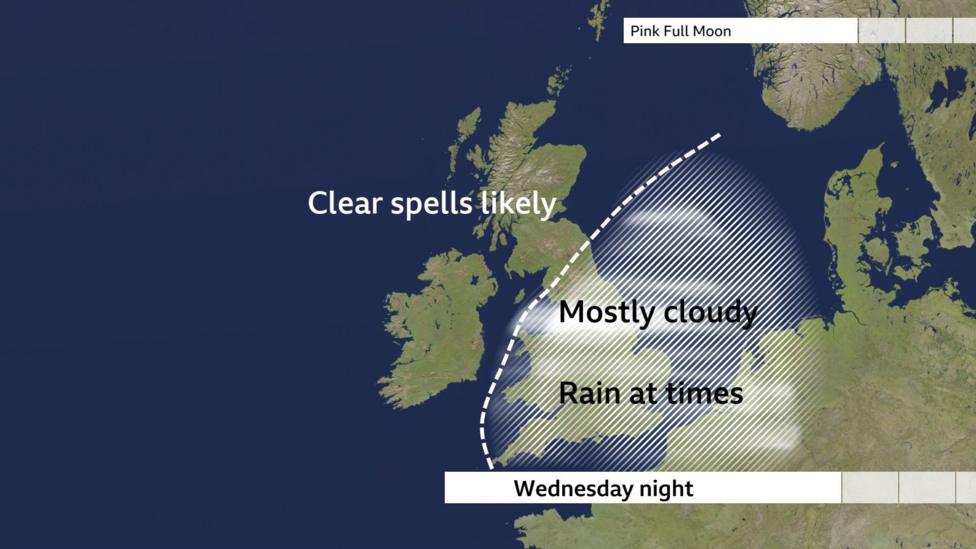
The forecast for Wednesday night currently indicates a cold front moving south across England and Wales, bringing cloud and rain.

The best chances for clear skies will be in the colder air over Scotland and Northern Ireland.
Keep updated with the weather forecast in your area via BBC Weather online and the app.
Why Is the Full Moon Key to Fixing the Date for Easter?
This year, Easter falls on 5 April. The date is determined by astronomical events. Easter always occurs on the first Sunday after the first full Moon following the spring equinox.
Historically, different parts of the Christian church used different calendars—the Gregorian and Julian calendars—resulting in Easter being celebrated on different dates worldwide.
Efforts to unify the date have led many Eastern European countries to use the Gregorian calendar for civil purposes while retaining the Julian calendar for Orthodox religious festivals.
The astronomical equinox naturally fluctuates between 20 and 21 March; in 2026, it will occur on 20 March.
However, the Christian church has fixed the equinox date at 21 March to standardize calculations.
Since the first full Moon after 21 March is the Pink Moon on 2 April, Easter is set for the following Sunday, 5 April.
In years when the full Moon falls on a Sunday, Easter is observed the following Sunday.
The new Moon marks the start of each lunar month in the Jewish calendar, with the full Moon occurring mid-month.
Passover begins halfway through Nisan, the first month of the Jewish calendar, coinciding with the April full Moon.
The Pink Moon behind the Prince of Wales Bridge over the Severn Estuary

- Seven celestial events to watch for in the spring night sky
- Stunning sky gazing events to come in 2026


