

Welsh Place Names Replaced by English Versions on Maps
Historic Welsh place names are being replaced with English equivalents on maps, a practice described as "undermining our language and national identity" by a Gwynedd councillor. Einir Wiliams has publicly criticised Ordnance Survey (OS) for adopting names that she claims have "no basis in tradition" across various platforms including online maps, signage, and publications.
Examples cited by Wiliams include the use of "Mushroom Garden" for Coed Cerrig y Frân, "Heather Terrace Path" for Llwybr Gwregys, and "Bala Lake" for Llyn Tegid.
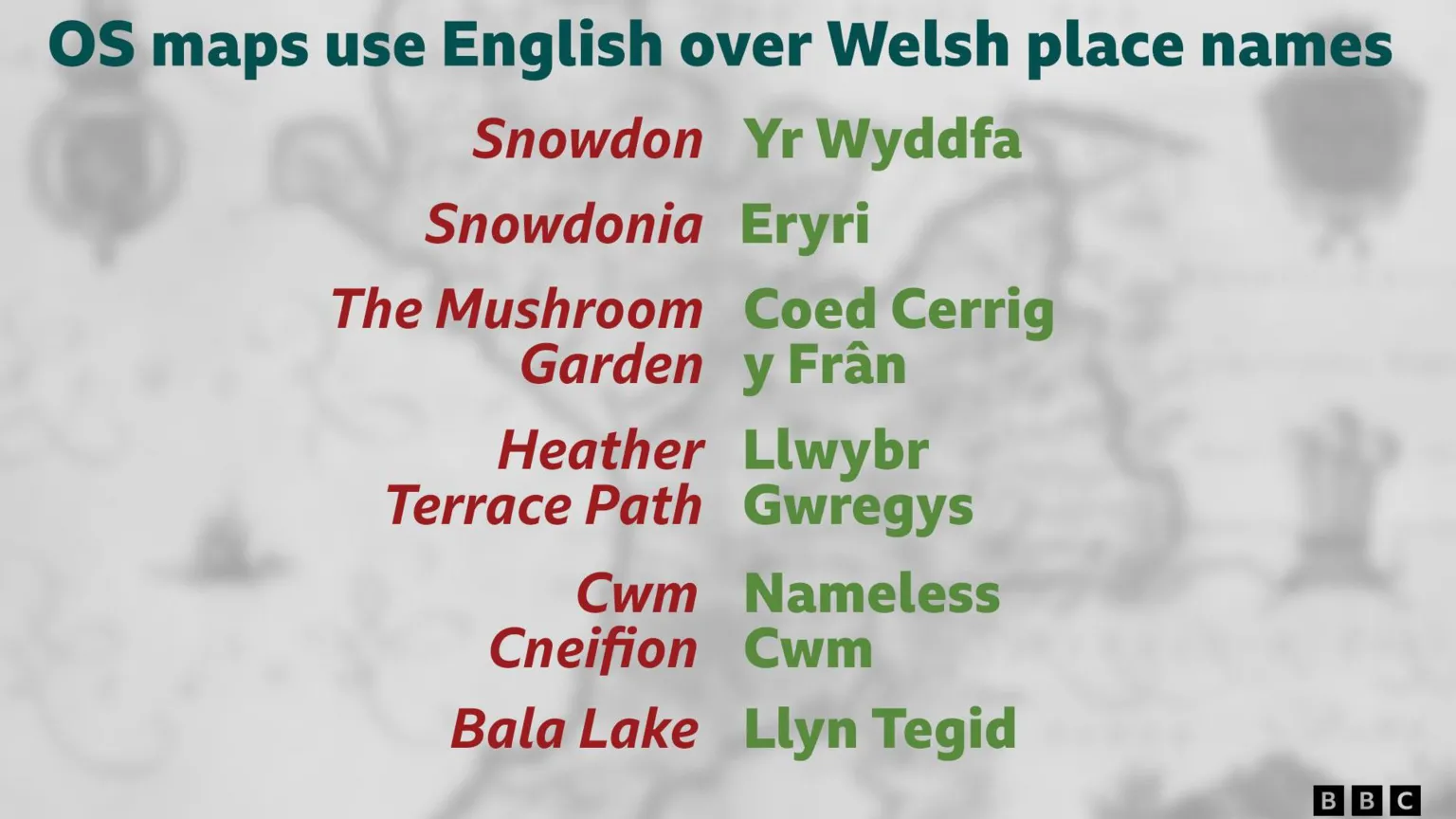
Wiliams has called for intervention from the Welsh government to address this issue.
Ordnance Survey Response
Ordnance Survey stated that it does not independently decide on name changes. Instead, any rare changes are typically the result of alterations made by authoritative bodies or when a name falls out of use and another becomes prevalent.
In a formal notice of motion, Wiliams expressed her concerns:
"I want to express deep and passionate concern about the current Ordnance Survey policy which is leading to the deletion, undermining and ignoring of Welsh place names that have been part of our landscape for centuries.
This council criticises these practices, as they contribute directly to the loss of Welsh names, and therefore undermine our language, history and national identity.
When the Ordnance Survey adopts an English name, it appears on websites, signs, publications, and media and, as a result, the Welsh name is pushed aside.
This happens even among young Welsh-speakers, who are often led to believe that the English name is the 'standard'.
This is how language is weakened, not in one shot, but in a thousand small steps.
Welsh place names are part of our cultural DNA. They tell the story of the land, the people, the legends, the work, the life.
No-one has the right to delete or replace them,"
Wiliams proposed that the council write to Ordnance Survey to "put an end" to what she described as a "harmful policy".
She added,
"This is not just a matter of maps. It's a matter of identity, respect and cultural justice."
The issue is scheduled to be discussed at the council meeting on 14 May.
Perspectives from North Wales Tourism and Ordnance Survey
Jim Jones, CEO of North Wales Tourism, referenced the Welsh Language Act 1993, which ensures that "both languages are treated equally". He stated there is "no reason" why maps could not be produced in both English and Welsh or even bilingually.
"I think it's encouraging to see more people wanting use Welsh," he said.
An Ordnance Survey spokesperson commented:
"Ordnance Survey is committed to holding authoritative versions of place names within its mapping where they are in common usage.
Accurate representation of place names, including bilingual names if they are both in use, is essential for delivering high-quality mapping products to the public and supporting government and emergency services.
Ordnance Survey cannot decide by itself to change a name.
Any rare changes we do make are usually as a result of changes made by either authoritative bodies or when a name falls into disuse and another name comes into use.
We continue to see an increase in the number of Welsh names and have supported recent work to adopt a number of standardised Welsh place names for lakes within Eryri National Park, ensuring they are captured in our database.
We are committed to working in collaboration with the Welsh government... to identify what more we can do to support the Welsh language in our mapping."
Welsh Government's Position
The Welsh government has been approached for comment on the matter but no statement has been provided at this time.


