

Introduction to Woody Brown
"May I say that I’m very glad to meet you," Woody Brown communicates by tapping on his word board. Brown is formal, humorous, and remarkably articulate. He possesses a profound talent for storytelling that delves into the minds of his characters, revealing their thoughts and perceptions of how others view them. Brown is autistic and non-speaking.
His debut novel, Upward Bound, portrays daily life at an adult day care centre in southern California. The title is ironic, as the young adults, referred to as clients, are generally stifled, patronised, unheard, and unseen. Despite their challenges, the staff are depicted with notable tenderness.
The narrative unfolds through multiple perspectives: Walter, loosely based on Brown, is only understood by his mother; Tom, who is strikingly handsome, attempts to communicate with the neurotypical world through blinking; Ann, a student volunteering to enhance her CV, is infatuated with Tom but oblivious to the charms of other clients; and Dave, the centre’s director, who once aspired to be an actor, treats the annual show like a Broadway production. Brown offers a vivid portrayal of individuals often misunderstood because, as he explains, their brain and body are not in verbal communication (pun intended).
Life and Communication
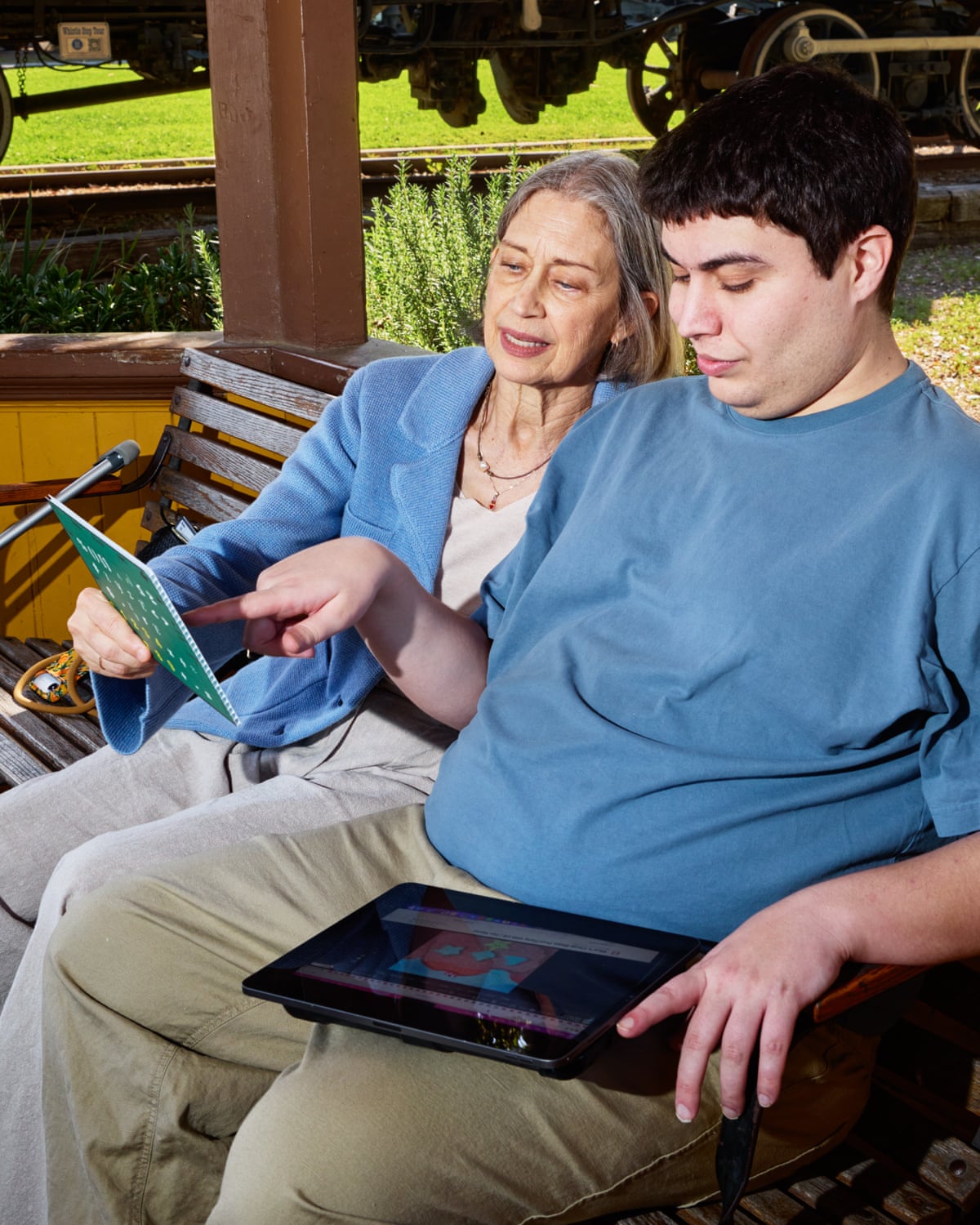
Brown, 28, is at home with his mother, Mary, in Los Angeles during the interview. Mary holds the letter board on which he taps out his responses and then voices them. Brown is not entirely without speech; occasionally, he utters words or phrases, often in a high-pitched tone and repeated, a phenomenon known as echolalia.
Brown and his mother share a close bond. She comforts him when stressed, patiently waits for his answers, and seems to understand him almost as well as he understands himself.
“She has been at my side for every moment of my journey,” Brown taps. “Without her there is no me.”
Early Challenges and Misunderstandings
The causes of Brown’s and other non-speaking autistic individuals’ conditions remain unknown. However, his family recalls that as a young child, specialists dismissed him as a lost cause, believing nothing was happening inside. His parents sensed otherwise. When he was a toddler, Mary watched Soma Mukhopadhyay, whose son Tito is autistic and non-speaking, on the TV program 60 Minutes. Mukhopadhyay had taught Tito to type, enabling communication with the world. Inspired, Mary took Woody to see Mukhopadhyay, who tested him by asking him to spell words.
“I’ve been told he’s mentally retarded, and she says ‘Woody spell cat’. And he pulls down the C and the A and the T. He’s three at that point!”
Despite this, little changed. At school, teachers dismissed him as a hopeless case and did not attempt to educate him. He was placed in the lowest class and left to his own devices. At age eight, when asked for a synonym for sad, Brown spelled out “melancholy” correctly.
“When it gets to his turn he spells out ‘melancholy’ and he spells it correctly.”
Still, this did not alter perceptions. The misunderstanding worsened his behaviour; he became bored, angry, and disruptive, even throwing chairs in class.
“I was in the pit of despair,” Brown taps.When asked how he overcame this, he responds,
“It was a gradual ascent, starting when I was 12 and finally allowed to join the remedial class for lessons.”
He clarifies that he was not initially in the remedial class.
“I was meant to be in the lowest special ed class, which was so demoralising. At least in the remedial room they tried to teach some basic academics.”
Communication Style and Personality
Brown occasionally speaks in a high-pitched cartoon voice, surprising those who hear him. When asked if he is happy now, he replies,
“I am very happy now that I have real purpose and productivity. I want this for all autistic people. One of the reasons I wanted to be a great writer was that I wanted neurotypical people to read my book, not out of pity but because it was a good book. That way I can reach the hordes who underestimate and infantilise us, and show them how vivid and magnificent we are.”
Brown wears a T-shirt featuring Japanese trains. When asked about it, he explains,
“I love trains and Murakami. Hence Japanese trains. Murakami’s my favourite author. I’ve read so many of his books. We read every day, and I can’t get enough!”Mary reads aloud to him due to his visuospatial difficulties that make focusing on written words challenging.
Comparing his writing style to Murakami’s, Brown smiles and taps,
“He’s also not very social like me!”
Mary asks about his metaphor of the “pit of despair.” Brown responds,
“Murakami always talks about a well, which stands in his books as a metaphor for depression and loneliness. There’s a well in every Murakami book. I think of Murakami’s wells as a visual manifestation of my isolation.”
Engagement and Multitasking
During the interview, Brown sometimes looks away, which initially appears as avoidance of eye contact. However, he explains,
“May I say I think better when I have my screens going?”
Mary then shows the three computer screens on a mobile cart that Brown uses: one displays his favourite cartoon, Thomas the Tank Engine; another shows the game Angry Birds; and the third plays videos of vintage steam locomotives.
When asked if he uses the screens because he finds the interviewer boring, Brown clarifies,
“No. May I say I have many screens running through my brain at all times. My brain is so busy that I have to occupy more than one channel at a time. If I only looked at you the top of my head might blow right off! It’s exhausting to narrow my vista to one window.”
The interview is conducted in 30-minute segments due to Brown’s fatigue. During a break, he playfully shouts in his cartoon voice,
“Sorry boss! Sorry boss!”Mary asks if he wants a break, to which he replies in a deeper voice,
“Yes.”He then walks away with his cart of screens, saying goodbye in his cartoon voice. Mary explains that "Molly" is a character from Toy Story 3.
Character Reflections and Autobiographical Elements
After resuming, Brown describes Walter, the protagonist of Upward Bound, as his alter ego.
“Walter is my alter ego. We share aspects of disability and personality.”When asked how, he explains,
“Many aspects of non-speaking autism are shared, particularly the frustration of being misunderstood by most people. I wanted to show how Walter was perceived by the other characters to get a glimpse of how inaccurately others see him. Only his mom is able to translate his verbal nonsense and Walter is lucky to have that one small corner of understanding.”
In one scene, Walter’s mother invites autistic parent friends to watch a film about Temple Grandin. Walter is angered by the portrayal of Grandin by Claire Danes, whom he describes as a "lovely, lithe actress," contrasting with the real Grandin, whom he characterises as "big and awkward and ugly, in the way that Eleanor Roosevelt was ugly, magnificently ugly." Walter has a meltdown and injures his hand. Brown reveals,
“May I say the Temple Grandin chapter is autobiographical.”He shows his scar.
Regarding his mother, Brown notes,
“She used to be more stressed out. Her behaviour improved as mine did.”Mary adds with a laugh,
“Also we have both been working on our anxiety which helps us be nice.”Brown comments,
“Anxiety is a constant companion, but I can manage it better now. Meditation has helped greatly.”

Characters and Themes
Tom, a handsome client at Upward Bound, is misunderstood by everyone. Brown recalls,
“I remember a boy like Tom from childhood, and I have always been concerned about him. I worry that no one ever heard him, and that he languishes somewhere alone.”When asked if many autistic people languish unheard, he replies,
“Oh yes! People put their own ideas on to a blank page that they can’t otherwise read.”He last saw a boy like Tom around age 10 and confirms,
“Oh yes! He was gorgeous!”
Dave, the care centre’s director, symbolizes well-intentioned but ultimately self-centred carers. Brown states,
“Dave is a symbol of well-intended but ultimately self-centred carers who find their way into the land of disability by accident.”He acknowledges having encountered carers like Dave,
“Their voices are louder than the true believers.”He explains,
“People who get it tend to be more quiet and introspective. They listen more than they need to be heard.”
One carer who truly understands is Carlos, who has a troubled background. Brown calls him,
“the hero of the story.”
Continuing the Conversation
Mary notes that Brown is beginning to tire, and they agree to continue the interview the following morning. Brown concludes the session by tapping,
“I’ve got more to say, but I’m all done now.”He then says goodbye in his cartoon voice, referencing a character from Thomas the Tank Engine.
The next day, Brown arrives slightly late and appears stressed, repeatedly saying,
“In trouble.”When reassured he is not in trouble, he responds in his cartoon voice,
“Sorry boss, sorry boss!”Mary comforts him with a deep hug, calming him.
Academic Achievements and Family Background
In 2022, Brown became the first non-speaking autistic graduate at the University of California, Los Angeles (UCLA), earning the English department’s top writing honours. He completed his master’s degree at Columbia University in 2024, with Mary attending both courses alongside him. Brown used his cart and three screens during his studies, as multitasking was essential for focusing on lectures and seminars. At home, he operates even more screens simultaneously.
Mary is an English graduate who worked for 20 years as a story analyst in the film industry, collaborating with figures such as Steven Spielberg. Brown’s father, Drew, is head of production at Paramount TV. Mary anticipates scepticism about her involvement in Brown’s work but insists she has had no creative input beyond translating his letterboard sentences and minor editing.
Observing their interactions reveals Mary’s linguistic skill and Brown’s exceptional intelligence and vocabulary. Sometimes Mary asks Brown to explain concepts she finds difficult to express. For example, Brown uses trains to describe his mind’s workings, a concept potentially worthy of a metaphysics PhD.
“My mind feels like there are thousands of train lines all running at once, and there are trains on all of them. But they’re not on flat ground, they’re all in 3D. In the universe above me there are all these trains on their tracks just floating around and I’m on all the trains all the time.”
When asked why many autistic people love trains, Brown replies,
“Parallel lines and soothing progress.”However, with infinite trains floating in the universe and his presence on all of them, it is not always soothing. A documentary trailer about Brown features the chaotic sounds of a railway station.
Brown describes his internal experience:
“My head is so loud that it’s like Grand Central at rush hour. When alone in my room I turn everything, all my screens, to top volume. I drive my parents nuts with the noise. Cacophony is the only word to describe it.”Asked if this noise brings peace, he answers,
“Strangely, yes. Mom loves quiet, I love chaos.”When questioned whether he truly loves chaos or if it helps him find serenity, he explains,
“Chaos outside neutralises the chaos inside.”
Romantic Themes and Personal Hopes
Brown discusses the unrequited romances in Upward Bound. Walter loves Emma, who is also autistic and non-speaking. Brown confirms,
“Emma is a real person. My friend since childhood. And I do feel love for her. I know we communicate via autistic energy fields. Our senses are disordered which makes us less attuned to some input and hyper-attuned to others. My childish wish is to find someone who will make a life with me in spite of my shortcomings.”
When asked why he describes this wish as childish, he clarifies,
“Fabulistic may be a better word. It’s hard for people who are so dependent to have a relationship in real life.”
Regarding living independently, Brown says,
“Yes. They are old, and I will probably survive them. My sister Annie and her husband, Matt, want to share their lives with me when Mom and Dad can’t take care of me any more. They like me. Go figure!”
Echolalia and Communication Insights
Mary recounts Brown’s echolalia, which she initially thought was random. Eventually, she recognized it as a form of shorthand. She shares an example:
“Woody used to s with a blue dog. He still does. I can’t say the name because it stresses him. He’d have a meltdown and he’d say ‘straight’ all the time. How old were you when this was happening?”Brown nods.
Mary continues,
“Then I watched him watching the video and the character in the video was trying to hang up a picture, and it was crooked, and he couldn’t get it straight and he was just so frustrated, and when I realised ‘straight’ meant frustration I was like ‘Oh my gosh’. I’d been dismissing these words as nonsense.”
Brown explains,
“I use phrases that I can access with my mouth to compensate for all the words my mouth can’t say.”
Views on Autism and Political Climate
Autism is currently subject to negative rhetoric by some political figures in the United States. Donald Trump and Robert F. Kennedy Jr. have referred to autism as a “disease” and claimed there is an “epidemic.” Brown expresses his feelings:
“May I say that they both distress me terribly. Their words and actions are dangerous.”
In Upward Bound, the carer Ann observes that clients who can speak often do so repetitively, concluding that speech is not their superpower but their kryptonite. When asked if he views his inability to speak as a superpower or kryptonite, Brown replies,
“Neither. My disorder is just that. A disability that says nothing about who I really am. Some people have more strikes against them than others, but we all have things to overcome. Is being non-speaking worse than a child’s fate in Gaza or an immigrant’s destiny on the streets of Minneapolis? How dare I complain from my comfortable home? Perspective is everything.”
Future Projects and Closing Remarks
Brown is currently working on his second novel, Alfie, which he describes as a bildungsroman about his search for camaraderie. Mary admits uncertainty about the pronunciation of "bildungsroman." Brown explains,
“Alfie is a boy in Arkansas who excels at baseball.”When asked if Alfie is autistic, he replies,
“No, although he hides his anxiety behind his catcher’s mask.”
After an hour-long conversation, Brown smiles when complimented on the title Upward Bound.
“Irony is my middle name,”he taps.
As the interview concludes, Brown says,
“Thank you. Byeeeee! Say goodbye Molly.”


