

Tell us: has the conflict in the Middle East affected your household or business costs?
We invite residents in the UK to share if they have experienced increases in the cost of goods or services, or have encountered delays, cancellations, or other disruptions related to the ongoing Middle East conflict.
Goldman Sachs continues to forecast that the Bank of England will reduce interest rates this year. Their baseline projection anticipates the first rate cut in July, followed by additional quarter-point reductions in November and February, ultimately lowering the Bank rate to 3%.
This outlook contrasts with money market expectations, which suggest rates will increase to 4% from the current 3.75% next year.
Like most City analysts, Goldman Sachs expects the Bank of England to maintain the Bank Rate at its current level during Thursday's meeting. They predict a 7-2 vote split, with policymakers Swati Dhingra and Alan Taylor favoring a 25 basis point rate cut.
"The minutes will probably acknowledge that the latest energy futures prices suggest that headline inflation is likely to remain above target for longer than previously expected, while stressing that the path ahead is highly unpredictable. We think that the Committee will indicate that it is alert to the possibility of second-round effects and will likely assess that the risk of persistence in underlying inflation has increased. That said, we expect the minutes to reiterate that risks remain two-sided given continued labour market weakness."
Goldman Sachs anticipates that the Committee will avoid providing a strong indication regarding the near-term policy outlook, noting that in the current environment of elevated uncertainty, decisions on the appropriate degree of monetary restriction will be made at each meeting. However, the guidance is expected to suggest that further policy easing remains possible if energy prices decline.
Shares in the airline sector are declining this morning due to rising oil prices increasing fuel costs. British Airways’ parent company, IAG, and budget airline easyJet have both fallen by 2%, ranking among the top decliners on the FTSE 100 index. Wizz Air is the largest faller on the FTSE 250 index of mid-sized firms, down 4%.
UK house asking prices rising this month despite fears of higher rates
The ongoing Iran crisis has not yet triggered a downturn in the UK housing market. Rightmove, the property portal, reported that average new seller asking prices increased by 0.8% (£3,023) in March, reaching £371,042. This rise aligns with typical seasonal trends, despite diminished buyer expectations for interest rate cuts this month.
Rightmove also notes that the number of homes for sale remains at an eleven-year high for this time of year, which limits more significant price growth. Consequently, sellers need to price properties more competitively to attract buyers.
Rightmove commented on the market sentiment, stating:
"Seller denial and a dogged optimism for a bullish spring market lingered in this month @rightmove HPI. Asking prices rose 0.8% making the average house price on this index £371,042 in March. The issue for sellers is the number of homes for sale is at an eleven‑year high for this…" pic.twitter.com/4k0XQS27lh
Concerns are mounting that disruptions to shipping through the Strait of Hormuz may impede fertiliser shipments, potentially leading to food shortages and increased prices. EU foreign policy chief Kaja Kallas described the closure of the strait as "really dangerous" for global supply chains and highlighted its impact on fertiliser production, according to .
"And if there is a lack of fertilisers this year, there’s going to be also food deprivation next year."
Svein Tore Holsether, CEO of Norway’s Yara International, a major fertiliser producer, warned that prolonged conflict could severely affect crop yields.
In the stock market, Shell (+1.3%) has joined BP as one of the top gainers on the FTSE 100 this morning. Both companies are expected to benefit from the Iran conflict; Goldman Sachs predicts that the two oil majors will collectively earn an additional £5 billion in profits this year due to the surge in crude prices linked to the war.
Starmer to announce support for households hit by energy price spike
Keir Starmer is anticipated to unveil a support package worth tens of millions of pounds aimed at assisting Britons affected by rising energy prices resulting from the Iran conflict. The Prime Minister will present the plans during a Downing Street press conference on Monday, where he will also criticize certain heating oil suppliers for price gouging.
The assistance is primarily targeted at households using heating oil for home heating, many of which are in rural areas of Northern Ireland, where Starmer recently visited.
Bloomberg: Pakistan oil tanker transits Hormuz
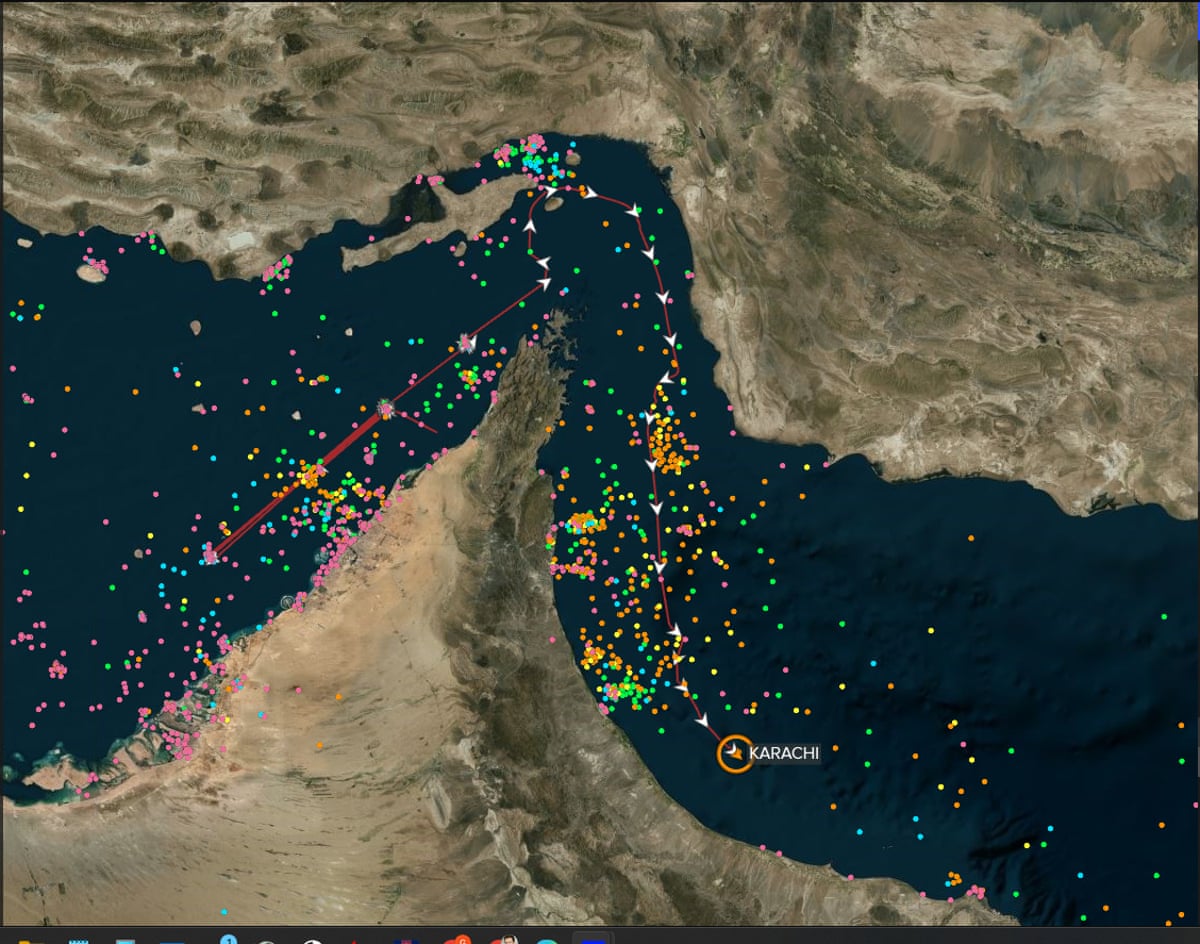
A crude oil tanker, the Karachi, operated by Pakistan’s National Shipping Corporation, has reportedly passed through the Strait of Hormuz and is en route to Pakistan. This vessel is among the latest to exit the Persian Gulf since the onset of the Iran conflict.

As of this morning, the Pakistan-flagged Aframax tanker was observed near Oman’s Sohar. Vessel-tracking data indicate:
"The 2022-built Karachi made its way across Hormuz and around Iran’s Larak Island, the vessel-tracking data show. It then proceeded eastbound close to Iran’s coastline, before leaving the strait Sunday evening. Other ships leaving the strait also appear to have taken a route on the Iranian side of Hormuz."
The Karachi last loaded crude oil in the United Arab Emirates. Draft readings suggest the ship is not fully laden.
FTSE 100 opens higher
The London stock market opened with gains today. The FTSE 100 index rose by 33 points to 10,293, an increase of 0.33%. Retail group Kingfisher (+1.75%) led the gains, followed by oil giant BP (+1.7%).
The British pound is recovering slightly from a three-month low reached at the end of last week. Sterling gained 0.2 cents to $1.324 this morning after falling on Friday following stagnant economic growth in January.
Kathleen Brooks, research director at XTB, commented:
"The pound is coming under pressure as the dollar resurgence continues, however, it was not the weakest performer in the G10 even though UK GDP at the start of the year showed no growth.
Although inflation remains a key risk for the UK economy, the rising unemployment rate suggests that the UK economy is not operating at full employment, which may tilt the BOE away from rate hikes this year and towards remaining on hold instead. If the sharp rise in UK Gilt yields ease, then the pound may take a breather from its recent sell off."
Mortgage shelf-life nosedives amid market uncertainty
The average shelf-life of a UK mortgage has significantly decreased, even before the recent surge in energy prices dampened expectations for interest rate cuts. Data indicates that the average shelf-life fell to 14 days as of March 1, the lowest level since August 2023.
Moneyfacts reports that, in a complete reversal from the typical seasonal slowdown in January, the mortgage market is entering a period of uncertainty amid global pressures. Lenders have been rapidly repricing mortgage products this month as financial markets revise previous forecasts for multiple UK interest rate cuts this year.
This repricing pushed average mortgage rates in the UK above 5% last week. Moneyfacts predicts that lenders may withdraw more products until the future direction of interest rates becomes clearer.
Rachel Springall, finance expert at Moneyfacts, stated:
"Borrowers looking to refinance would be wise to act quickly to secure a new deal, as the significant push in mortgage activity during February has led to a significant fall in the average shelf-life of a mortgage to just 14 days.
This is a complete contrast to the notable seasonal slowdown in activity during January. However, since this data was captured, there has been a notable shift in swap rates, amid the unrest seen in the Middle East. It is worth noting that the average shelf-life of a mortgage has not been this low (14 days) for over two years, last lower for August 2023, at 13 days. This was just one month after a record low of 12 days recorded for July 2023."
Introduction: Oil higher after attack on Kharg Island
Good morning, and welcome to our continuous coverage of business, financial markets, and the global economy.
For the third consecutive Monday, oil prices are rising as the Iran conflict threatens to impact the global economy adversely. Brent crude, the international benchmark, has increased approximately 2.6% today to $105.80 per barrel, remaining above the $100 per barrel mark it crossed last week for the first time since 2022. US crude is up 1.5%, trading just above $100 per barrel.
These prices are below overnight highs, with Brent reaching as high as $106.50 per barrel when markets reopened last night.
Crude prices have risen following a US strike on Iran’s critical Kharg Island oil facility over the weekend, through which approximately 90% of Iran’s oil exports typically pass.
The Strait of Hormuz remains severely disrupted. Former US President Donald Trump has urged other nations to deploy ships to help reopen the strait, warning that failure to do so "will be very bad for the future of NATO." Iran’s Foreign Minister, however, denied that the strait is closed, asserting it remains open to all nations except the United States, Israel, and their allies.
This statement has somewhat alleviated concerns in the oil market. Tony Sycamore, market analyst at IG, explained:
"This context is crucial: China and India alone account for approximately 50% of all oil that normally transits the Strait of Hormuz.
Additionally, Saudi Arabia’s East-West pipeline is rerouting 7 million barrels per day, bypassing Hormuz entirely, with reports indicating tankers are lined up ready to collect this redirected cargo."
The agenda
- 9.30am GMT: UK’s Office for National Statistics to update inflation basket
- 12.30pm GMT: New York Empire State Manufacturing Index for March


