Introduction: UK Living Standards Decline Amid Economic Growth
Good morning, and welcome to our continuous coverage of business, financial markets, and the global economy.
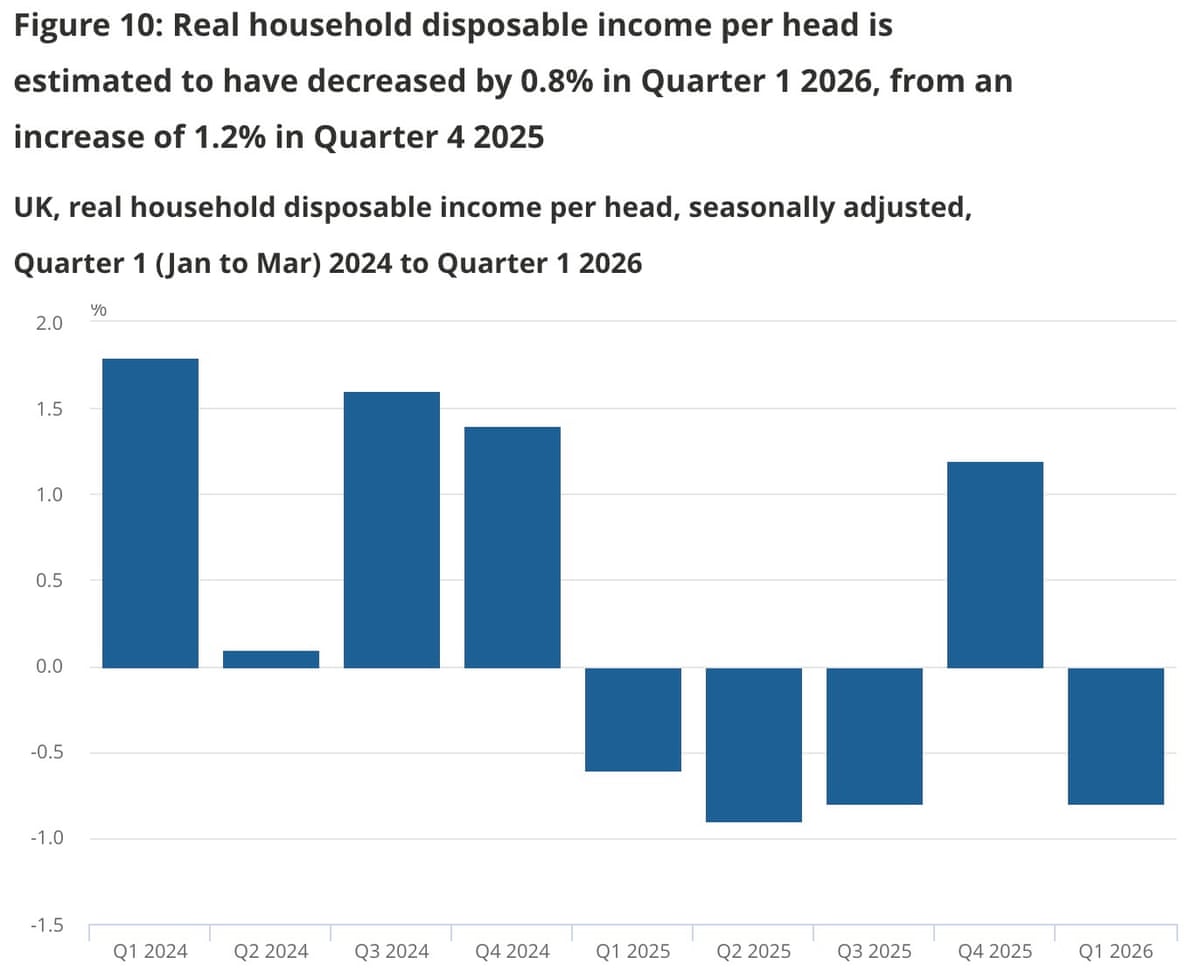
UK living standards declined in the first quarter of 2026 despite economic growth, underscoring the challenges Andy Burnham faces as he vows to "lift the country back up." New data released today by the Office for National Statistics (ONS) reveals that real household disposable income per head decreased by 0.8% in Q1 2026, indicating that individuals had less money available to spend after taxes.
The ONS reports that although wages and income from property increased during the quarter, these gains were outweighed by higher taxes on wealth and income, alongside a reduction in net social contributions.
The household saving ratio, which estimates the proportion of disposable income saved rather than spent, fell by 0.7 percentage points to 8.9%. This decline was driven by a reduction in non-pension savings, suggesting that rising living costs left households with less capacity to save.
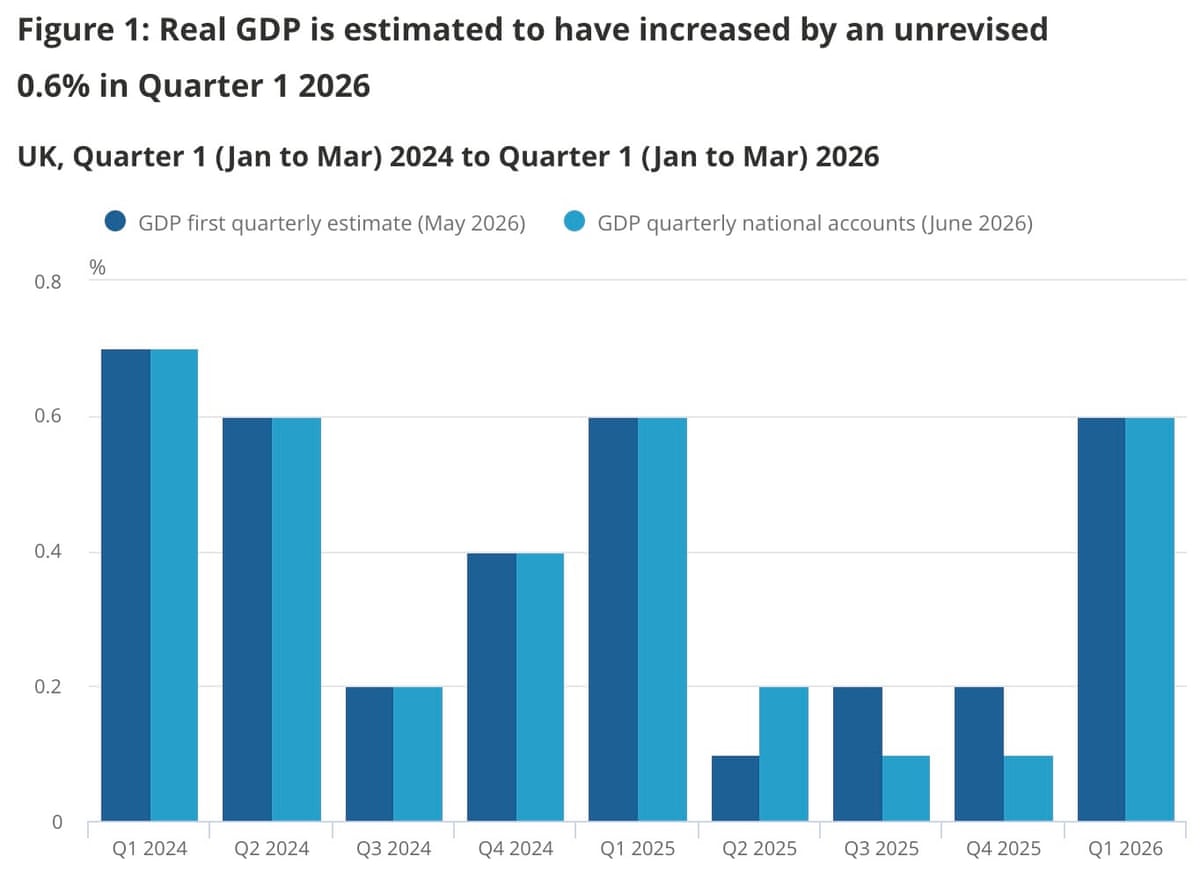
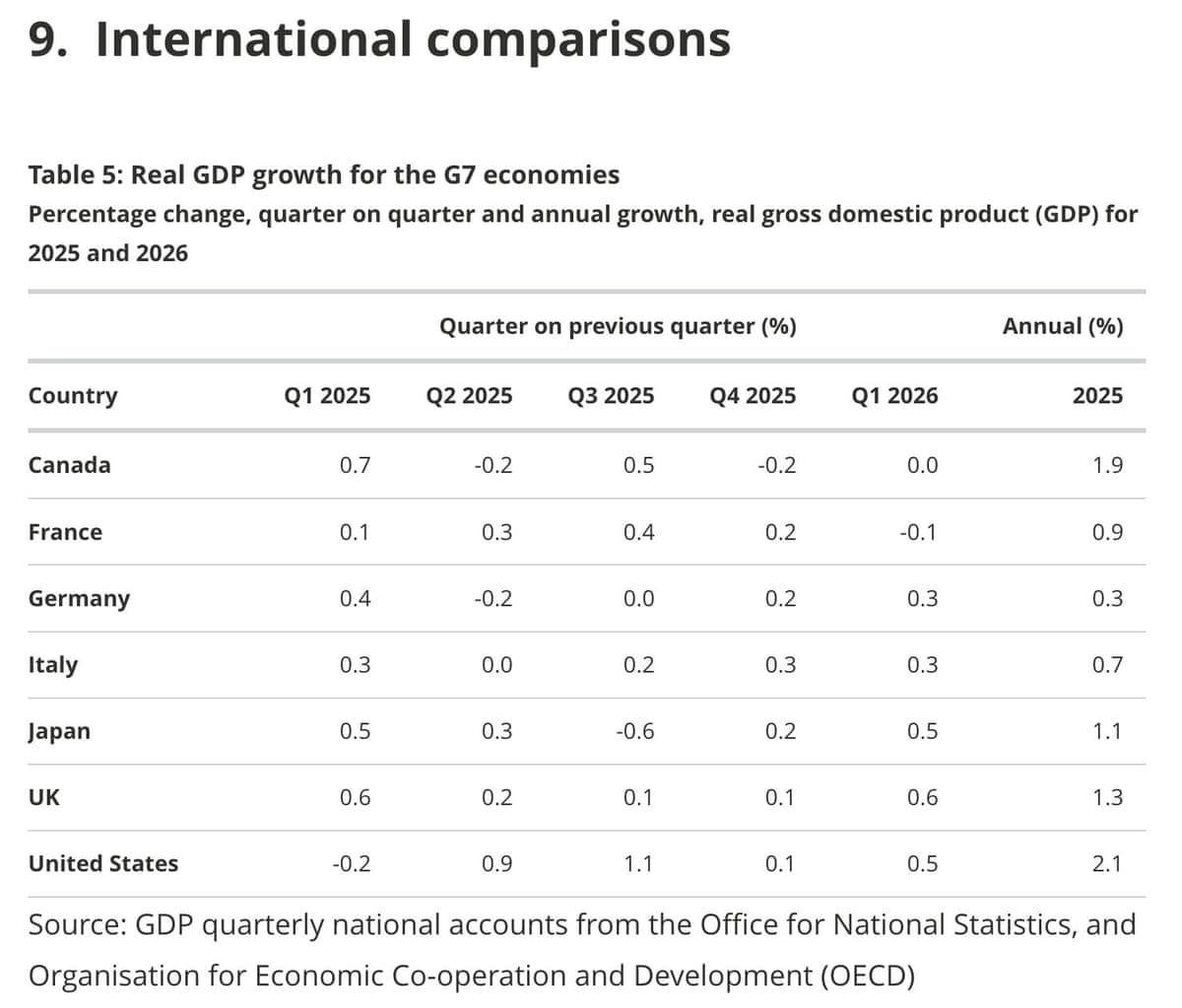
On a positive note, the ONS confirmed that the UK economy expanded by 0.6% in Q1, marking the fastest growth among G7 nations for January. This is a point of optimism for Rachel Reeves as Burnham considers potential chancellor appointments ahead of a likely succession of Sir Keir Starmer as Prime Minister.
However, the reduction in disposable income highlights that GDP growth alone does not guarantee a healthy economy benefiting all citizens.
“Our latest set of figures show no revision to economic growth in the first quarter of this year. However, growth for 2025 was revised down a little. Services were the main driver of growth in the latest quarter, with strength in computer programming, wholesale and advertising only partially offset by falls in rental companies and recruitment agencies. Production and construction also both grew overall, although construction only partly reversed its recent weakness. The household saving ratio continued to ease at the start of 2026 but remains above its pre-pandemic levels.”
— Liz McKeown, Director of Economic Statistics
The Agenda
- 7am BST: ONS releases UK quarterly accounts for Q1 2026
- 7am BST: German retail sales for May
- 8.55am BST: German unemployment report for June
- 2pm BST: US house price index for April
Three in Five UK Homes Listed This Year Remain Unsold
The UK housebuilding sector has experienced weakening demand in 2026, with three out of five homes listed since January remaining unsold, according to property portal Zoopla.
Zoopla reports a 15% year-on-year decline in buyer demand across the UK, attributing this to a combination of political uncertainty and increased borrowing costs.
“Higher mortgage rates and political uncertainty have shrunk the pool of committed home buyers, pushing sales agreed to 7% below last year. A change of Prime Minister and questions over future tax and spending priorities in the Autumn Budget have added to the uncertainty. At the same time, buyer demand has fallen by 15% YoY, with more people taking a wait-and-see approach until the outlook becomes clearer. However, this is not the first time that the market has absorbed economic and political uncertainty, with the 2022 mini-budget triggering a sharp fall in sales agreed of more than 20%, with the market recovering once mortgage rates stabilised.”
This situation has negatively impacted housebuilder shares this morning; Persimmon shares fell by 3.9%, and Barratt Redrow by 3.6%, leading declines on the FTSE 100 index.
German Unemployment Slightly Falls in June
Germany reported a decrease of 1,000 unemployed individuals in June, surpassing forecasts that predicted an increase of 7,000, according to labour office figures.
The seasonally adjusted unemployment rate remained steady at 6.3% in June, unchanged from the previous month.
“There is little sign of change in the labour market,” said Andrea Nahles, head of the labour office. “Unemployment is falling only slightly, and employment subject to social security contributions is continuing its slight downward trend.”
Axel Springer Completes Telegraph Takeover
European media conglomerate Axel Springer has finalized its £575 million acquisition of The Telegraph after securing all necessary regulatory approvals.
“Today is a day we have worked towards for a long time, and one we will always remember. Axel Springer was founded in 1946 under a British press license, and The Telegraph was our North Star. Axel Springer and The Telegraph share strong commitments to freedom, values, a tradition of embracing and pioneering technological change, and an entrepreneurial will to actively shape the future. This creates a strong foundation for further accelerating our AI-powered digital transformation. Together we can lead the next generation of trusted media.”
— Mathias Döpfner, CEO of Axel Springer
Axel Springer's acquisition thwarted a competing bid from the owner of the Daily Mail. The company also owns prominent outlets including Bild, Business Insider, Morning Brew, Politico, and WELT.
A 'Decent' Start to 2026 and Positive UK Inflation Outlook
Investec's Philip Shaw described the UK's 0.6% GDP growth in Q1 as “a decent start to 2026.”
“Attention will soon turn to the scale of any negative impact of the recent surge in energy prices. Indeed we envisage growth coming close to a halt in Q3, although the level of the saving ratio will give households in aggregate a cushion to absorb cost increases without an abrupt interruption in spending. Thereafter the unwinding of the energy price spike should form a tailwind and help to support expenditure and economy activity more widely.”
Investec has revised downward its forecast for UK inflation this year.
“We have lowered our forecast of the peak in inflation over the remainder of the year from 4.0% to 3.1% though, thanks to the sharp decline in energy prices and to May’s CPI data, which showed evidence of considerable disinflationary pressures in the pipeline prior to the Iran war. We feel more confident now that the 2.0% target will be in sight by end-2027.”
Rob Wood, chief UK economist at Pantheon, predicts that high inflation will limit growth in UK living standards through 2026, following the Q1 decline.
“The income side of the national accounts showed that real household disposable income dropped by 0.8% quarter-to-quarter in Q1, cutting a chunk from the 1.3% gain in Q4 2025, as higher inflation ate into real household earnings. Sticky inflation over the coming year—despite the recent drop in energy prices—will mean that real household disposable income grows only slowly for the rest of the year.”
Wood also anticipates households may continue to reduce savings to sustain spending.
“The household saving rate was estimated to have fallen to 8.9% in Q1, down from 9.6% in Q4 2025, as households smoothed through a fall in real incomes, keeping spending going. The saving rate still remains well above its 2015-to-2019 average of 6.5%, and the latest money and credit data for May—released yesterday—suggest that households are willing to save less over the coming months in order to keep smoothing their spending through the energy price shock. So, we continue to think that consumers’ spending can help GDP growth hold up over H2.”
Concerns Over UK Economic Growth Sustainability
Jonathan Raymond, investment manager at Quilter Cheviot, warns that despite the 0.6% GDP increase in Q1, the UK economy struggles to produce consistent and sustainable growth.
“GDP fell by 0.1% in April, suggesting activity has started to soften as we moved into the second quarter. That shift highlights how quickly conditions have changed and raises the prospect that the first quarter may prove to be a peak for growth rather than the start of a sustained recovery. The broader backdrop remains uncertain. While a ceasefire between the US and Iran has helped ease immediate pressure on energy markets, it remains a fragile agreement with key details still unresolved. That leaves the risk of renewed volatility in energy prices firmly in place, which continues to cloud the outlook for inflation and continues to negatively impact consumer and business confidence. At the same time, the UK is entering a period of heightened political uncertainty. The prospect of an Andy Burnham-led government has already prompted closer scrutiny from markets, particularly around fiscal policy and borrowing, and any change in direction risks feeding through into financing conditions for the wider economy. This leaves the Bank of England in a difficult position. Growth is showing early signs of slowing, but inflation risks remain sensitive to energy prices and policy uncertainty. Even a solid first quarter does little to shift the broader picture, with the UK economy still struggling to generate consistent and sustainable growth.”
UK Trade Deficit Slightly Larger Than Initially Estimated
Today’s national accounts indicate that Britain’s trade deficit was marginally larger than first estimated for January-March 2026.
Excluding non-monetary gold and other precious metals, the trade deficit was 1.0% of nominal GDP in Q1 2026, up from a previous estimate of 0.9%.
UK Energy Price Cap to Increase Tomorrow
UK households will face increased financial pressure starting tomorrow as the energy price cap rises.
The cap on electricity and gas provider charges will increase by 13% on 1 July, reaching the equivalent of £1,862 annually for a typical bill.
“Tomorrow’s price cap rise should be a red energy warning. Energy inefficient homes take lives in winter and will increasingly threaten the most vulnerable in summer; London Ambulance Service had its busiest day on record on Friday. Fuel poverty means many cannot experience a comfortable and safe temperature at home, because the building fabric makes it impossible or the cost of doing so makes it prohibitive. This is a public health emergency for the most vulnerable and needs to be addressed as such. Tomorrow’s cap rise is another blow for millions already struggling. The legacy of the energy crisis is millions of households locked into debt they cannot repay, and that is pushing up bills for everyone. If we fail to act, we risk seeing more households forced onto prepayment and effectively cut off from energy. That cannot be the answer to a problem caused by unaffordable bills. We need urgent action to clear this debt and stop costs being baked into the system. The right response is to scale debt relief. As our new paper, Clearing the Decks, sets out, that means enabling and expanding Ofgem’s Debt Relief Scheme with additional funding so more of this debt can be cleared, reducing harm and lowering costs across bills.”
— Adam Scorer, Chief Executive at National Energy Action
2025 Growth Revised Downward
Data released today also shows that the UK economy grew less than previously estimated in 2025, the first full calendar year under the Labour government.
The ONS now estimates UK GDP growth at 1.3% for 2025, down from an earlier estimate of 1.4%.
The revision reflects a downward adjustment for the second half of 2025, with a slight upward revision for Q2 2025.
UK Tops G7 Growth Table in Q1 2026
The UK’s 0.6% GDP growth in January-March 2026 narrowly outpaced other G7 countries.
The US and Japan followed closely with 0.5% quarterly growth, while Italy and Germany each grew by 0.3%. Canada’s economy stagnated, and France’s GDP fell by 0.1%, placing it on the verge of a technical recession.
Reasons Behind the Fall in Real Household Disposable Income Per Head
The decline in UK real household disposable income (RHDI) in Q1 2026 occurred despite increases in some income components:
- Compensation of employees rose by £8.2 billion
However, these gains were offset by:
- An increase of £6.9 billion in taxes on income and wealth
- A decrease of £5.1 billion in net social contributions
The ONS explains:
“The impact of the reduction in the tax-free allowance for capital gains, and the resulting increase in Capital Gains Tax payments, contributed to the increase in taxes on income and wealth.”