

Economists Predict BoE Rate Cut in March After Inflation Falls
Many economists anticipate the Bank of England (BoE) will reduce interest rates in March following the release of inflation data showing a decline to 3% in January.
Money markets currently assign an 86% probability to a rate cut at next month’s meeting, lowering the Bank rate from 3.75% to 3.5%. This probability has increased from 77% the previous night and 65% a week earlier.
Yael Selfin, chief economist at KPMG UK, stated, "Today’s inflation data will likely prompt the Bank of England to lower interest rates next month. The MPC will welcome the broad-based fall in inflation, with both headline and underlying measures of inflation easing. Given the favourable inflation outlook, the Bank is expected to cut interest rates three times this year, leaving interest rates at 3% by the end of 2026."
She added, "Headline inflation has gradually eased since last summer and is expected to fall further as food and energy prices drop. The combined impact of the government’s energy bill package and the fall in wholesale gas prices could see household energy bills decrease by around 7% from April. Forward-looking data also points to food prices softening over the coming months, as recent declines in global food prices are passed on to households, with the recent adverse weather episodes across Europe not yet making their mark."
Rob Morgan, chief investment analyst at wealth manager Charles Stanley, predicted, "Another reduction as soon as the March meeting is now firmly on the table, and that’s unlikely to be the end of the matter with one or two further cuts likely as the year progresses."
The Bank’s recent decision reflects how close the Monetary Policy Committee (MPC) is to easing. The MPC voted 5-4 to maintain the Bank Rate at 3.75%, a tighter margin than the widely expected 7–2 split. Notably, long-time hawk Catherine Mann indicated a shift in her stance, acknowledging that new analysis has "moved the appropriate time for a cut closer." With Governor Bailey’s vote pivotal and Mann softening, the MPC’s balance appears to be tilting toward easing.
The Bank’s updated forecasts reinforce this shift, projecting CPI to fall to 2.1% by Q2 2026, down from 2.8% in the previous forecast, driven by lower energy costs and fiscal measures from the Autumn Budget. More notably, inflation is expected to dip below target to 1.7% next year and remain subdued through 2028, a significant change from earlier forecasts that anticipated inflation above target into the 2030s.
Trade Union Congress (TUC) general secretary Paul Nowak urged swift action, saying, "Inflation easing is welcome news for working people. And it’s right that the government has reduced the pressure - cutting energy bills, freezing rail fares and prescription charges, and raising the minimum wage. But after years of falling living standards millions of families are still struggling to make ends meet. With households squeezed there’s less money being spent on the high street - holding back businesses and choking off growth. The Bank of England must now act. From next month we need a series of quick fire interest rate cuts. That would put money back into people’s pockets, give businesses the confidence to invest and help Britain finally move on from a cost-of-living crisis that has dragged on for far too long."
But Rate Cut Might Not Come Until April
Not all economists expect a rate cut in March. Ellie Henderson of Investec believes the BoE’s MPC will delay cuts until April.
Henderson noted, "For now though, inflation at 3.0% is still some way above the Bank of England’s 2.0% target, meaning that caution should still prevail when it comes to loosening policy further. On the economic data available to us thus far, our base case remains that the next cut will not be until April, with the fact that today’s numbers exceeded the Bank of England projection a reason to support that call."
She added, "However the risk of a March cut has certainly risen over the past month or so, not least because it seems as if there are more dovish voices on the committee than we previously thought. We next look to retail sales data for January, and ‘flash’ PMIs for February at the end of the week to provide a more rounded view of the health of the UK economy and the implications that has for price pressures."
Debapratim De, director of economic research at Deloitte, also supports an April cut, stating, "The sharp slowing of price rises in January is consistent with expectations of inflation plummeting over the coming months. A substantial reduction in energy bills, much slower rises in regulated prices compared to last year, and a moderation in food price rises are set to bring headline inflation at or close to the Bank of England’s 2% target in April. This, alongside a softening labour market, should create room for further interest rate cuts. Recent MPC voting patterns and today’s data point to an earlier easing than markets foresee. We expect two 25-basis-point cuts between now and autumn, with the first cut coming in April."
Professor Costas Milas of the University of Liverpool’s Management School commented, "We might as well trust the forecasting instincts of the public which predicted 2.8% one year ago (compared to the poor 2.3% forecast of the BoE). When I decompose inflation to its drivers, I find that the latest cuts in Bank Rate are unfortunately keeping inflation higher than it should be. Therefore, I agree with BoE’s Chief Economist Huw Pill who noted that we ‘need to retain some restrictiveness in the stance of monetary policy until that process of disinflation is complete’. In other words, we should wait to see a drop in inflation closer to 2.5% before the MPC cuts Bank Rate further. The next inflation reading is on the 25th of March, that is, after the MPC’s March decision (on the 19th of March)."
ING: Services Inflation Is Proving Sticky
Economists at ING have expressed concerns that UK services inflation remains persistent.
James Smith, ING’s developed markets economist, explained, "Headline inflation is down from 3.4% to 3.0% in January, largely as expected. It’s a consequence of a seasonal fall in air fares, lower fuel prices and the impact of last year’s private school VAT change dropping out. Most importantly, though, food inflation is down sharply – from 4.5% to 3.6%. That’s roughly in line with BoE forecasts, but it should help the hawks become a little more relaxed about the upside risks to inflation. A big concern last year was that higher food inflation would spark a much wider and more persistent bout of price pressure. Those concerns now look overblown."
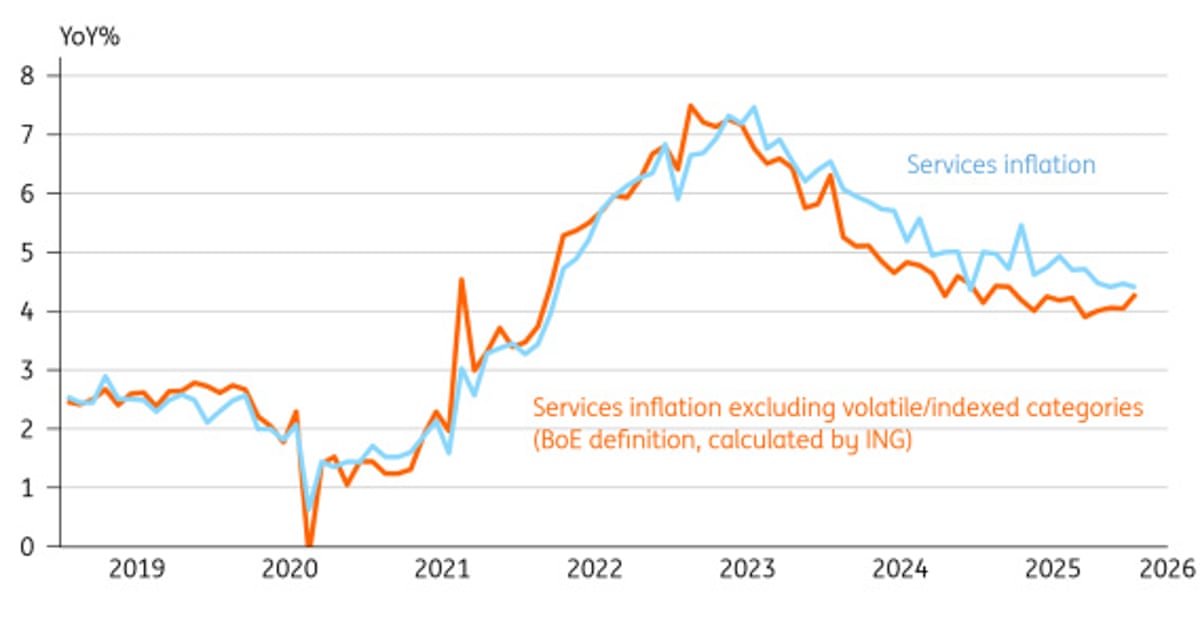
He continued, "But services inflation was stickier than expected in January. Importantly, that’s not really because of quirks like air fares or holidays. In fact, we calculate that the Bank’s preferred measure of ‘core services’ inflation nudged up from 4.0% to 4.3%, once volatile and indexed items are excluded. Catering – often seen as the archetypal service-sector category, one that’s driven by underlying economic demand – has nudged a little higher over the past couple of months."
Education inflation slowed in January, according to the Office for National Statistics (ONS). This is because it has now been a year since the government introduced VAT on private school fees.
Prices in the education division rose by 5.1% in the 12 months to January 2026, down from 7.6% in the 12 months to December 2025. On a monthly basis, prices were unchanged in January 2026, compared with a rise of 2.4% a year ago. The downward contribution came entirely from private school fees, which rose by 12.7% a year ago after becoming subject to VAT, with no change in price in January 2026.
FTSE 100 Hits Record High
Britain’s stock market reached a new all-time high at the start of trading in London. The FTSE 100 index of blue-chip shares gained 41 points, or 0.4%, to an intraday high of 10,597 points, as investors anticipate UK interest rate cuts this year amid easing inflation.
The index has risen 6.6% so far this year. Weapons manufacturer BAE Systems was the top riser, up 5% after exceeding City forecasts with a 12% increase in operating profits for the last year.
Chief executive Charles Woodburn told investors, "In a new era of defence spending, driven by escalating security challenges, we’re well positioned to provide both the advanced conventional systems and disruptive technologies needed to protect the nations we serve now and into the future."
Core Inflation Dropped in January Too
Underlying inflation also declined in January. Core CPI, which excludes energy, food, alcohol, and tobacco, rose by 3.1% in the 12 months to January 2026, down from 3.2% in December 2025.
Goods inflation decreased from 2.2% to 1.6%, while services inflation slightly fell from 4.5% to 4.4%.
Derrick Dunne, CEO of YOU Asset Management, described this as a "crucial" development, saying, "This is a significant slowdown in the rate of inflation and effectively clears the way for the Bank of England to proceed with rate cuts, especially given the broader picture of faltering GDP growth and labour market weakness. Perhaps most crucial in today’s data is that core inflation has now fallen to its lowest level since September 2021. Core inflation has remained stubbornly high for a number of years now and has been one of the main drivers of rate caution from the Monetary Policy Committee in recent decisions. Rate cuts are already priced in by markets, but if employment and GDP figures continue to disappoint then we could see rate cut expectations grow. This could come from additional cuts beyond the two forecast in March and June or from larger cuts to get ahead of the economic slowdown."
Chancellor Rachel Reeves attributed the drop in inflation to 3% in January to government measures, stating,
"Cutting the cost of living is my number one priority. Thanks to the choices we made at the budget we are bringing inflation down, with £150 off energy bills, a freeze in rail fares for the first time in 30 years and prescription fees frozen again. Our economic plan is the right one, to cut the cost of living, cut the national debt and create the conditions for growth and investment in every part of the country."
It should be noted that the freeze on NHS prescription charges applies to the 2026/27 financial year and was not a factor behind January’s inflation drop, although it is expected to lower inflation in April.
Food Inflation Lowest Since April 2025 After Prices Fall in January
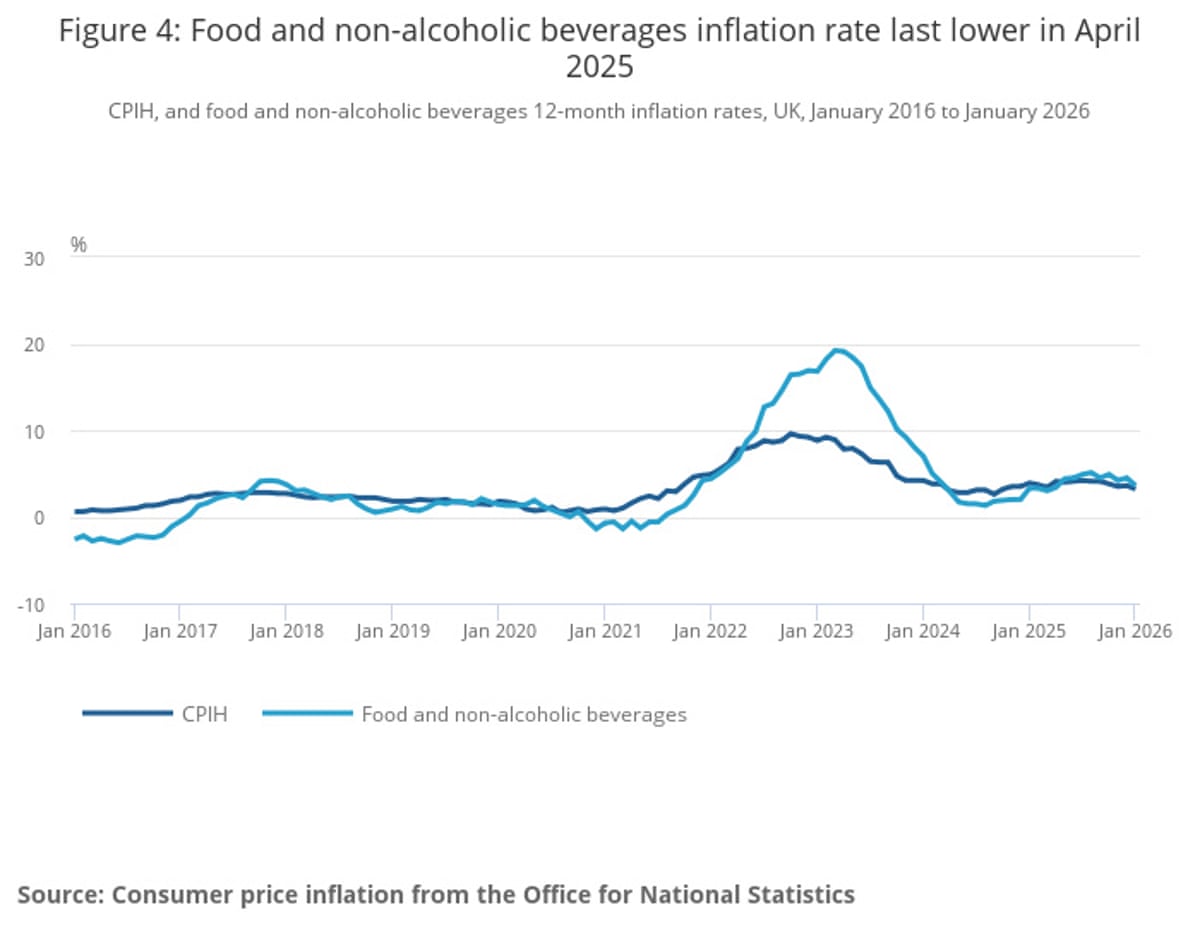
Food inflation has declined to its lowest level in nine months, easing the cost of living pressure on households. The ONS reported that prices for food and non-alcoholic beverages rose by 3.6% in the 12 months to January 2026, down from 4.5% in the 12 months to December 2025.
On a monthly basis, food and non-alcoholic beverages prices fell by 0.1% in January 2026, compared with a rise of 0.9% a year earlier.
The ONS noted price decreases month-on-month in six food categories, including bread, meat, and dairy products:
- Bread and cereals – down 0.04 percentage points
- Meat – down 0.02 percentage points
- Milk, cheese and eggs – down 0.01 percentage points
- Food products not elsewhere classified – down 0.01 percentage points
- Coffee, tea and cocoa – down 0.01 percentage points
- Mineral waters, soft drinks and juices – down 0.01 percentage points
Dr Liliana Danila, lead economist at The Food and Drink Federation (FDF), commented, "It’s positive to see a lower rate of food inflation in January, however it still remains a real worry for household budgets and above long-term averages. After many years of rising costs businesses across the supply chain have had their margins eroded, leaving manufacturers particularly susceptible to the supply chain shocks caused by geopolitics or climate change. We’ve previously seen the impact that this can have on inflation, with prices of ingredients like cocoa and coffee skyrocketing, so the UK’s recent extreme wet weather flooding farms is a concern for the year ahead. To help stabilise food inflation in the long term and protect shoppers from future price spikes, government must incentivise investment in business resilience."
Bank of England Rate Cut Now Seen as More Likely
The likelihood of an interest rate cut next month has increased following the news that UK inflation fell to 3% in January. Money markets now indicate an 81.5% chance of a quarter-point rate cut, up from 77% the previous night and approximately 65% the prior week.
The BoE’s MPC voted narrowly to keep rates on hold earlier this month in a 5-4 split, so a single 'hold' voter changing position could lead to a cut.
Scott Gardner, investment strategist at JP Morgan Personal Investing, said, "Inflation fell sharply in January, providing some relief to UK consumers at the start of the year. Prices are clearly moving in the right direction, with closely watched core and services inflation continuing their downward trend from previous months. Behind the headline figure, motorists were helped as petrol pump prices continued to decline in January to their lowest level since summer 2021. Food inflation also fell after the Christmas period but is still a key area to watch in 2026 as it accounts for a large part of the UK’s everyday spending. Industry barometers suggest that weekly supermarket shops are still elevated with fresh produce prices rising over the month. In theory, this fall in inflation could signal a rate cut from the Bank of England at its March meeting barring any surprises between now and then. The progress made on the inflation front over recent months and clear cooling in the jobs market could encourage policymakers to cut interest rates for a seventh quarter in a row. With that said, the Bank of England will remain vigilant as services inflation remains elevated."
UK Factory Gate Inflation Slows as Input Costs Drop
Another positive indicator is the decline in costs paid by UK factories last month. The ONS reported that producer input prices fell by 0.2% in the year to January 2026, down from 0.5% in the year to December 2025. This decrease was mainly due to cheaper crude oil, with prices falling 23.8% over the past year.
With input costs declining, factories faced less pressure to raise their own prices. Producer output prices, or prices at the ‘factory gate,’ rose by 2.5% in the year to January 2026, down from 3.1% in the year to December 2025.
ONS chief economist Grant Fitzner said, "The cost of raw materials for businesses fell over the past year, driven by lower crude oil prices, while the increase in the cost of goods leaving factories slowed."
How Petrol and Air Fares Pushed Down Inflation
A reduction in transport costs contributed to the decline in UK inflation in January. The ONS reported that prices in the transport division rose by 2.7% in the 12 months to January 2026, down from 4.0% in the 12 months to December 2025.
The largest downward effect came from motor fuels, where the average price of petrol fell by 3.1p per litre between December 2025 and January 2026. This pushed the average petrol price down to 133.2p per litre in January 2026, compared with 137.1p per litre a year earlier.
The second-largest downward effect came from air fares, which typically rise in December and fall in January, as illustrated by the following chart:
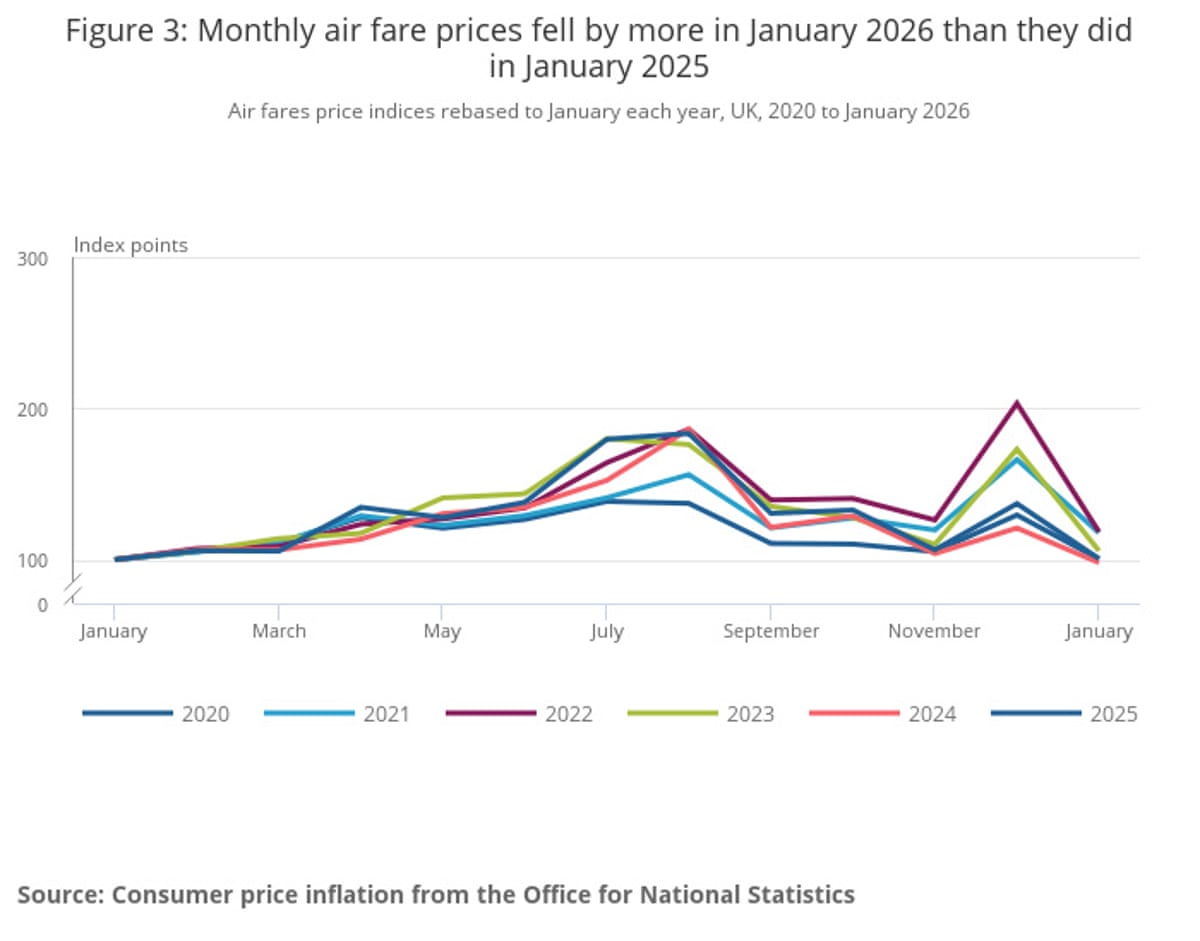
While the pattern of air fares rising into December and falling into January was less pronounced last year, this year’s index followed a more conventional pattern, possibly because return flights in December did not fall on Christmas Eve and New Year’s Eve. The more pronounced rise into December 2025 and fall into January 2026 led to a large upward contribution to the annual rate change in December 2025 and a large downward contribution in January 2026.
ONS: Decrease in Petrol Prices Pushed Inflation Down
Grant Fitzner, ONS chief economist, said, "Inflation fell markedly in January to its lowest annual rate since March last year, driven partly by a decrease in petrol prices. Airfares were another downward driver this month with prices dropping back following the increase in December. Lower food prices also helped push the rate down, particularly for bread & cereals and meat. These were partially offset by the cost of hotel stays and takeaways."
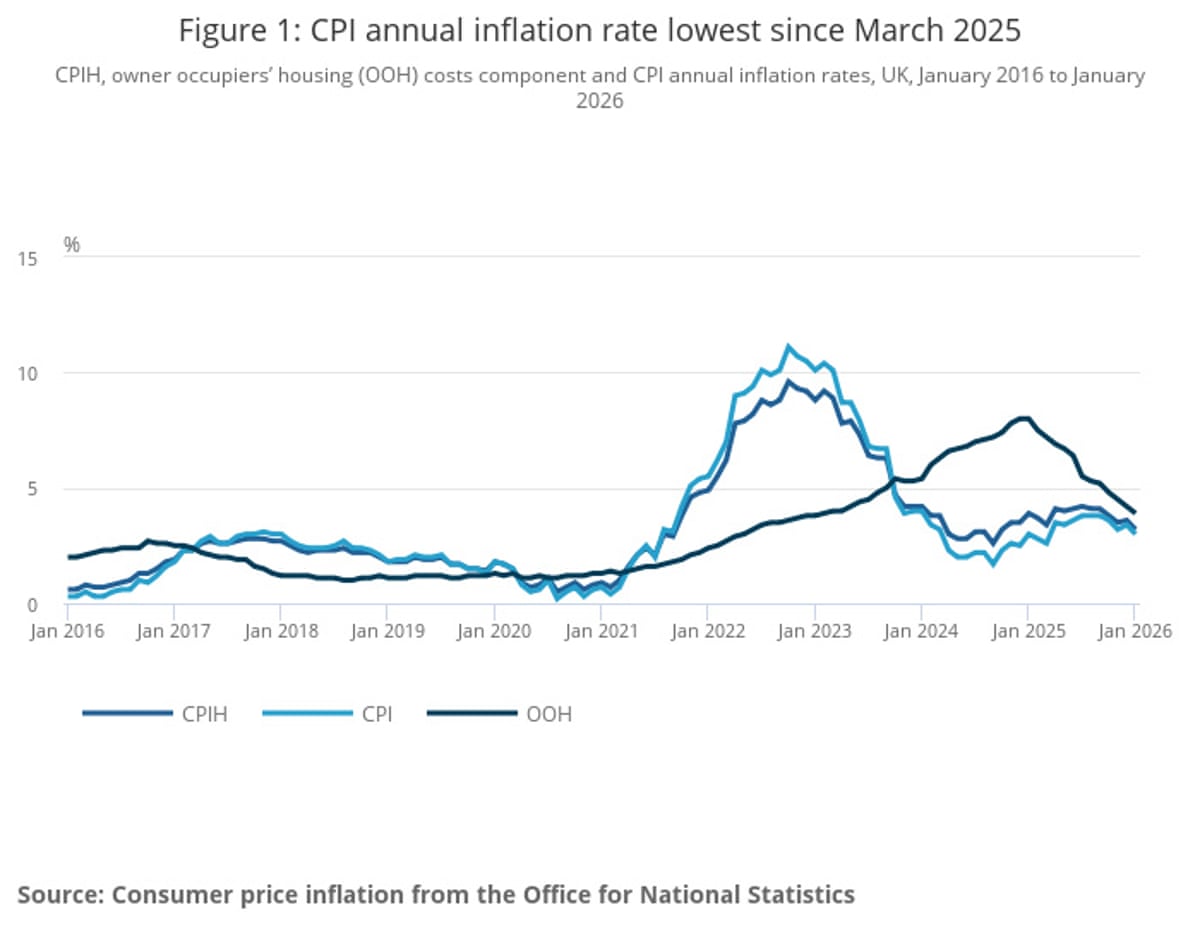
Chart: CPI Annual Inflation Rate Lowest Since March 2025
The ONS reported that prices fell by 0.5% on a monthly basis in January. Transport, food, and non-alcoholic beverages made the largest downward contributions to this monthly change.
UK Inflation Falls to Lowest Since March 2025
Britain’s inflation rate has dropped to its lowest level in nearly a year. The Consumer Price Index (CPI), which measures price changes across the economy, fell to 3.0% in January 2026, according to the ONS, aligning with City forecasts. This is down from 3.4% in December 2025 and represents the lowest annual inflation rate since March 2025.
A significant drop in inflation could pave the way for the Bank of England to reduce interest rates next month. The money markets currently estimate a 77% chance of a rate cut in March, following a rise in UK unemployment reported the previous day.
Grant Slade, economist at investment research firm Morningstar, forecasted, "We expect tomorrow’s CPI data release to further evidence that price growth in the UK is decelerating. We forecast annual CPI inflation of 3.0% in January 2026, down 0.4 percentage points relative to its prior reading in December. A modest output gap is forming in the UK, with economic growth slowing in the fourth quarter of last year."


