

Introduction: UK house prices inch higher in June
Good morning and welcome to our rolling coverage of business, the financial markets and the world economy.
UK house prices nudged up 0.2% in June compared with the month prior, according to new figures from the lender Lloyds.
The average price for a home is now £299,330, it found, compared with £298,812 in May.
On an annual basis, house prices are up 0.6% – slightly higher than an annual growth rate of 0.5% in May. Northern Ireland remains the clearest outlier, with an annual growth rate of 7.4%.
Amanda Bryden, head of mortgages at Lloyds, said the figures reflected wider economic uncertainty.
Recent price trends continue to reflect wider economic uncertainty, including the impact of global events on inflation and interest rate expectations. While affordability remains stretched for many buyers, mortgage rates have eased from their recent highs, offering some encouragement to those considering a move.
While latest industry data shows the number of new mortgage approvals dropped in May, this wasn’t unexpected given the spike in rates seen earlier this year, and we’d expect to see activity recover assuming borrowing costs continue to fall.
…Looking ahead, we expect the housing market to continue moving at a measured pace. Lower borrowing costs should provide some support for demand, though affordability constraints remain an important factor. The outlook for house prices will depend largely on inflation continuing to ease and household confidence gradually improving.”
Meanwhile overnight, Asian stocks have been broadly falling as the chip sector has come under pressure. The MSCI Asia Pacific index is down 1.4%.
Samsung Electronics, which has been one of the best performing stocks in the region this year having more than doubled its share price, dropped as much as 10% despite reporting a 19-fold jump in profit. The chipmaker SK Hynix dropped 6%, and the South Korean Kospi index dropped 5.3%. Earlier in the day an 8% drop in the index triggered a temporary trading halt.
The agenda
- 7am BST: Lloyds house prices for June
- 9.30am BST: Fiscal risks and sustainability report from the Office for Budget Responsibility
- 10.30am BST: Bank of England Financial Stability report
- 1.30pm BST: US May trade balance
Thames Water creditors ‘will bid for company even if it is nationalised’
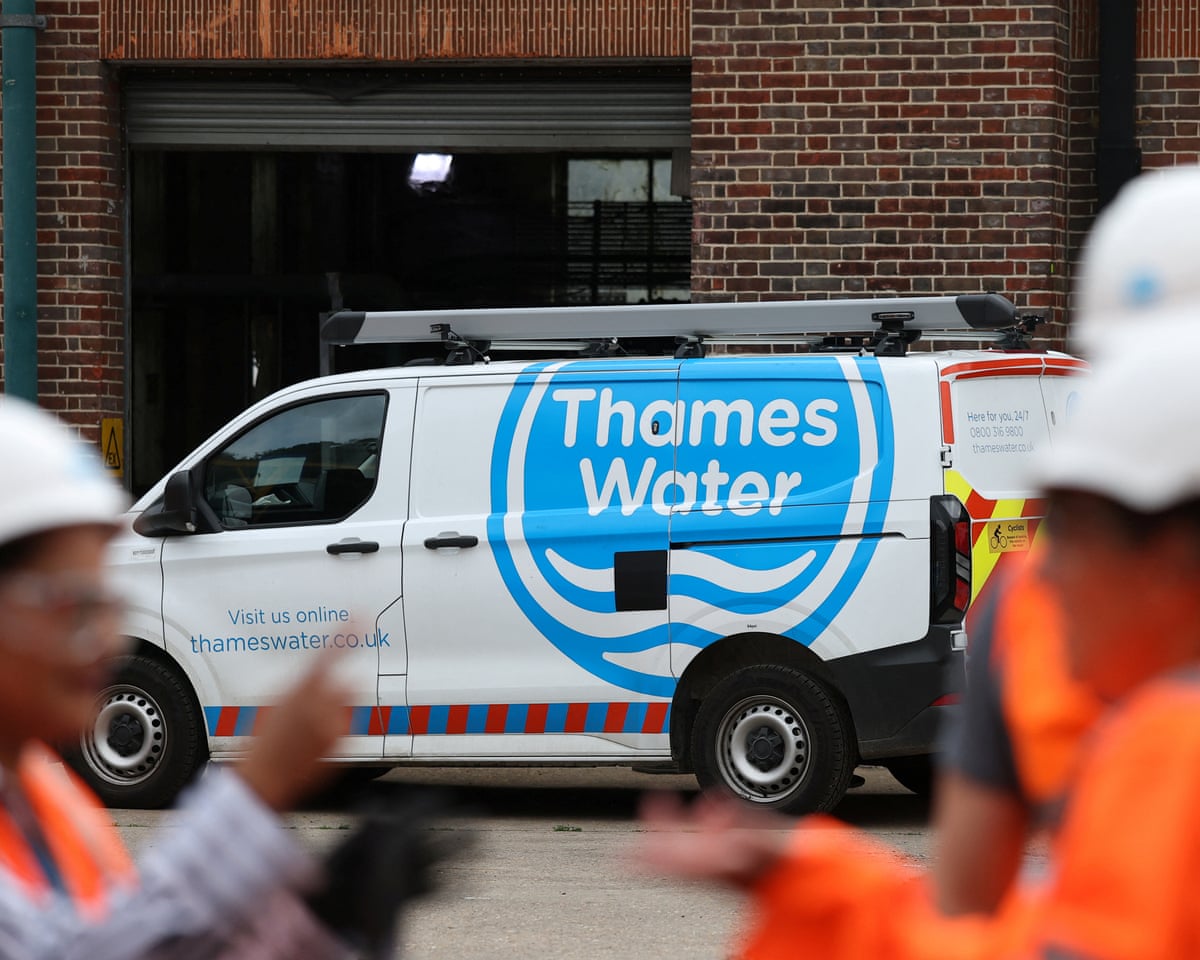
Thames Water’s creditors are willing to pursue their bid for the debt-laden company even if the probable next prime minister, Andy Burnham, brings it into temporary nationalisation.
The group of 100 institutional investors, which hold about £14bn of Thames’s senior debt, are still discussing a £10bn rescue proposal for the struggling company with officials from the regulator Ofwat, and they have held meetings in recent days.
Emma Reynolds, the environment secretary, objected to the proposal in mid-June because it would place an “undue burden” on consumers, pushing Britain’s biggest water company closer towards a form of temporary nationalisation called a special administration regime (SAR).
Creditors would want to buy Thames out of temporary nationalisation as they regard it as a process but not a solution, sources said, in news first reported by the Financial Times.
Britain will need more tax rises or spending cuts to avoid debt spiral, OBR says
Britain will need more tax rises or spending cuts early next decade to prevent government debt spiralling, the Office for Budget Responsibility has warned in its annual “fiscal risks and sustainability” report.
The independent budget watchdog found that government debt was likely to move onto an “unsustainable and ever-rising path” unless the government takes action to manage spending on health, social care and the state pension.
The increase in the UK’s public debt as a share of GDP has been one of the steepest of any advanced economy over the past two decades, the OBR found. It said this was partly due to an ageing population, and forecast that spending on health will rise from 8% of GDP in 2030-31 to 13% of GDP by 2075-76.
It would be possible to maintain current public debt levels at around 95% from 2030/2031 onwards via spending cuts or tax rises that cut the deficit by 3.8% of GDP in that year, the OBR said.
This represents a one-year adjustment that would be around a third larger than the tightening the government plans to deliver over the coming five years, and roughly equivalent to total onshore corporation tax receipts or current departmental spending on education in 2030/31.
It added that the adjustment would need to be 8% of GDP if action is delayed until the early 2050s. It said:
This would make it more costly and place more of a burden on future generations.
ITV shares sink 6% as investors digest Sky deal
Shares in ITV are down 6% this morning, making it one of the worst performers in London’s stock market, as investors digest the announcement yesterday that it agreed to sell its broadcast and streaming business to Comcast’s Sky for £1.6bn.
Analysts at the bank JP Morgan have downgraded their view on ITV stock from “overweight” to “neutral” and cut its price target from 104p to 85p. The shares are currently trading just above 76p.
Shares in ITV are now down about 4.8% in the year to date.
Over in the All-Share, the construction specialist Keller Group is the best performer, with its shares up 18% this morning after an upbeat trading update.
The chemicals company Victrex is a close second, with its shares up 17% after it told investors that its aerospace and electronics division was keeping up growth.
Capita is the worst performer across the index, with its shares slumping 16% after the professional services company issued an apology about delays in administering the civil service pension scheme.

Shell agrees to sell South African fuel business to UAE's state energy company
Another reason Shell’s shares are rising today – it has agreed to sell its fuel supply business in South Africa to UAE’s state energy company, Adnoc Distribution.
The $1bn (£750m) deal covers 580 service stations and other operations and is expected to close next year, Adnoc said.
Adnoc Distribution chief executive Bader Saeed Al Lamki said the deal reflected the group’s belief in South Africa’s “high-potential, well-regulated fuel retail sector”. The brand had fuel volumes of approximately 3.5bn litres and operated 360 convenience stores as of 2025, it said.
Adnoc Distribution, which is listed on the UAE’s stock exchange, said the deal is expected to boost its earnings per share by 6% in the first full year after it completes.
Shares in Shell are up 2.5% this morning.
FTSE 100 opens higher, European stock market lags
The UK’s blue chip 100 index has opened 0.3% higher this morning, boosted by a 2.2% rise in Shell’s shares after the energy company’s update this morning.
That puts the UK stock market ahead of Europe, with the Stoxx Europe 600 (which tracks the biggest companies on the continent) down 0.1%. The European index is being dragged down by its tech sector, with the French Soitec – a manufacturer of chip materials – down more than 7% and the worst performing stock in the group.
Young's pubs get World Cup boost
More evidence that the football World Cup is providing a much needed boost for British pubs: operator Young & Co has said that its like-for-like sales rose nearly 6% in the first 14 weeks of its financial year thanks to good weather, and the World Cup drawing more drinkers to its pubs and gardens.
It said revenue was up 9.4% overall for the period between March 31 and July 6, thanks to the newly acquired Cubitt House pubs, and up 5.5% on a like-for-like basis.
Chief executive Simon Dodd said:
Our premium, well-invested and differentiated pubs and bedrooms continue to deliver, with Young’s pubs performing strongly in the first quarter. This was supported by favourable weather, a busy summer of sport, with England’s success in the World Cup so far a welcome boost, and contributions from our expanded estate, as we integrate the Cubitt House pubs.
While the backdrop remains challenging, we are well positioned and looking ahead to the rest of the year with confidence.
Its shares are up by 2.9% this morning.

Also this morning: the oil giant Shell has said that it expects gas trading in its second quarter to be “significantly” higher than in the first.
It did however flag that output is expected to be much lower than in the first quarter because of the impact of the conflict in the Middle East, including the production freeze at its gas-to-liquids facility in Qatar in mid-March after an attack on the Ras Laffan Industrial City damaged the facility.
It expects its integrated gas output in the April-to-June period to be about 610,000 to 650,000 barrels of oil equivalent per day, down around 30% from the 909,000 boed in the first quarter. It previously expected a range of 580,000 to 640,000 boed.
Oil prices rise after reports of attack on vessel in strait of Hormuz
While many markets are holding out for less economic uncertainty and geopolitical volatility, there appears to have been a flare up this morning – oil prices are rising after an attack on a vessel in the strait of Hormuz, the key shipping channel that was closed due to the US-Israel war with Iran.
Brent crude, the international benchmark, is up 1.1% today, back up above $72 a barrel. Reports suggest a liquefied natural gas carrier was hit by a projectile near the Omani coast as it exited the strait of Hormuz in the early hours of Tuesday.
Tom Bill, head of UK residential research at the estate agent Knight Frank, says that house prices are “going sideways” as a result of higher mortgage rates since the start of the war in the Middle East.
The good news is that geopolitical risks are subsiding as both sides move gradually towards a ceasefire and mortgages are edging lower. The bad news is that domestic political risks are rising and various trial balloons about changes to property taxation are being floated for the third consecutive year, which will keep a lid on activity and prices this summer.”
Meanwhile Amy Reynolds, head of sales at a Richmond estate agency Antony Roberts, says that while the market is broadly flat, it is expected given that fixed-rate mortgages have been “sitting at an artificially elevated level, driven as much by lenders managing a surge in applications as by the underlying economics”.
The encouraging news is that brokers are already seeing the first signs of a correction coming through on fixed rates – not a return to the sub-4% deals of six weeks ago, but a genuine easing from where we’ve been.
If this continues, we’d expect to see it feed through into more confident buyer activity over the coming months, rather than the cautious, wait-and-see approach that’s kept price growth so muted.
We’re also seeing more interest in tracker mortgages, priced off base rate rather than a fixed margin, as buyers hedge against uncertainty while keeping the option to switch to a fixed deal without penalty once pricing settles further. In short: these figures reflect the peak of the rate squeeze, not the start of a new slowdown, and there’s a reasonable case for a gentler market from here, as well as a reason for cautious optimism.”
Modest rise in UK house prices is the first increase in four months, Lloyds says
The modest 0.2% month-on-month rise in UK house prices in June represents the first increase in four months, Lloyds has said. In May, prices had slipped by 0.2% compared with the month prior.
Bryden adds that for first-time buyers, annual house price growth rose from 0.8% in June from 0.3% in May. The average first-time property now costs £240,433, according to Lloyds.
London remains the most expensive market in the UK, where an average property costs £534,831 – though prices here fell by 1.1% year-on-year in June. More broadly, the south east was the worst performing region across the UK, with prices down 2% y-o-y.
Scotland was the second strongest behind Northern Ireland, where prices were up 3.9% to an average of £223,277.
In Wales, prices were up 0.9% on an annual basis to £231,142. In the north east of England, prices were up 2.8% to an average of £181,133, while the north west recorded a rise of 2.4% to £248,218.


