

UK economy failed to grow in January
The UK economy stagnated in January, experiencing no growth in GDP even before the escalation of the Iranian conflict increased energy prices.
The Office for National Statistics (ONS) reported that UK GDP remained unchanged in January, contrary to expectations of 0.2% growth.
Monthly GDP data indicated zero growth, following increases of 0.1% in December and 0.2% in November 2025.
Sector-wise, services showed no growth, production declined by 0.1%, while construction increased by 0.2% in January 2026.
These figures suggest the economy was weaker than previously estimated prior to the looming energy price shock.
Brent crude oil prices remain above $100 per barrel, continuing to rise since the onset of the Iran war nearly two weeks ago.
Estate agent activity slumped
A decline in the property sector negatively impacted the economy over the three months leading to January.
The ONS reported a 7.1% decrease in "real estate activities on a fee or contract basis" during this quarter.
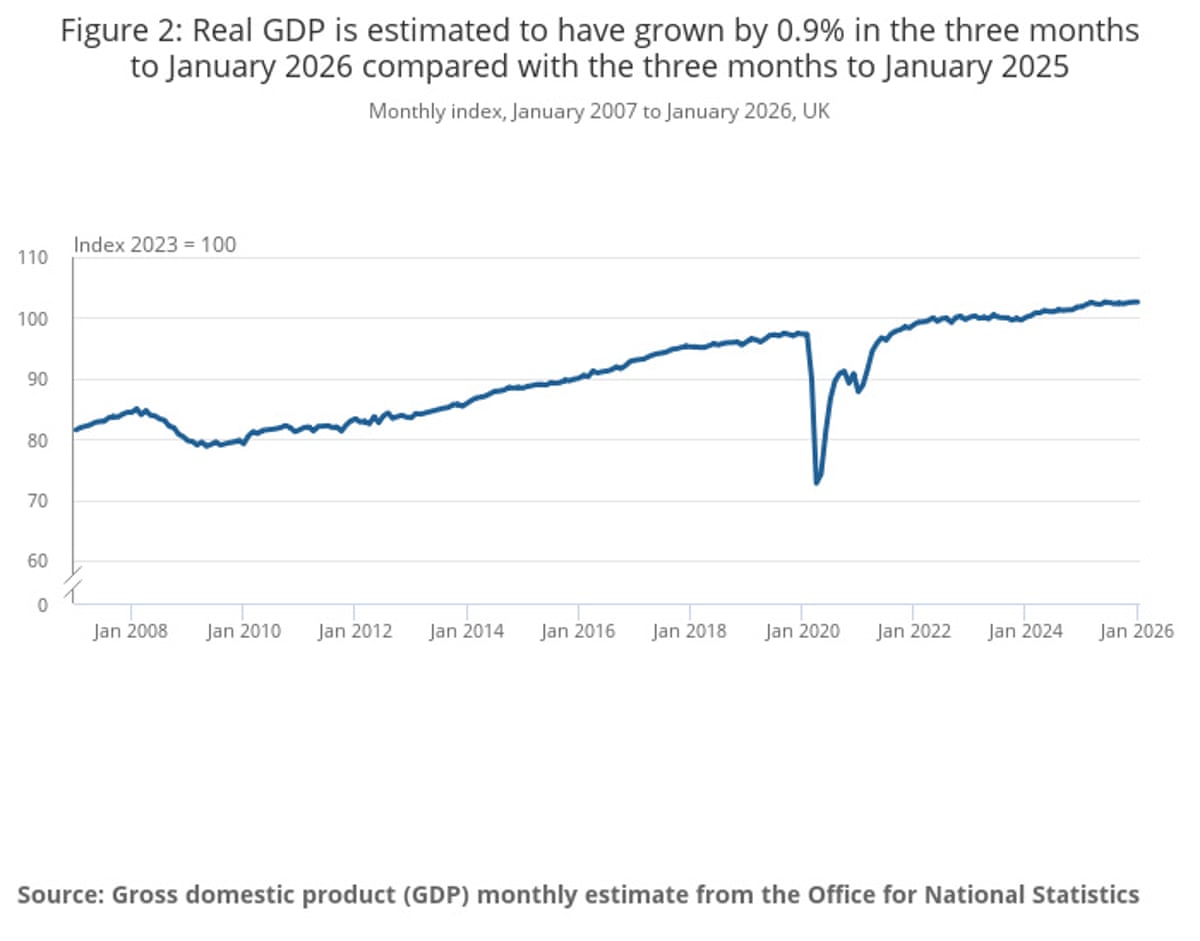
On an annual basis, UK GDP was estimated to be 0.8% higher in January 2026 compared to January 2025, marking a relatively poor performance historically.
UK grew 0.2% in last three months
For the three months ending in January, the UK economy grew by 0.2%, an increase from 0.1% growth in the preceding three months to December.

This growth partly reflects increased activity at Jaguar Land Rover's car factories following a cyber attack in September that had halted production.
"Growth ticked up slightly in the latest three months, partly reflecting the recovery of car manufacturing, following the cyber incident in the Autumn. Within services, which also increased, wholesale continued to rebound from a weak summer. However, the overall picture remains subdued, with no growth in the latest month.
There was another large fall in the construction industry in the latest three months, with continued contraction in housebuilding."
These remarks were made by Liz McKeown, ONS director of economic statistics.
Introduction: UK GDP report for January
Good morning, and welcome to our continuous coverage of business, financial markets, and the global economy.
Since January, significant developments have occurred, including conflict in the Middle East that has driven oil prices to $100 per barrel, disrupted supply chains, and raised concerns about stagflation.
Consequently, the latest indicator of the British economy's health may already be outdated as it is released this morning.
The UK GDP report, scheduled for release at 7am, was anticipated to show a 0.2% growth in January 2026, up from 0.1% in December.
Under normal circumstances, this would be viewed as evidence of a strengthening recovery. However, the potential for an energy price shock suggests caution among government officials.
"After a disappointing end to the year, we expect the economy to jump to a flying start in Q1-26. Indeed, activity data has thus far been encouraging. And we expect some catch up in the first couple of months of the year, after a weak Q4-25."
Sanjay Raja, Deutsche Bank’s chief UK economist, provided this analysis.
He added that the upcoming GDP report is unlikely to dominate market attention, as ongoing events in the Middle East overshadow delayed economic data.
The unfolding energy shock will significantly affect inflation and real disposable incomes. Signs of labour market stability now appear fragile, and the prospects for interest rate reductions are uncertain. Overall, uncertainty has increased, with growth risks skewed downward and inflation risks skewed upward.
The agenda
- 7am GMT: UK GDP report for January
- 7am GMT: UK trade report for January
- 10am GMT: Eurozone industrial production report for January
- 12.30pm GMT: US PCE inflation measure
- 2pm GMT: US JOLTs Job Openings report
- 2pm GMT: University of Michigan’s survey of US consumer confidence


