UK 30-year borrowing costs hit highest since 1998 amid oil surge and political instability
Britain’s long-term borrowing costs have reached their highest level since 1998, driven by rising energy prices due to the Iran conflict and political uncertainty surrounding Prime Minister Keir Starmer’s position.
The yield on 30-year UK government bonds has climbed to 5.76%, surpassing the 27-year high recorded last September. Bond yields increase when bond prices decline.
The recent bond sell-off follows a surge in oil prices triggered by escalating tensions in the Middle East, after former US President Donald Trump deployed warships to break Iran’s blockade of the Strait of Hormuz.
The continued closure of the Strait of Hormuz has pushed oil prices to multi-year highs, fueling inflation and threatening economic growth, which in turn could increase government borrowing requirements.
Market participants are also concerned that the government’s adherence to fiscal rules might weaken if Starmer loses office following this week’s local elections. Allies of Greater Manchester Mayor Andy Burnham claim he has a credible plan to return to Westminster within weeks.
Analysts at ING cautioned last week that UK bond yields might rise further amid a deepening political crisis, stating:
"Britain’s local elections come at a particularly sensitive moment for UK financial markets. Government bond – gilt – yields have just risen above 5% for the first time since 2008, a time when the economy was growing significantly faster than it is today. Much of the latest spike is down to inflation, but the politics can’t be ignored. Prime Minister Keir Starmer is in a fight for political survival and a bad election night on 7 May could prove fatal."
The yield on 10-year UK government bonds, considered a benchmark for borrowing costs, is also increasing. Ten-year bond yields rose by 12 basis points to 5.09%, the highest since late March 2026.
This reflects concerns that the Iran war could elevate UK inflation, exerting pressure on the British economy.
The most favorable outcome from this week’s local elections for UK assets would be a relatively contained Labour defeat, allowing Prime Minister Starmer to remain in office for a short period longer.
Michael Brown of brokerage Pepperstone commented:
"Though such a scenario may lead to a relief rally in the GBP [the pound] and in Gilts, any such move is likely to prove relatively short-lived, considering that the present political inertia will likely continue. In fact, for markets, under this scenario, the question would likely rather quickly become one of when sticking with Starmer, and a Government that is struggling to govern, is a worse outcome than changing leader?"
However, markets are expected to react negatively to the prospect of a Labour leadership challenge and the potential removal of Prime Minister Starmer for several reasons.
Firstly, markets generally dislike uncertainty, especially political instability. The UK has experienced significant Westminster upheaval in recent years, with six different Prime Ministers in the last decade. Political uncertainty complicates market participants’ ability to forecast future policies and often leads corporations to delay hiring and investment decisions, which can hinder economic growth.
Secondly, a leadership challenge would likely be prolonged and uncertain but would probably result in the new leader replacing Chancellor Reeves with their own appointee. While Reeves’s tax and spending policies have been criticized, she is viewed by many Labour MPs as the 'least bad' option due to her commitment to strict fiscal rules. A replacement Chancellor might abandon these rules, adopt a looser fiscal policy, increase government spending and borrowing, and run a larger budget deficit. Tax increases to fund such measures could be counterproductive, given the already rising tax burden.
Consequently, UK assets face a combination of near-term political uncertainty and a probable medium-term fiscal deterioration. This situation poses significant downside risks to the pound sterling and long-dated Gilts, which are currently vulnerable.
Shares in Anheuser-Busch InBev, the producer of Budweiser, rose nearly 8% after reporting a surprise increase in sales and expressing optimism about benefiting from the upcoming men’s football World Cup.
The company, which also produces Corona and Stella Artois, defied expectations of a slight sales decline by reporting a 0.8% increase in sales volume for the January-March quarter. It stated it is "well positioned" to capitalize on events such as this summer’s FIFA World Cup.
CK Hutchison sells its stake in UK mobile operator to Vodafone in £4.3bn deal
After more than 25 years since acquiring a stake in the UK mobile spectrum through the 3G auction, Hong Kong conglomerate CK Hutchison is exiting the sector.
Vodafone will acquire full control of the UK’s largest mobile operator in a £4.3 billion buyout deal, purchasing CK Hutchison’s 49% stake in Vodafone Three, a network with over 27 million rs.
CK Hutchison previously held a controlling stake in Three before merging with Vodafone’s British telecom network in 2023.
Three originated from the UK’s lucrative 3G spectrum auction in 2000, where existing and new telecom operators competed for licenses to offer faster mobile services.
Hutchison Whampoa, as it was then known, secured the license for new entrants at a cost of £4.385 billion and launched the Three mobile service. The entire auction raised over £22 billion, far exceeding the Treasury’s expected £5 billion.
Canning Fok, deputy chairman of CK Hutchison, said:
"Our Group was one of the first in the world to invest in 3G mobile telecommunications with the establishment of 3UK in 2000 and introduce ground-breaking mobile broadband telephony to consumers. The company has grown from a start-up mobile operator, and through merging and forming the present Vodafone Three, has become the number one operator in the UK by r numbers and a market leader in the delivery of telecommunications products and services to UK consumers. The present transaction now allows us to realise the value of our investment in Vodafone Three for the benefit of the Group and our shareholders."
UK car sales jump: what the experts say
James Hosking, managing director of Cox Automotive UK, commented:
"April’s figures suggest the new car market has maintained momentum beyond the March plate-change boost, which is an encouraging sign for the industry. While March typically does the heavy lifting, sustained demand into April points to underlying resilience among buyers, even as economic pressures remain. However, the market is still operating against a complex backdrop. Persistently high fuel prices, driven in part by ongoing tensions in the Middle East, are continuing to influence consumer decisions. That’s helping to accelerate interest in electric vehicles, as drivers look for more certainty over running costs. For many, the appeal of EVs is no longer just environmental, but increasingly financial."
Colin Walker, head of transport at the Energy & Climate Intelligence Unit (ECIU), added:
"With prices at the pump rising as a result of war in the Middle East, it’s no surprise to see EV sales jumping 59% in April. Drivers are voting with their feet seeking to shield themselves from these sudden jumps in the oil price, and save hundreds - even thousands - of pounds a year in running costs. Just recently Autotrader pointed out that EV sticker prices are now cheaper on average than petrol cars. With more than a quarter of new cars sold now EVs this reduces the UK’s demand for oil boosting energy security, with electric cars increasingly powered by electricity generated in British wind and solar farms. Calls from parts of the car industry to slow down the UK’s switch to EVs risks leaving our car industry in the slow lane, our drivers worse off, and the UK less energy secure. This is another step on the road to achieving net zero emissions."
Ian Plummer, chief customer officer at Autotrader, said:
"Despite a backdrop of geopolitical instability, UK car buying positivity continued apace in April with the UK’s new car market seeing a massive year-on-year increase, and an April monthly performance that is the nearest we’ve been to pre-pandemic highs. While this year-on-year growth is in part driven by comparison with last years’ changes to VED rates and Expensive Car Supplement, with new car enquiries surging by 43% on Autotrader, it looks increasingly as if the higher levels of competition from new brands entering the market, a continued surge of exciting new launches - as well as enhanced consumer offers - are driving car buyers back into showrooms in ever bigger numbers. As well as a strong month for electric sales, April also marked two consecutive months of average new EV pricing sitting below petrol, ending the month with a £455 price gap – up from £296 in March."
Mortgage affordability 'at tightest level since 2008'
UK mortgage affordability has reached its tightest point since 2008, according to a new report, even before recent borrowing cost increases linked to the Iran conflict.

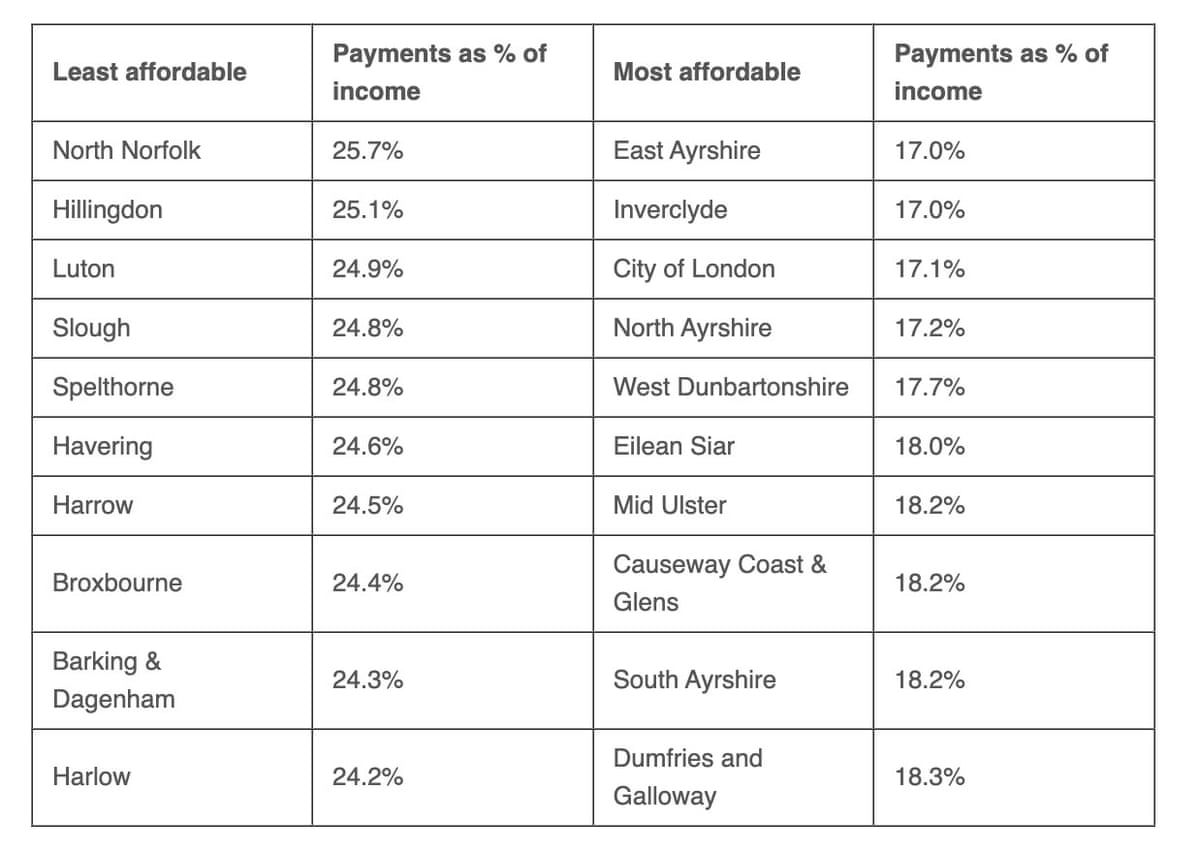
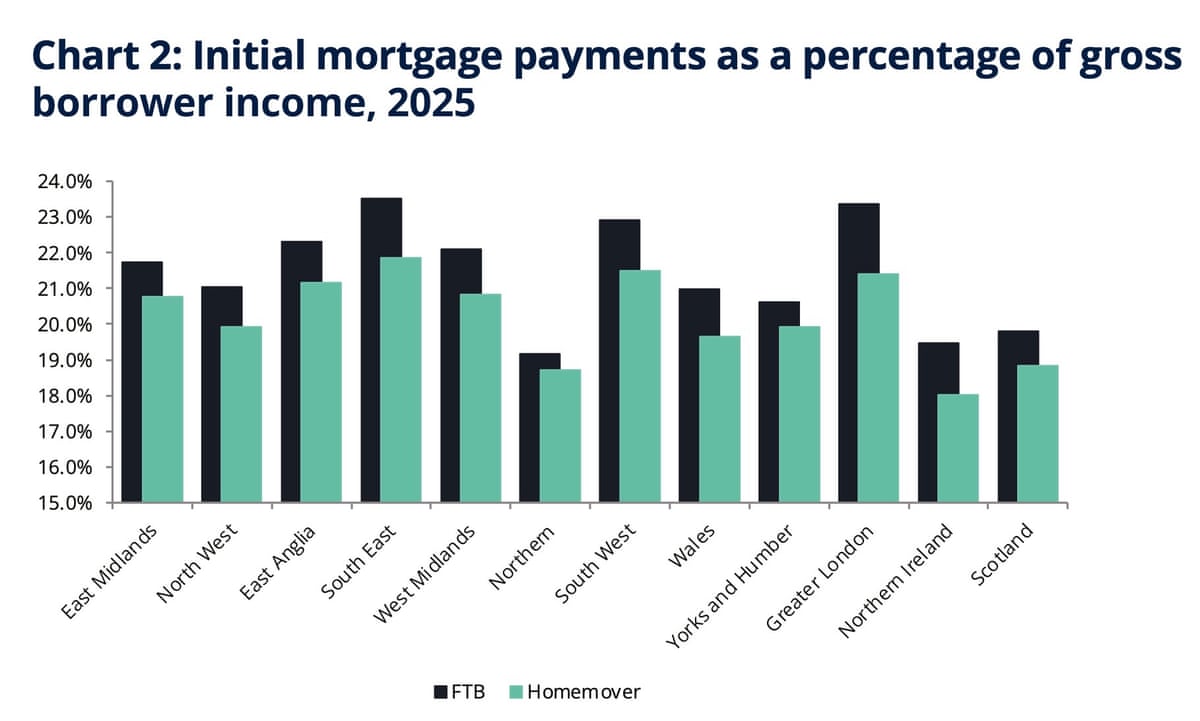
Industry group UK Finance reports that in 2025, the average homebuyer spent 21.3% of their gross income on mortgage repayments, the highest level since 2008.
There are significant regional disparities across the UK.
"In general, there is a delineation between relatively affordable housing in the north of England and the other UK nations, compared with the south of England where affordability pressures are, overall, much more acute."
The report shows borrowers in North Norfolk in East Anglia and the London Borough of Hillingdon spent over a quarter of their gross income on mortgage repayments. Eight of the top ten least affordable places were in the London commuter belt, including Luton, Slough, and Spelthorne.
Conversely, seven of the ten most affordable local authorities were in Scotland.
The UK is on track to miss its targets for electric vehicle uptake, the Society of Motor Manufacturers and Traders (SMMT) warns.
The SMMT estimates battery electric vehicles (BEVs) will comprise 32% of the market in 2027, leaving a persistent gap of about six percentage points against the mandated target.
"Year to date, BEVs comprise 23.1% of the overall new car market, significantly short of the 33% required by the Zero Emission Vehicle Mandate, despite billions in manufacturer discounts and the introduction of the Electric Car Grant last year."
UK car sales jump as two millionth EV registered
UK car sales surged in April, driven by stronger demand for electric vehicles.
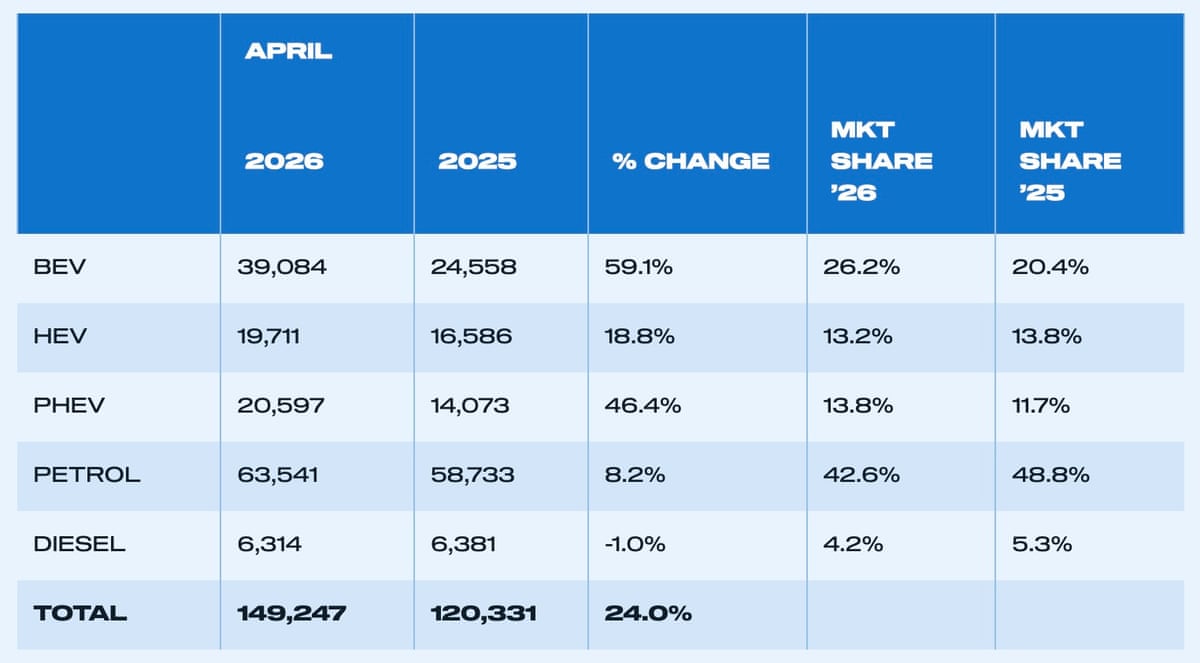
The UK new car market grew by 24.0% year-on-year in April, with 149,247 new cars registered, according to the SMMT. This marks the best April for car sales since 2019 and follows a weak April in 2025 when new vehicle tax increases were introduced.
The SMMT also reported that the UK’s two millionth battery electric car was registered in April, calling it a "market milestone." Battery electric car registrations rose 59% year-on-year, plug-in hybrid registrations increased 46.4%, and hybrid electric vehicle registrations grew 18.8%. Petrol car sales rose 8%, while diesel car sales declined by 1%.
The SMMT has revised its forecast for total new car registrations in 2026 to 2.093 million, up from 2.048 million forecasted in January. However, it lowered its forecast for battery-powered cars’ market share to 26.8% from 28.5%, citing an underperforming first quarter.
The industry group expressed concern that inflation, higher energy prices, and the resulting cost-of-living pressures could dampen demand for electric vehicles, despite the recent energy cost surge linked to the Iran conflict boosting interest in EVs.
Mike Hawes, SMMT chief executive, said:
"April’s rebound is welcome, but underlines just how significantly fiscal changes can influence the market. Two million electric car registrations is a considerable milestone to celebrate, although natural demand is still well below the level demanded by the mandate. The mounting cost of compliance threatens to limit consumer choice, overall decarbonisation and the sector’s competitiveness so the need for a rapid review of the transition to align policy with market realities is unchanged, else Britain’s attractiveness as a vehicle market and manufacturing hub will be put at risk."
Full story: HSBC profits fall amid $400m fraud-related charge and Iran war
HSBC has recorded a $1.3 billion (£961 million) reduction in profits, influenced by the US-Israel war on Iran and a fraud-related charge.
The London-headquartered bank reported a 4% decline in profits for the first quarter of 2026, falling $100 million to $9.4 billion compared to the same period in 2025. Revenue increased 6% to $18.6 billion.
The profit decline was attributed to a rise in potential loan losses to $1.3 billion, including $300 million linked to the Middle East conflict.
HSBC also disclosed a $400 million "fraud-related, secondary, securitisation exposure" in the UK, connected to its investment banking division. Chief Financial Officer Pam Kaur explained the charge involved loans made to an unnamed private equity group, which was exposed to private credit-related loans.
The Financial Times, citing sources, reported the case relates to the home loan lender Mortgage Financial Solutions (MFS). HSBC declined to confirm the firm’s identity.
Philippines inflation hits three-year high as Iran war drive up costs
In the Philippines, inflation has surged to a three-year high as food and energy costs rise due to the Iran conflict.
Inflation jumped to 7.2% in April, up from 4.1% in March, the Philippine Statistics Authority reported, marking the highest rate since March 2023.
Food and non-alcoholic beverage inflation more than doubled to 6.5%, up from 3.1% in March. Transport inflation rose sharply to 22.1% in April from 9.6%, while the housing, water, electricity, gas, and other fuels index increased to 7.8% from 4.3% in March.
Analysts suggest the Philippine central bank may need to implement more aggressive interest rate hikes to curb this inflationary surge.
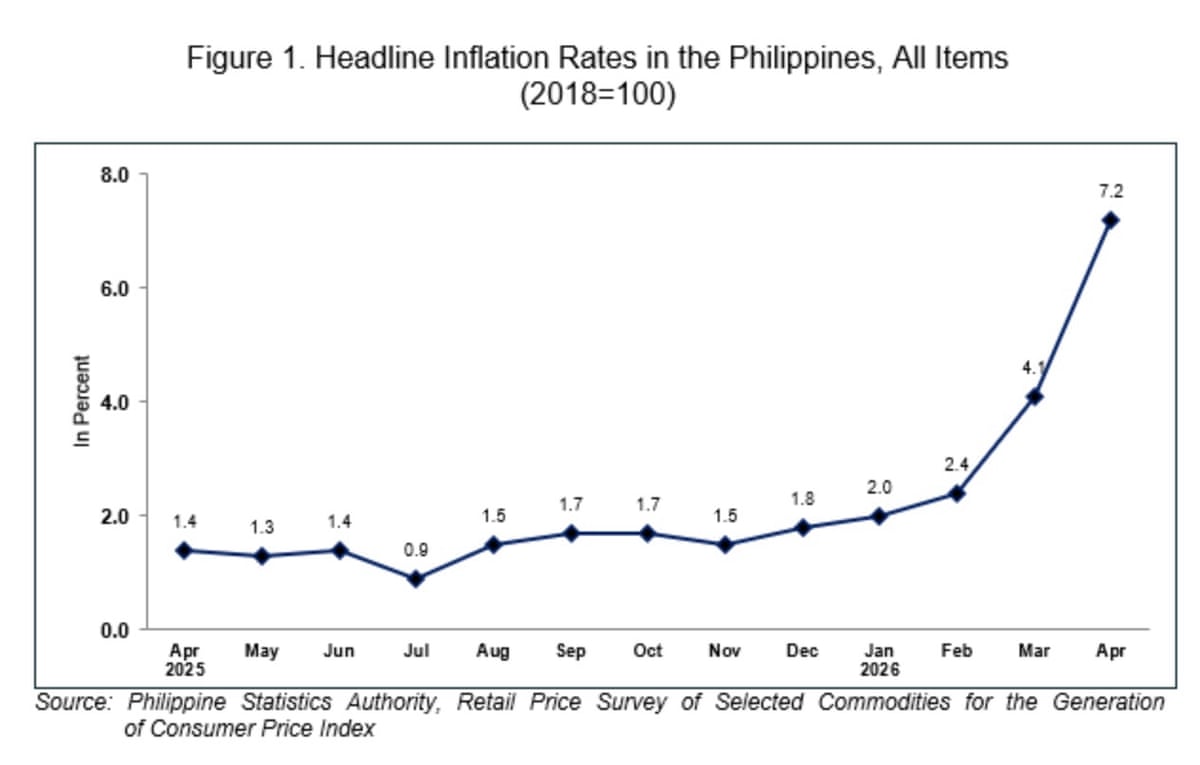
Chart: UK car sales by fuel type in April
[Chart data not provided in original text]
Summary
The UK is experiencing its highest long-term borrowing costs since 1998 amid rising oil prices and political uncertainty. Bond yields have surged due to Middle East tensions and concerns over fiscal policy stability. Meanwhile, UK car sales have increased significantly, driven by electric vehicle demand, although mortgage affordability is at its tightest since 2008. HSBC profits declined due to Middle East conflict impacts and a fraud-related charge. Inflation in the Philippines has also reached a three-year high, driven by rising food and energy prices linked to the Iran war.