

Trump administration launches portal to initiate tariff refunds
Welcome to the live blog covering the latest developments in US politics.
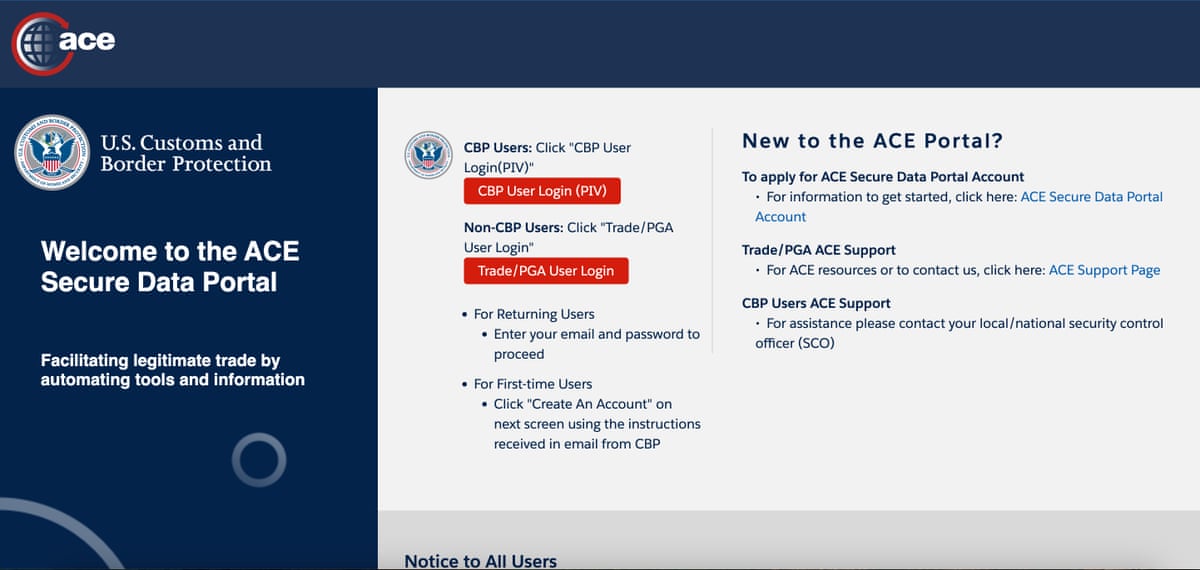
The US Customs and Border Protection (CBP) agency is set to launch an online refund system for businesses that paid tariffs later invalidated by the Supreme Court. This initiative represents the first step in reimbursing approximately $166 billion in tariffs after justices ruled that the Trump administration exceeded its constitutional authority.
Importers and their brokers will be able to submit refund claims through an online portal starting at 8am ET, according to CBP, which is responsible for administering the system.
This marks the beginning of a complex process that could eventually extend refunds to consumers who were charged some or all of these tariffs on products shipped from abroad.
Companies must provide detailed listings of the goods on which tariffs were imposed. Upon approval of a claim by CBP, refunds are expected to be issued within 60 to 90 days. CBP estimates that over 330,000 importers paid about $166 billion on more than 53 million shipments.
More than 3,000 businesses, including FedEx and Costco, have filed lawsuits against the Trump administration seeking refunds, according to the New York Times. FedEx has indicated that customers may be eligible for refunds on overpaid tariffs, while Costco has suggested it might pass savings on to consumers through lower prices.
Democratic leaders have been urged to more vocally advocate for the affordability and resilience of clean energy amid global economic shocks. As the ongoing conflict in the Middle East drives up oil and gas prices worldwide, many countries are accelerating their transition to cleaner energy sources. However, in the US, former President Donald Trump has sought to eliminate alternatives to fossil fuels, while some Democrats have been hesitant to link the conflict directly to climate action.
The closure of the Strait of Hormuz, a critical passage through which a fifth of the world's oil and gas typically flows, following US and Israeli attacks on Iran, has caused energy prices to spike globally. In the US, the national average price of gasoline has surged to $4.10 per gallon, with Trump warning that prices could rise "a little bit higher" by November.
"There’s a timely clash on climate and costs that Democrats can win, as long as we have the nerve to actually show up to the fight," said Senator Sheldon Whitehouse, a Democrat. He added, "true energy independence will be achieved by powering our economy with renewable energy, the fuel sources for which are unlimited, free and independent of geopolitical events."
Experts view the Iran conflict as a "unique moment of opportunity" for Democrats to highlight the benefits of low-pollution technologies such as electric vehicles. The emphasis, they argue, should be on reducing consumer costs, which should have been the primary message in climate protection efforts.
Paul Bledsoe, a former climate adviser to Bill Clinton’s White House, stated, "I don’t think they’ve grasped the political opportunity yet. They have to stay really focused on how these next-generation technologies will provide a consumer benefit. When you pitch clean energy as cutting consumer costs first and improving the overall economy second, people are happy to cut emissions third."
FISA negotiations continue on Capitol Hill after lawmakers pass short-term extension
Congress has agreed to a short-term extension of section 702 of the Foreign Intelligence Surveillance Act (FISA), granting lawmakers 10 additional days to negotiate reforms. This provision permits national security agencies to collect and review communications, such as texts and emails, sent to and from foreigners outside the US without a warrant.
GOP leadership faces the challenge of uniting their divided conference to address concerns about privacy protections. Several Democrats and conservative Republicans argue that the current form of section 702 threatens the privacy of American citizens inadvertently caught in surveillance.
Senate Majority Leader John Thune has committed to leading the discussions in the Senate, but it remains uncertain whether House Speaker Mike Johnson will be able to consolidate support in the House of Representatives.
Details on the tariff refund portal and process
The newly established Consolidated Administration and Processing of Entries (CAPE) tool aims to streamline the refund process for businesses that paid billions in tariffs. CBP estimates that businesses are owed approximately $166 billion in refunds following the Supreme Court's invalidation of tariffs imposed under the International Emergency Economic Powers Act (IEEPA).

Legal documents indicate that the initial phase of refunds will cover the majority of affected imports, according to NPR. Most importers eligible for refunds have enrolled in electronic payment systems; this group is reportedly owed around $127 billion.
Oil prices have experienced sharp increases and European stock markets have declined after the US seized an Iranian vessel, diminishing hopes for a peace agreement. Brent crude, the international oil price benchmark, rose by 4.8% on Monday to $94.69 per barrel.
These market changes followed Donald Trump’s announcement on Sunday regarding a naval incident near the Strait of Hormuz shipping channel.
Trump is in Washington today, spending most of the day in meetings. At 3pm ET, he is scheduled to sign executive orders; however, these events are closed to the press. Updates will be provided if any new information becomes available.
Following the Supreme Court's February ruling against Trump’s tariffs, US businesses have called for a prompt refund process to reimburse importers.
The US National Retail Federation, representing retailers ranging from Walmart to small manufacturers, urged for "a seamless process to refund the tariffs to US importers." It stated that "the refunds will serve as an economic boost and allow companies to reinvest in their operations, their employees and their customers."
The US Chamber of Commerce also advocated for swift tariff refunds. Neil Bradley, its chief policy officer, remarked,
"Swift refunds of the impermissible tariffs will be meaningful for the more than 200,000 small business importers in this country and will help support stronger economic growth this year."
"We encourage the administration to use this opportunity to reset overall tariff policy in a manner that will lead to greater economic growth, larger wage gains for workers and lower costs for families," he added.
Dan Anthony, director of the business coalition We Pay the Tariffs, highlighted the disproportionate impact on small businesses, many of which have taken loans, delayed hiring, and canceled expansion plans due to tariffs.
He predicted that refunds would enable these businesses to reverse such trends.
The coalition published a statement emphasizing the importance of returning funds without burdensome procedures.
"Full, fast automatic refunds is really where our focus is going to be," the statement said.
"They’ve taken out loans just to keep their doors open. They’ve frozen hiring, canceled expansion plans, and watched their life savings drain away to pay tariff bills that weren’t in any budget or business plan," it continued. "But a legal victory is meaningless without actual relief for the businesses that paid these tariffs."
US-Pakistan talks and Iran conflict update
Donald Trump announced that US negotiators will be in Pakistan on Monday and reiterated threats to destroy the country’s power plants and bridges if no agreement is reached. While Trump did not specify the delegation leader, a White House official confirmed Vice President JD Vance will head the talks.
Negotiations appear uncertain after Iran declared it has no plans for new discussions, accusing Washington of violating a ceasefire agreement. A spokesperson emphasized that Tehran cannot overlook prior US attacks during diplomatic talks and affirmed Iran’s commitment to defending its national interests.
As background, the US-Israeli conflict with Iran, which began on 28 February, and a 12-day war last year both erupted during negotiations over Iran’s nuclear program.
For ongoing updates on the conflict with Iran, follow our live blog.


