

Business Protests Delay New Tax Regime in Malawi
Peaceful demonstrations across Malawi’s four major cities have resulted in a postponement of a new tax system that many business owners fear will severely impact their livelihoods.
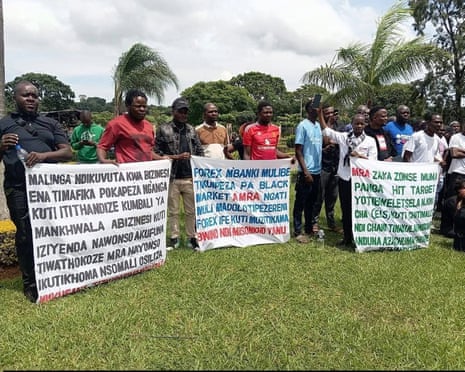
Over the past week, tens of thousands of business owners signed petitions which were submitted to tax officials. On Monday, thousands of small traders closed their shops and businesses to participate in protest marches in Blantyre, Lilongwe, Zomba, and Mzuzu.
The protests have successfully delayed the implementation of the electronic invoicing system (EIS), introduced by the Malawi Revenue Authority (MRA). This system, designed to provide a more detailed tax framework than previously existed, was scheduled to be launched this week but has now been postponed until April.
Economic Challenges and Political Context
The protests highlight ongoing unrest in Malawi, a country grappling with aid reductions, foreign currency shortages, and rising costs of essential goods. Previous demonstrations in September and November were disrupted by political groups and accompanied by outbreaks of violence.
President Peter Mutharika, elected last year with a mandate to restore the economy, has implemented adjustments to fuel prices, electricity tariffs, and value-added tax (VAT), including a 12% increase in electricity costs.

Concerns of Small Traders
Protesters, dressed in black and carrying placards criticizing the revenue authority for prioritizing revenue targets over the welfare of vendors, expressed particular concern about the difficulties they face in importing and exporting goods.
They attribute their struggles to a shortage of foreign currency, which forces them to purchase US dollars for imports at nearly three times the official bank rate.
“Our businesses are under threat because of the economy,” said Robert Nachamba, a representative of small business owners, after a group of 1,000 protesters submitted their petition at the Blantyre revenue authority offices.
“The country does not have foreign currency in the banks and now the Malawi Revenue Authority is coming with issues that threaten our businesses even further.
“When we think about how tough things are in the country, our pain is that there is a lack of foreign exchange which forces us to buy it on the black market because it is not available in the banks. Now we have already got it at an abnormally high rate and now we need to declare the prices of goods to the tax authorities? This will make the prices of our commodities higher even compared with our neighbouring countries and we don’t need that system,” he said.
“We closed our shops and travelled to submit our petitions. That is why they were peaceful because we can’t destroy our own shops.”
Government Response and Economic Analysis
Malawi’s Minister of Finance, Joseph Mwanamvekha, has urged citizens to “remain resilient” as the government enforces stringent economic measures aimed at stabilizing the economy, reducing expenditure, and enhancing revenue collection.
Economists acknowledge that while the measures, including the introduction of the electronic invoicing system to improve tax administration and reduce evasion, are technically sound, the informal sector businesses require support to survive.
Malawian economist Bertha Bangara-Chikadza told :
“The [policies] are being implemented under extreme macroeconomic challenges. If the government can use the resulting revenue to stabilise the economy and improve public services, it may indeed be a good step. However, if the increased tax burden fails to translate into improved infrastructure and energy, it risks further straining an economy.”
Regional Context of Tax Reforms
Malawi joins a number of African countries, including Kenya, Nigeria, Egypt, and Uganda, in adopting electronic and real-time tax reporting systems as part of efforts to enhance revenue collection and combat fraud.


