

Introduction: Oil Prices Drop and Markets Rally Amid Middle East De-escalation Hopes
Good morning, and welcome to our continuous coverage of business, financial markets, and the global economy.
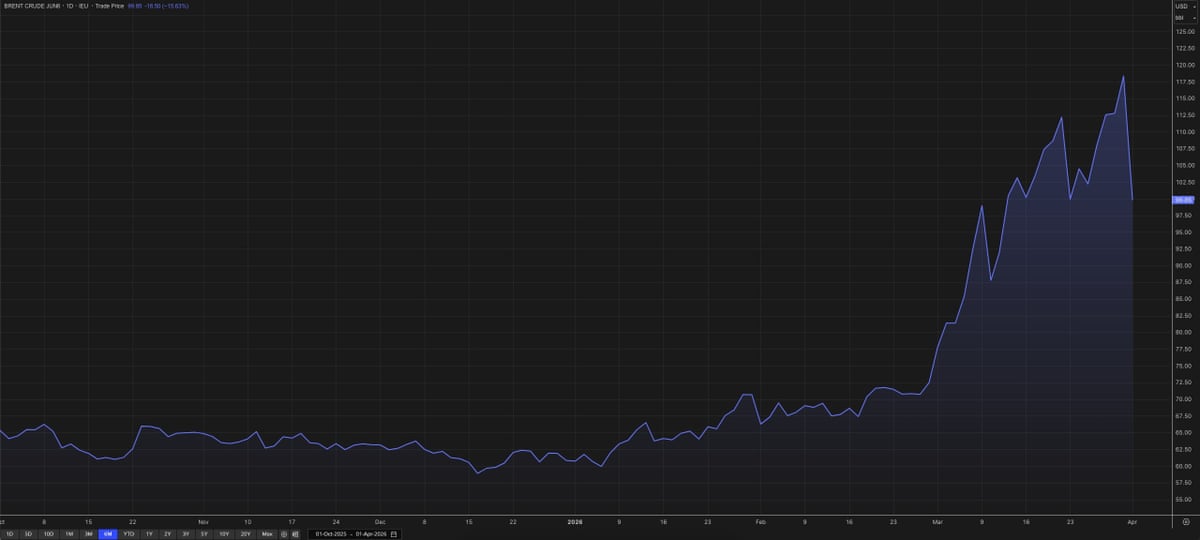
Following its largest monthly increase on record, oil prices have sharply declined due to optimism about de-escalation in the Middle East.
Brent crude has fallen approximately 13% since last night, retreating to $103 per barrel, as investors respond positively to signals from Washington DC suggesting the Iran conflict may conclude soon.
Yesterday, US President Donald Trump stated that the United States could cease military operations against Iran within two to three weeks, declaring:
"Now we’re finishing the job. I think in two weeks or maybe a few days longer, we’ll do the job. We want to knock out everything they’ve got."
President Trump is scheduled to address the US public at 9pm ET tonight (2am BST tomorrow morning).
Asia-Pacific markets have also opened April with strong performances.
China’s CSI 300 index has increased by 1.5%, Japan’s Nikkei surged 4.9%, and South Korea’s KOSPI jumped 9.5%.
These gains follow a robust session in New York, where the Dow Jones Industrial Average rose by 2.5%.
Investor sentiment has been further buoyed by reports that Iranian President Masoud Pezeshkian expressed Iran’s willingness to end the conflict, contingent upon guarantees "to prevent the recurrence of aggression."
Chris Weston, head of research at Pepperstone, commented on the encouraging tone from both US and Iranian sides, which is prompting traders to re-enter riskier assets:
"We saw reports breaking in Asia yesterday from the WSJ that Trump was willing to end the war without taking the Straits of Hormuz. In fact, he encouraged other international peers to take the strait without US involvement. There are different ways to interpret that, both positive and negative, but the market has taken this as a small step towards appeasing and compelling the Iranian camp. The Iranians have also come out with more constructive rhetoric for risk, signalling the necessary will to end the war. They have outlined their conditions, some of which were already known. But the combination of the narrative, driven through headlines, has certainly seen risk come back into play."
The Agenda
- 9am BST: Eurozone manufacturing PMI for March
- 9.30am BST: UK manufacturing PMI for March
- 10am BST: Eurozone unemployment data
- 10.30am BST: Bank of England releases financial stability report
- 2.45pm BST: US manufacturing PMI for March
Brent Crude Falls Below $100 a Barrel
Optimism that the Iran conflict may soon end has driven Brent crude prices below the $100 per barrel threshold.
The international benchmark has declined more than 15% since yesterday, settling at $99.78 per barrel, marking its lowest level in one week.
Last night, Brent closed at $118.35 per barrel before the sharp drop.
Reduced Expectations for Bank of England Rate Hikes in 2024
City traders are significantly lowering their expectations for UK interest rate increases this year amid growing hopes that the Iran conflict may be nearing resolution.

Money markets currently price in approximately 41 basis points (0.41 percentage points) of increases to the UK Bank rate by the end of 2026, indicating that two quarter-point hikes are no longer fully anticipated.
In contrast, yesterday’s market priced in 66 basis points of rate rises by Christmas, and last week, 75 basis points (equivalent to three quarter-point increases) were fully expected.
Gold Prices Reach Near Two-Week High
Gold prices have risen to their highest level in nearly two weeks.
Following a 3.5% increase yesterday, gold has gained an additional 0.8% today, surpassing $4,700 per ounce.
Tony Sycamore, market analyst at IG, noted that an end to the Iran conflict could have mixed effects on gold:
"On one hand, a lasting peace agreement would remove the geopolitical safe haven bid that supported prices in the run-up to the conflict. On the other hand, it would allow for lower oil prices and easing inflation fears, which would revive expectations for Federal Reserve rate cuts later in 2026. This dynamic, combined with the underlying structural demand from central banks who have been accumulating gold for diversification, means we could still see upside."
European Stock Markets Poised for Rally
European stock markets are expected to open higher in approximately 30 minutes, according to Emma Wall, chief investment strategist at Hargreaves Lansdown:
"Markets paint an optimistic picture this morning – choosing to believe the optimism from the White House that the war in Iran will be over in a couple of weeks. US President Donald Trump yesterday announced that he saw the war ending within a couple of weeks, and that he would be addressing the nation with further details later today. This was enough to propel the S&P 500 into a relief rally, up 2.9%, the best day for the market since May last year. Asian markets have continued the optimism early today, with the Hang Seng in Hong Kong up nearly 2%, and the Nikkei in Japan jumping 4.56%. European futures are also looking positive, with markets in the UK, France, Germany and Italy set to open up."
UK Food Inflation Forecast Tripled to 9%
The UK is facing a significant rise in food inflation, now forecast to reach at least 9% by the end of this year, as the cost of living crisis is exacerbated by the Iran conflict.
The Food and Drink Federation (FDF) has revised its food inflation forecast upward, tripling its previous estimate.
Previously, the FDF expected food price inflation to reach approximately 3% by year-end; it now anticipates an increase between 9% and 10%.
"This is a fast-moving situation, and our update is based on assumptions that the Straits of Hormuz opens within 2-3 weeks and energy production in the Middle East returns to normal within a year. As one of the UK’s energy intensive and most globally connected sectors, food and drink manufacturing is unusually exposed to these shocks, with cost pressures on multiple fronts hitting the industry at once."
In addition to rising energy costs, food producers are contending with a surge in fertiliser prices.
Last month, the CEO of one of the world’s largest fertiliser companies, Yara International, warned that global food supplies could be severely impacted this year if the Iran conflict becomes prolonged.
UK Faces 'Awful April' with Multiple Bill Increases
UK households are bracing for a difficult April, marked by a series of bill increases that will raise the annual cost of essentials, including council tax and water, by over £200.
The price hikes, intensified by the Iran conflict, will add to the financial strain on households.
An end to the Middle East war and a subsequent drop in energy prices would provide much-needed relief as the UK enters this challenging period.
More details on this story are available here.


