Call for Meter Readings Amid Rising Energy Prices
Consumers are being encouraged to provide energy meter readings as household energy prices increase by 13% for millions across England, Scotland, and Wales starting Wednesday.
Those on tariffs regulated by Ofgem's price cap who do not have smart meters should submit a reading to avoid being charged the new, higher rate on previous usage.
Price increases are primarily driven by the rising cost of gas but may have a limited effect due to warm weather and reduced energy consumption during summer.
However, analysts at Cornwall Insight warn that elevated energy prices, influenced by the US-Israeli conflict with Iran, are expected to continue into winter.
Cornwall Insight forecasts a slight 0.5% decrease in Ofgem's price cap in October, which could increase pressure on the government to provide support.
Government officials highlight reforms implemented earlier this year to reduce bills. Chancellor Rachel Reeves indicated possible targeted assistance in autumn, though her position may change under new Labour leadership. Prices have not surged as much as initially feared following the US-Iran truce.
"The Iran ceasefire gave the markets some breathing room, but this is a pause, not a resolution to the conflict. What comes out of the final agreement, if there is one, will matter enormously for energy prices," said Craig Lowrey, principal consultant at Cornwall Insight.
"Even in the best-case scenario, the enduring effects from the conflict will be with us for a while."
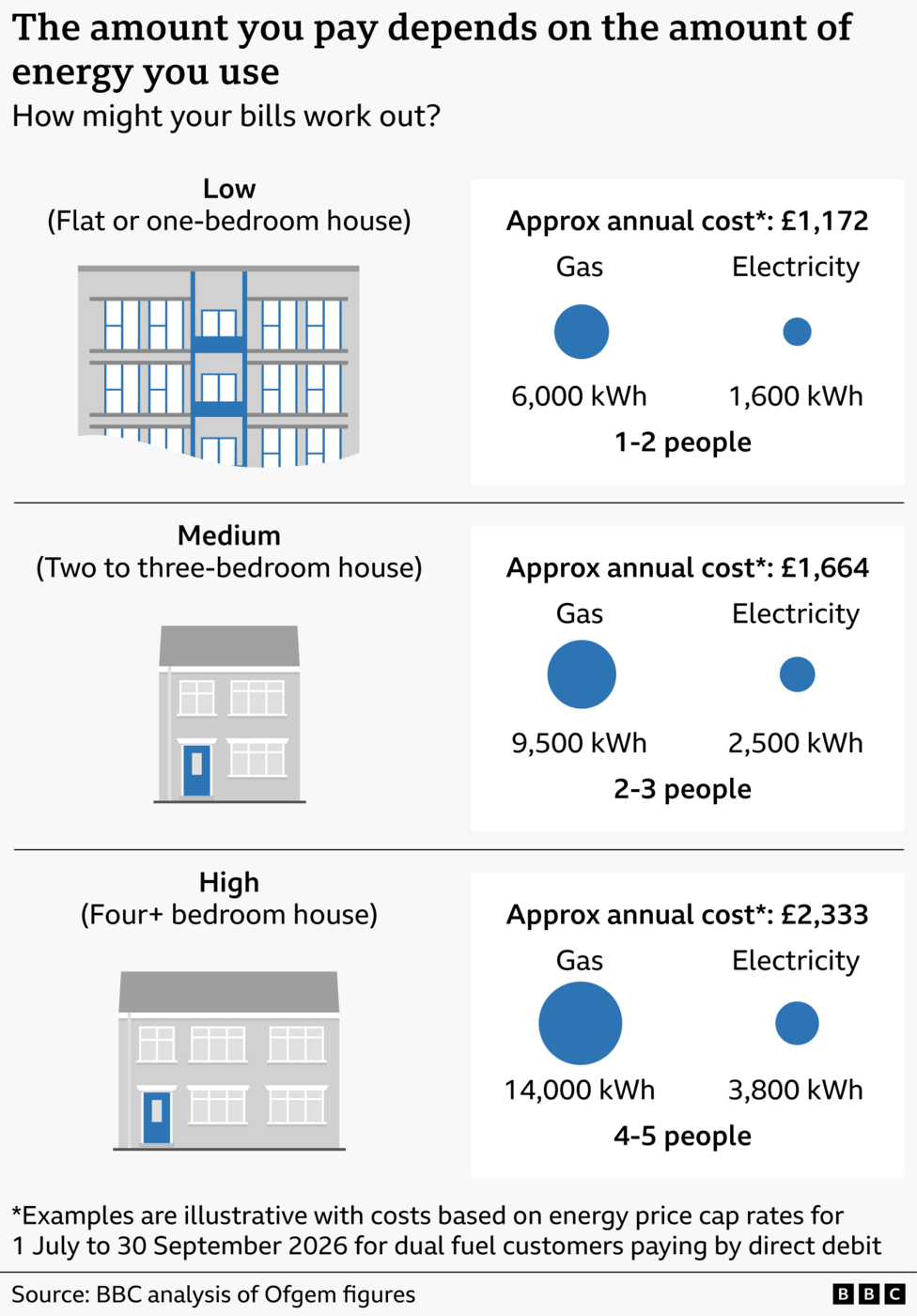
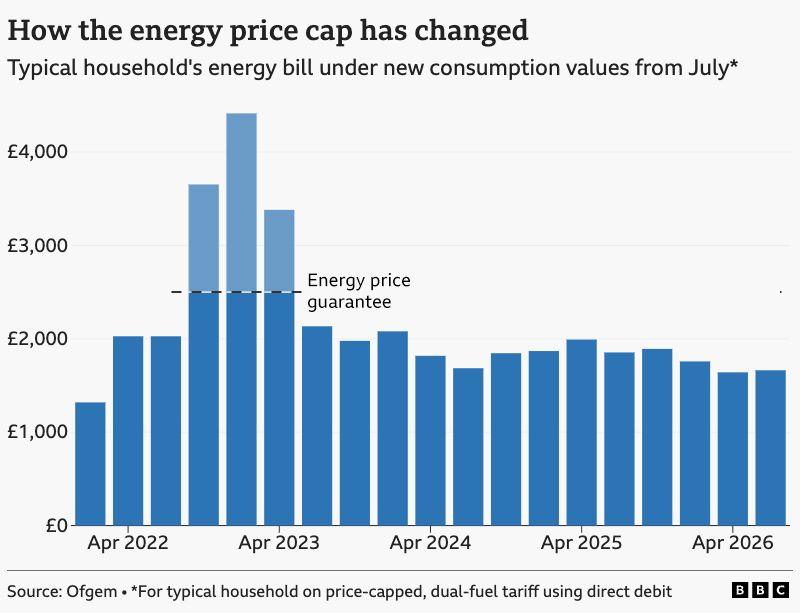
The increase under Ofgem's new price cap translates to an additional £18 per month for a household with typical electricity and gas usage. Gas bills rise by 24%, electricity by 5%, while standing charges remain nearly unchanged.
Ofgem has adjusted its estimate of "typical" energy consumption downward due to widespread reductions in usage and improved energy efficiency. The new typical annual consumption is 9,500 kWh of gas and 2,500 kWh of electricity.
The energy price cap affects 33 million households in England, Wales, and Scotland; Northern Ireland has separate regulations.
Households on fixed tariffs will not experience price changes until their contracts expire; about 40% of consumers have fixed deals.
Consumers on variable tariffs with standard meters are advised by price comparison site Uswitch to submit meter readings promptly to avoid paying the higher rates on previous consumption.
As prices rise, the Trades Union Congress (TUC) has called for a social tariff to alleviate energy bill burdens for most households.
Social tariffs offer discounted rates typically reserved for benefit recipients and are available for some broadband and water services but not for energy.
Generally, the cost of social tariffs is offset by higher bills for others or increased taxation. The TUC suggests funding energy social tariffs through higher taxes on bank profits.
The total debt owed to energy suppliers in England, Scotland, and Wales reached a record £4.79 billion in the first quarter of the year, a 15% increase compared to the previous year.
Fuel poverty charity National Energy Action emphasized that even the recent heatwave underscored the need for debt relief and property upgrades.
"Energy inefficient homes take lives in winter and will increasingly threaten the most vulnerable in summer," said Adam Scorer, its chief executive.
Energy suppliers provide various support schemes for customers struggling to pay or anticipating difficulty.
The industry body Energy UK maintains a list of these schemes but stresses that assistance is often only available if customers contact their suppliers to report payment difficulties.
How You Can Save Money on Your Energy Bill as Debts Rise
The energy price increase coincides with a report indicating that many people remain vulnerable to price rises on essentials and require up to three more years to recover from recent cost-of-living pressures.
Pensions and investment firm Royal London found that 30% of UK adults are financially fragile, with limited savings and low capacity to handle financial shocks.
"We are starting to see some signs of improvement in people's finances," said Sarah Pennells, consumer finance specialist at Royal London.
"[But] the reality is that millions of people are still living very close to the edge and may be only one bill shock away from financial crisis."