Introduction: Bank of England Interest Rate Decision Today
Good morning, and welcome to our continuous coverage of business, financial markets, and the global economy.
UK households and businesses may avoid an increase in borrowing costs today as the British economy faces pressure from the ongoing conflict in Iran.
The Bank of England (BoE) is widely anticipated to maintain interest rates at 3.75% at noon following its latest monetary policy committee meeting.
BoE policymakers face the challenge of managing imported inflation resulting from the Middle East conflict while trying not to exacerbate the financial strain on firms and consumers already impacted by rising energy prices.
With the UK economy contracting slightly in April and inflation lower than expected in May, a rate hike seems unnecessary. London money markets indicate a 98% probability that rates will remain unchanged, with only a 2% chance of an increase.
Tomasz Wieladek, chief European macro economist at investment management firm T. Rowe Price, suggests that further monetary tightening may not be required in the near term.
"Monetary policy in the UK appears to be finally working. A prolonged period of restrictive monetary policy has, to a degree, weakened inflation dynamics. Given the good news on inflation and the recent decline in oil prices, the MPC will likely conclude that no more hikes are necessary to stabilise inflation in the UK."
The Agenda
Noon BST: Bank of England interest rate decision
1.30pm BST: US initial jobless claims
1.30pm BST: Philadelphia Fed Manufacturing Index
Norway Follows Switzerland by Leaving Rates on Hold
Central banks are active today. Norway’s central bank in Oslo has held its policy interest rate steady at 4.25%, while signaling potential future increases.
Governor Ida Wolden Bache stated:
"Inflation is too high, and the rapid rise in business costs in recent years will contribute to keeping inflation elevated ahead. New information indicates that inflation pressures are slightly stronger than we had anticipated earlier. We expect that a somewhat tighter monetary policy stance will be needed to bring inflation down to target within a reasonable time horizon. If developments turn out as currently envisaged, the policy rate will be raised at one of the forthcoming monetary policy meetings."
Similarly, Switzerland’s central bank maintained its key interest rate at zero for the fourth consecutive quarter after inflation rose to 0.6% in May.
The Swiss National Bank (SNB) commented:
"Inflation has risen in recent months as a result of higher energy prices. Medium-term inflationary pressure, however, is virtually unchanged compared with the last monetary policy assessment. The SNB’s monetary policy is appropriate to keep inflation within the range consistent with price stability and it supports economic development. The SNB will continue to monitor the situation and adjust its monetary policy if necessary, in order to ensure price stability."
Tesco’s UK Sales Growth Slows Amid Middle East Conflict
Tesco, the UK’s largest retailer, reported that its sales growth has more than halved, attributing the slowdown to ongoing uncertainty caused by the Middle East conflict, which affected consumer confidence.
Comparable sales increased by 1.8% to £13.4bn in the three months ending May, below the previous quarter’s 4.2% growth and the 2.3% forecast by analysts.
Online sales rose by 8.9%, contributing to a 1% increase in group sales to £16.8bn.
The decline in UK sales growth reflects dampened consumer confidence amid higher fuel prices linked to the conflict. Additionally, exceptionally warm and sunny weather during the same period last year boosted food and drink sales, complicating year-on-year comparisons.
Tesco’s shares fell 2.8% in early trading, making them among the larger decliners on the FTSE 100 index this morning.
Private Sector Pay Continues to Shrink in Real Terms
The Resolution Foundation has calculated that private sector pay in the UK continues to decline when adjusted for inflation.

Annual average regular earnings growth was 2.9% for the private sector from February to April, slightly below the rate of price increases.
Louise Murphy, senior economist at the Resolution Foundation, explained:
"The UK labour market is weaker than it has been in recent years. This weakness is showing up through rising irregular work in the form of self-employment and zero-hours contracts, higher youth unemployment and lower wage growth. The real wages of private sector workers have now been falling since last October. With further inflation rises expected over the coming months, these workers should brace themselves for this squeeze to continue over the summer."
Oil Prices Drop to Lowest Since Early March After Iran Peace Plan Signed
Oil prices have declined further today, with Brent crude falling over 2% to as low as $77 a barrel, marking the lowest level since early March, the first week of the Iran war.
The decline followed Donald Trump signing a 14-point agreement with Iran, which will reopen the Strait of Hormuz and grant Tehran several political and financial concessions.
Labour Market Challenges Persist, Suggests Deutsche Bank Economist
Sanjay Raja, chief UK economist at Deutsche Bank, argues that the labour market is still facing difficulties and sees little reason for the Bank of England to hasten interest rate increases.
"Survey data remain weak. HR1 advanced redundancy notifications have jumped in April and May. The claimant count rate is also back to its highest level since March last year. And still falling vacancies point to more slack in the jobs market. We expect the labour market to remain a bit sluggish through the coming months. But there is some light at the end of the long enduring US/Iran conflict. Should the MoU [memorandum of understanding] hold, we would expect employment trends to pick back up on the margins. For now, today’s mixed data buys the MPC (monetary policy committee) more time to wait and see how the economy evolves and how geopolitics play out. We see little rush for the MPC to push for rate hikes just yet. Instead, the Bank can let the dust settle on the energy conflict before recalibrating policy again."
UK Vacancies Fall to Five-Year Low
The number of vacancies in the UK economy has dropped to its lowest level in five years.
The Office for National Statistics (ONS) estimates vacancies decreased by 19,000 in the March to May period, reaching 707,000—the lowest since February to April 2021.
Anna Leach, chief economist at the Institute of Directors, attributes this to government policies increasing the cost and risk of hiring.
"Low levels of employer demand for labour unfortunately reflect a combination of government policies which have increased the cost and risk associated with hiring employees. This is choking off work opportunities for young people in particular, as jobs continue to decline in important youth employment sectors such as accommodation and food and retail. The cost of doing business has risen sharply in recent years, driving persistent weakness in hiring."
UK Jobs Report Shows Mixed Signals
ING economist James Smith notes that, on the surface, the latest UK jobs report is not overly negative.
"The unemployment rate ticked down to 4.9%. Payrolled employment rose after three consecutive monthly declines (it increased by a marginal 2000 workers). Average weekly earnings growth was higher than expected. But the details still look dovish for the Bank of England. And the report is another reminder that the case for higher rates is far from the clear cut. Take those payroll numbers. April’s atrocious 100,000 fall in employment has been cut in half, after revisions. That’s not a surprise; the latest reading is always prone to change – and usually in an upwards direction. But the newly revised April figure, showing a 53k drop in workers, is still pretty bad. The better May figure should be read in that context – and if you strip out government, private-sector payrolls still fell."
Another positive aspect is that fewer people left company payrolls in April than initially feared.
The ONS revised its estimate for payroll losses in April down to 53,000 from the original 100,000.
For May, payrolls are estimated to have increased by 2,000.
Pay Growth Stronger Than Forecast
UK wage growth exceeded expectations in the three months to April, according to this morning’s labour market data.
Basic pay, excluding bonuses, rose by 3.4% year-on-year during the quarter, while total pay, including bonuses, increased by 4.4%; both figures were unchanged from the previous month.
Average pay growth was 5.1% in the public sector and 2.9% in the private sector. The ONS noted:
"Public sector pay growth is once again affected by the timing of pay awards varying this year."
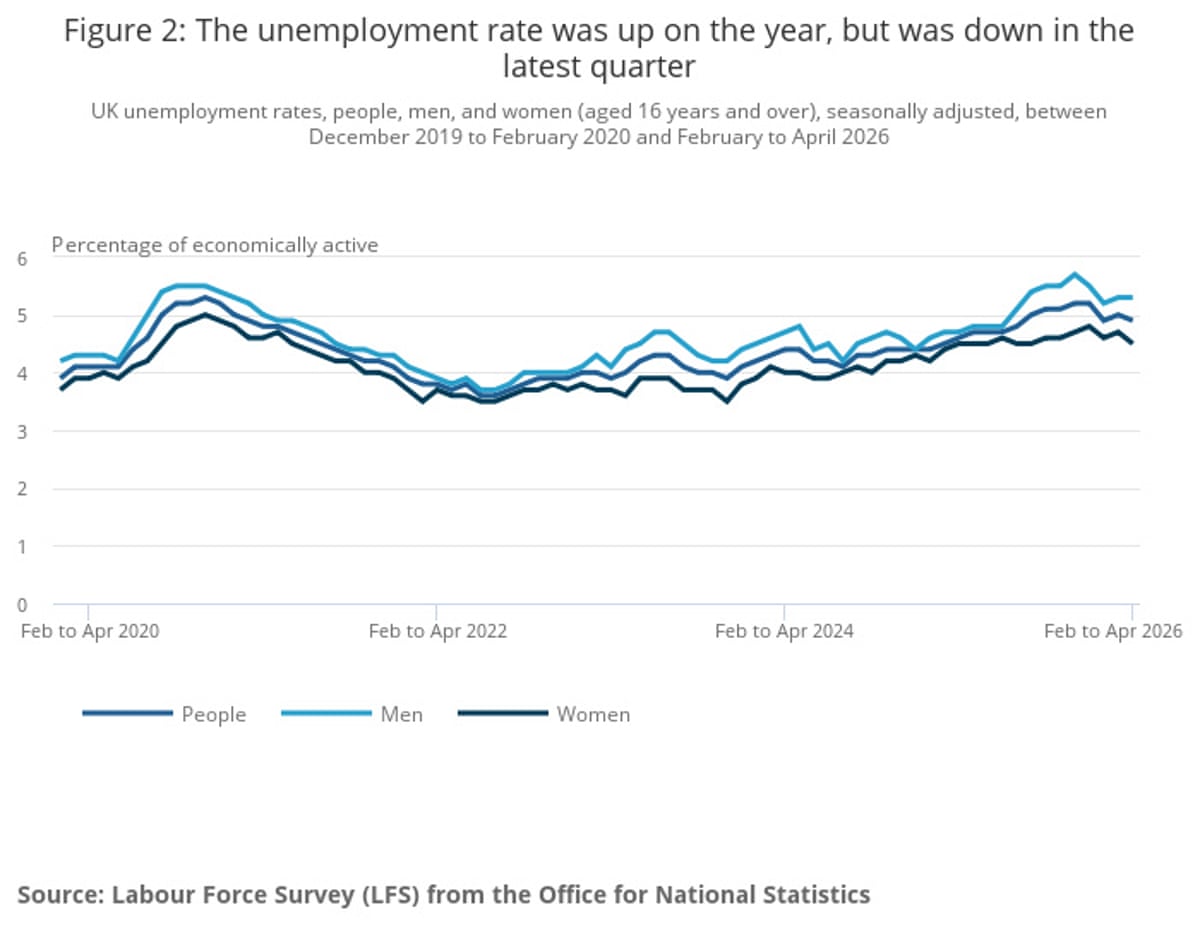
Unemployment Rate Falls to 4.9%
Unemployment in Britain has declined as more individuals either found employment or left the labour market.
The UK unemployment rate decreased to 4.9% in the three months from February to April, down from 5% the previous month, alleviating concerns that the energy crisis might increase job losses.
The ONS reports a reduction of 105,000 unemployed individuals in the quarter, bringing the total to 1.764 million.
Employment rose by approximately 100,000 to 34.410 million, while the number of economically inactive people (neither working nor seeking work) increased by 137,000 to 9.136 million.
ONS director of economic statistics Liz McKeown commented:
"The labour market remained broadly stable in the latest quarter, with further softening evident in some measures. Payroll numbers continued to fall over this period, with new recruits at their lowest level in five years. However, overall employment was little changed, with some signs of workers moving into self‑employment. Vacancies also continued to fall, further suggesting that firms are becoming more cautious about taking on new staff. The decline has been most persistent among lower‑paying sectors and smaller employers, although the largest fall this quarter was in professional services."