

Max Richter’s Oscar Nomination and Musical Journey
The German-born British composer Max Richter received his first Oscar nomination this year for his score for the Shakespeare drama Hamnet, highlighting his versatile and adaptive musical style. Despite this being his first nomination, Richter’s work has had a significant impact on film music for years.
In 2016, the Academy of Motion Picture Arts and Sciences disqualified Jóhann Jóhannsson’s score for the film Arrival because it was difficult for viewers to distinguish the Icelandic composer’s original soundtrack from a piece by Richter. The track in question, Richter’s expansive and emotive composition On the Nature of Daylight, was used at both the beginning and end of Denis Villeneuve’s alien invasion film, leading to the score’s disqualification.
A decade later, Richter’s work on Hamnet earned him a nomination for best original score. If he wins, it would mark a significant milestone in what has already been an exceptional year for the composer, who will turn 60 shortly after the Oscars ceremony in Los Angeles.
Last year, Richter’s 2015 album Sleep surpassed two billion streams across all platforms, becoming the first classical record to reach this milestone. He was awarded a CBE in the New Year Honours list, and his contributions to music will be further recognized with the Berlinale Camera award at the upcoming Berlin film festival. Additionally, a ballet scored by Richter and inspired by the works of Virginia Woolf will be livestreamed in UK cinemas starting Monday.
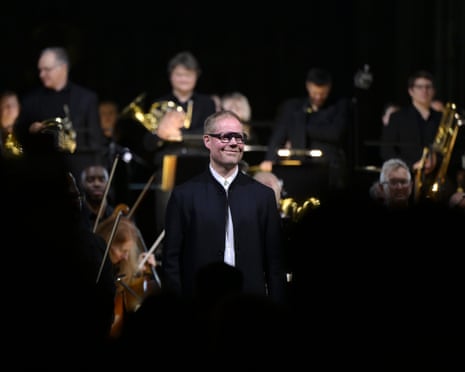
On the Nature of Daylight: A Ubiquitous Composition
Despite Richter’s growing acclaim, his widespread success has also brought some criticism. Hamnet prominently features On the Nature of Daylight to evoke emotional depth, but the piece has become so commonly used in film and television that some critics view it as a cliché. ’s Tom Service described it as “the go-to cliché for moments of serious contemplation or emotional intensity” in cinema.
Early Life and Musical Influences
Richter’s rise was far from predictable. Born in Hamelin, Lower Saxony, and raised in Bedford, England, he was introduced to minimalist music around the age of 12 or 13 by a local milkman who was passionate about new music. This milkman delivered records by Terry Riley, Philip Glass, and John Cage along with the daily milk, sparking a revelation for Richter. In a recent interview with the German newspaper Die Zeit, Richter recalled,
“Until then, I thought ‘new music’ was Stravinsky.”
This early exposure helped Richter develop a unique ability to traverse the often invisible boundary between “high” and “low” music. Although classically trained, he has openly embraced influences ranging from the pioneering electronic sounds of Kraftwerk to the raw energy of punk bands like Stiff Little Fingers.
Collaborations and Career Development
Before establishing himself as a composer, Richter worked with electronic artists such as the Future Sound of London in the mid-1990s and contributed string arrangements to Roni Size & Reprazent’s 2000 album In the Møde.
Christian Badzura, vice-president of A&R at Deutsche Grammophon, Richter’s record label, recalled his reaction to Richter’s early albums. He said,
“He clearly had these classical pen-and-paper skills, but he managed to create tonal music that never sounded thin. There was a lot of emotional intensity.”
Richter’s 2002 debut album Memoryhouse and its 2004 follow-up The Blue Notebooks have since been recognized as seminal works within the genres of neo-classical, post-minimalism, and new repertoire. A notable aspect of Richter’s career is his prominence through collaborations.

Kevin O’Hare, director of the Royal Ballet, which has performed three collaborations between Richter and choreographer Wayne McGregor, noted Richter’s professionalism and reliability. He said,
“The first thing about Max is that he’s really, really good with deadlines. In ballet, you commission a work two or three years in advance, and the person who really gets it going is the composer. So you’re reliant on Max, and he always delivers.”
McGregor’s ballet productions, including 2015’s Woolf Works and 2022’s MaddAddam, avoid linear storytelling in favor of snapshot narratives. O’Hare explained that Richter’s music adapts well to sudden shifts in mood or setting, stating,
“It’s not that everybody’s sobbing all the time, but he has that ability to just hit the right emotions at the right moments.”
Film Scores and On the Nature of Daylight’s Impact
Richter has been a sought-after film composer since his synth-driven score for Ari Folman’s 2008 animated war documentary Waltz with Bashir. His composition On the Nature of Daylight has been widely used in various film genres, including fantasy romances like Stranger than Fiction, noir thrillers such as Shutter Island, post-apocalyptic dramas like The Last of Us, and even in the 35th anniversary episode of the British soap opera EastEnders.
Director Chloé Zhao incorporated the track in the final moments of Hamnet, despite Richter having composed original music for the scene. Zhao later explained that the piece “could not be replaced, spiritually,” especially after a choral version had been used during rehearsals.
The composition begins with a nearly ecclesiastical 24-bar chord progression on the lower strings, layered with minimalist, repetitive violin melodies. While On the Nature of Daylight may lack variation, its harmonic richness compensates for this.
Jono Buchanan, a TV composer and music lecturer at the Guildhall School of Music and Drama, noted the piece’s harmonic appeal to both pop and classical audiences, saying,
“You are just as likely to find similar harmonic shapes in Coldplay’s Fix You as in Barber’s Adagio for Strings.”
The piece uniquely balances brightness and darkness, warmth and coldness simultaneously. Buchanan added,
“It doesn’t nail its emotional colours to the mast, so you can nail it to any mast you like.”
Criticism and Artistic Purpose
Richter’s music, while widely admired, has also faced criticism for its perceived emotional neutrality. Alex Ross of The New Yorker wrote,
“What troubles me about Richter’s enterprise is, ultimately, its inoffensiveness. The music is impassive, deferential, anonymous.”
Richter’s compositions often serve to amplify emotions and soothe listeners. His record-breaking eight-hour album Sleep is designed to facilitate a full night’s rest and is accompanied by an app that allows users to create personalized musical sessions for meditation, focus, or sleep.
Sam Jackson, controller of BBC Radio 3 and the BBC Proms, emphasized that Richter’s music transcends mere background ambiance. He stated,
“Contemporary composers who embrace melody, like he does, are sometimes dismissed as making music to ‘lean back to’; to have on in the background to serve your mood. But his music also inspires people to lean forward.”
Jackson highlighted Richter’s 2020 project Voices, created with his creative and life partner, visual artist Yulia Mahr. The work integrates words from the Universal Declaration of Human Rights into music. Jackson noted that listeners frequently contacted Radio 3 after hearing On the Nature of Daylight to learn more about the piece, indicating deep engagement with both the music and its message.


