

Introduction to Angel Otero’s Artistic Journey and Collaboration
Angel Otero is visibly emotional as he recounts his experience contributing to fellow Puerto Rican artist Bad Bunny’s La Casita – a stage set used during the musician’s 31-show residency on the island last year. The set is a recreation of a typical single-storey home common across Puerto Rico and the broader Latin American diaspora.
“When I was invited, of course, I accepted,”Otero says, standing in his temporary studio in Somerset.
“Although I tend to shy away from things like that. The replica is a very similar setting to the one I grew up in, and I had multiple feelings when I got there. Of course, there’s the spectacle of being on the stage of a significant artist of our time, who is from my island. But it also transported me into the subject I’ve been working on for so long. It was a sort of validation, seeing people enjoying the culture, people specifically from my kind of upbringing.”
Otero, aged 45, was born in the Santurce neighbourhood of San Juan, the capital of Puerto Rico, where his childhood home faced the ocean. Although Santurce has undergone gentrification, in the 1980s his grandmother Maria Luisa, with whom he was raised, endured a series of robberies. The family constructed a home above his mother’s apartment in Bayamón, where Otero spent most of his childhood while his mother worked full-time at a bank.
“I grew up with women – the men all left early.”
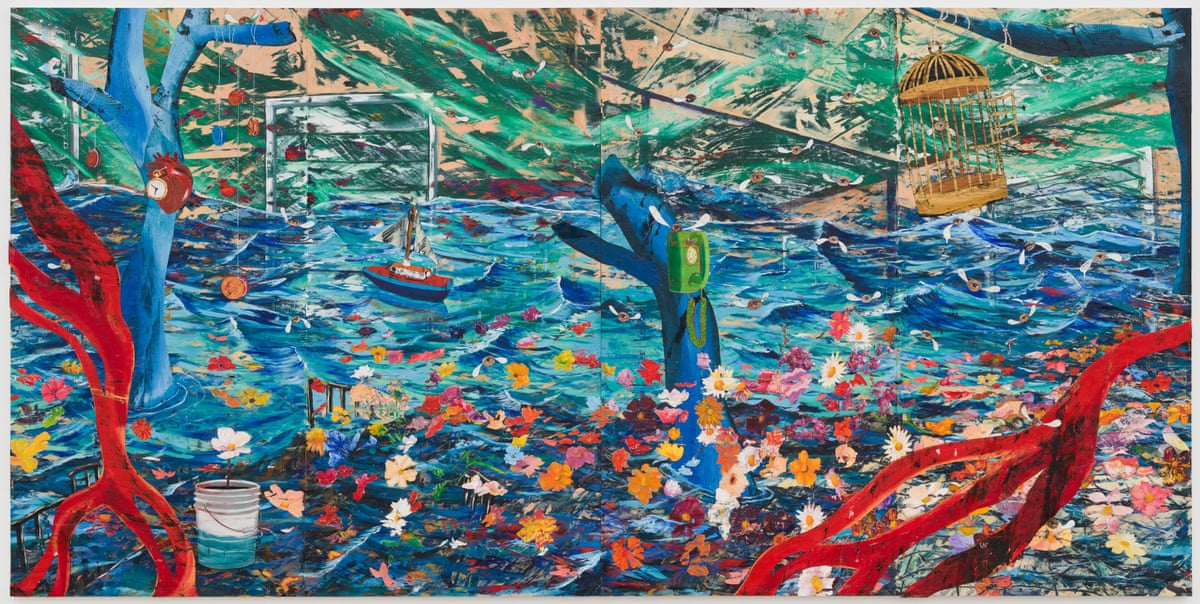
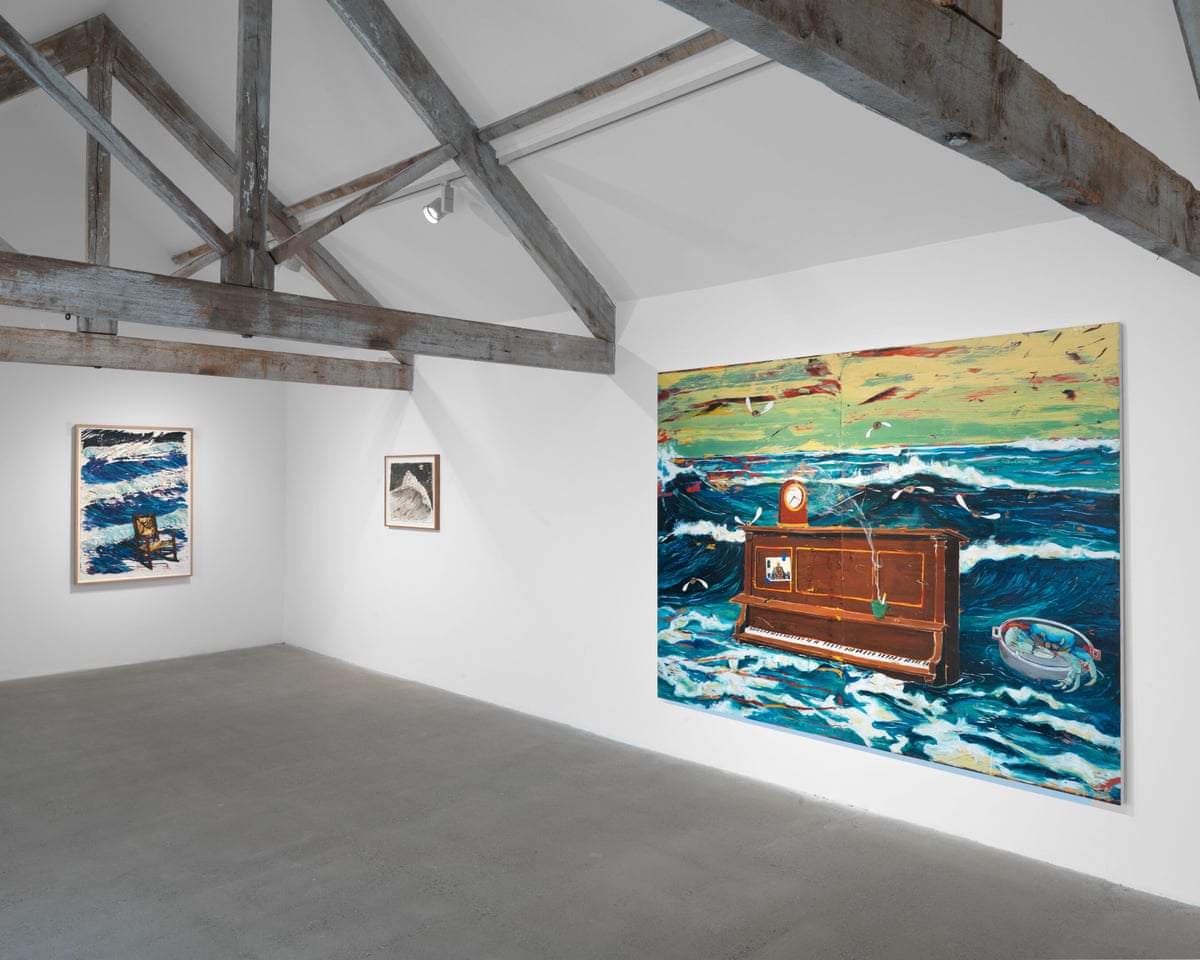
Otero’s modest apartment, along with its furniture, knick-knacks, and photographs, has been a recurring inspiration in his dreamlike, large-scale, semi-abstract paintings since his student days in Chicago. Elements such as flowers, houseplants, a pink vanity cabinet, a four-poster bed, a piano, birdcages, and clocks float against a backdrop of a turbulent sea in his recent works, all directly referencing his childhood home.
Artistic Style and Themes
For nearly two decades, these motifs have served as an indirect representation of Otero’s family and cultural heritage. Initially hesitant to paint direct portraits of family members, he developed a distinctive style that challenges traditional oil painting techniques by applying paint skins—layers of dried paint on Perspex panes—onto the canvas. This method, born from resourcefulness, evolved into a signature technique that conveys the tensions and layered complexities of human existence. His early experiments received positive feedback from peers and tutors, and the paint skins have become a hallmark of his work, blending collage and sculpture within painting.

Currently, we stand before a large diptych, the most figurative painting Otero has produced. It is based on a photograph of his grandmother holding him on his first birthday, dressed in a sailor suit, depicted from two angles. Thick striations of paint overlay the portrait, creating a struggle between image and surface. The figures are distinct yet distant, fading as if submerged in the currents of memory and time.
Otero admits that until recently, he felt uneasy and vulnerable about exposing his personal story and background to the art world’s spotlight.
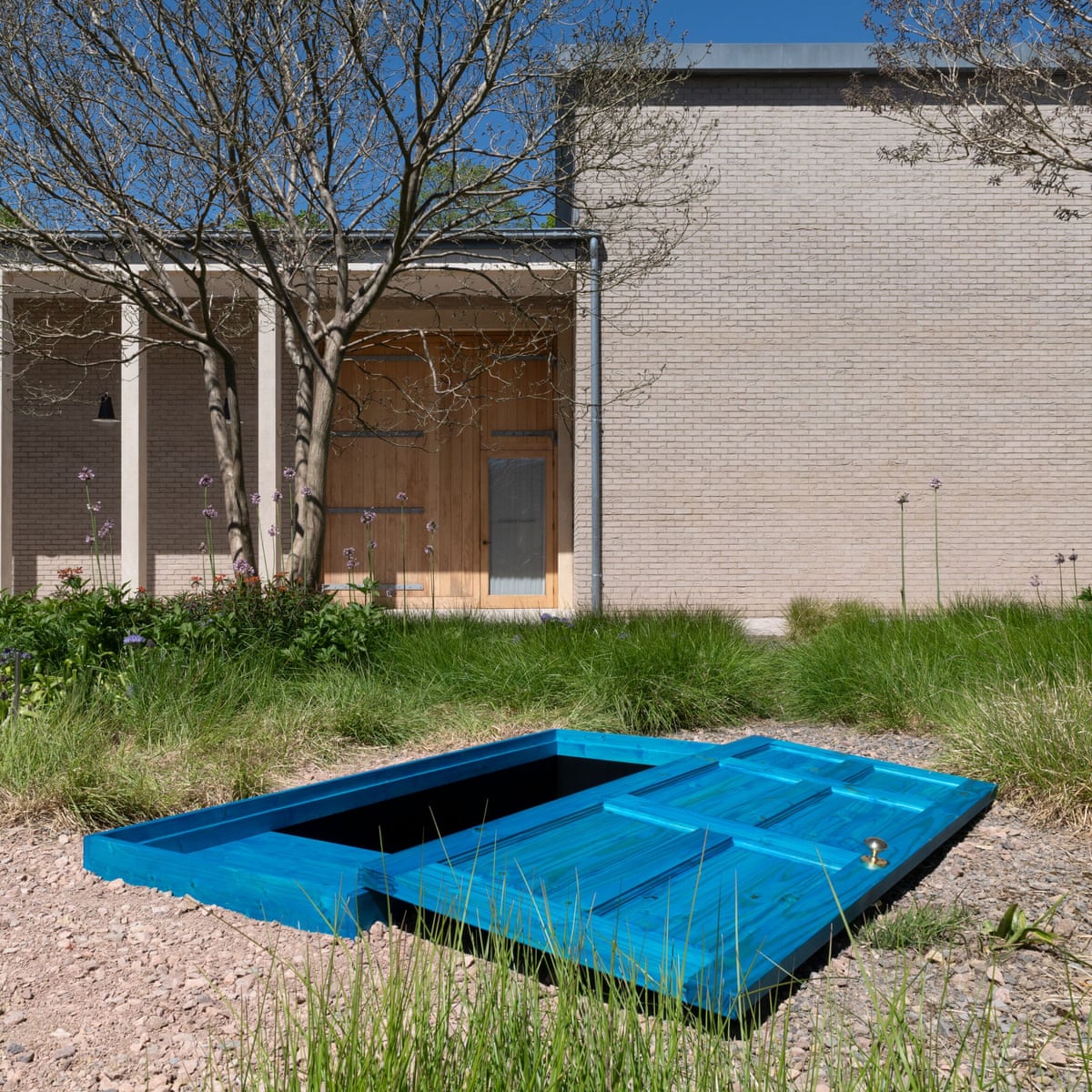
“I felt I was opening a door, but I couldn’t let people out.”Doors are a recurring motif in his new work, including a painting of a door mysteriously opening amid a flower-covered sea, with stairs descending into an unseen place. Additionally, Otero is installing a similar door sculpture in the ground at Hauser & Wirth Somerset as part of his solo exhibition.
Personal Reflections and New Work
Otero’s recent, more intimate works reflect his current stage in life as a father and a man. His daughter is now a teenager, and his father, who was largely absent during his childhood, is terminally ill with lung cancer. He recalls a visit to the Metropolitan Museum of Art in New York with his father, who chose to remain outside smoking rather than enter. His grandmother Maria Luisa passed away years ago, but Otero continues to process her loss.
“These are the layers of life – my relationship with my grandmother, the person who took care of me, educated me, loved me and made me who I am today. Now I have someone under my wing, and I have to think about who I am gonna be for this person.”
The sea is a prominent element in the new paintings and lends the exhibition its title, Agua Salada (Salt Water). The metaphor of salt water evokes both calcification and healing, as well as tears, imbuing the works with a sense of melancholy, as if life’s experiences are eventually carried away by the currents of time.
“I don’t want to be ashamed of vulnerability, sensitivity,”Otero states.
“I’ve navigated so many different environments in the art world, and it’s so superficial.”
Life in Somerset and Exhibition Details
Otero has been residing in Bruton for several weeks, creating this body of work and contemplating the concept of home. He has spent many evenings at the local pub, the Blue Ball, engaging with residents.
“It reminds me of the bars back home in San Juan,”he remarks. However, he did not visit the pub the previous night, as he was preparing to send his paintings off.
“The day before the works leave the studio for a show, I like to spend a full night with them. I open a bottle of wine and put some music on and just celebrate and pay my respects.”
Agua Salada explores themes of releasing the past while holding tightly to the present. It is also a meditation on the idea of home. Otero expresses satisfaction with the exhibition and his personal journey.
“I’m happy where things are with this exhibition and with myself – I’m looking forward to putting it on the walls, not just me and my story. Opening the door for people to come to my casita.”


